30 September 2026 · 6 min read
Why Sunlight and Heat Can Damage Your Perfume Oil
Sunlight and heat can slowly change your perfume oil. Learn why fragrance degrades, the warning signs, and how to store your oils properly.
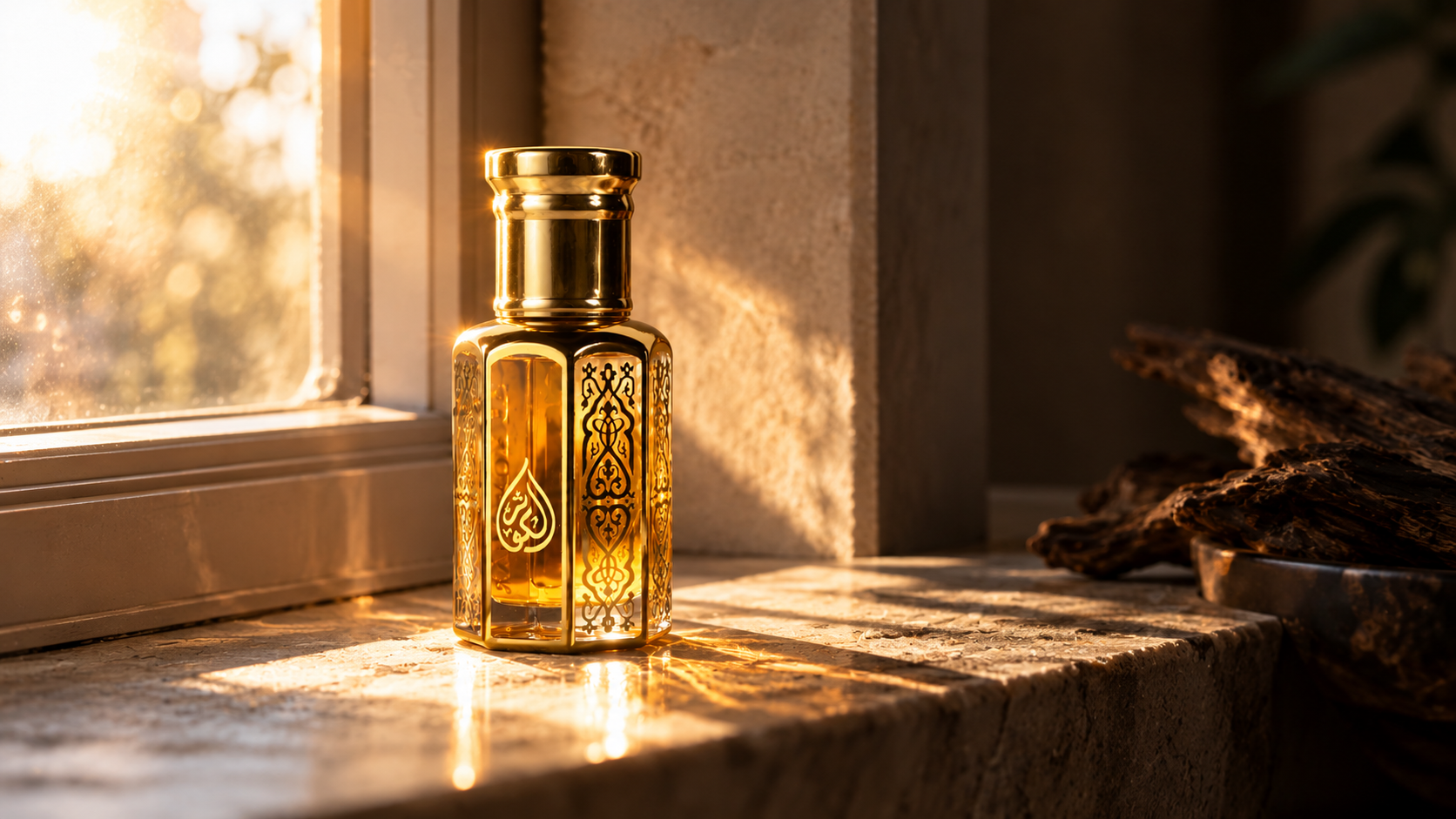
Your perfume may look beautiful sitting beside a sunny window.
But that could be one of the worst places to keep it.
Perfume is a carefully balanced mixture of aromatic materials, and those materials can change when they are repeatedly exposed to light, heat and oxygen.
This doesn't mean your perfume will suddenly become unusable after one warm afternoon.
The problem is repeated exposure over time.
So let's look at what is actually happening inside the bottle — and how you can protect your perfume oils.
Why Is Sunlight Bad for Perfume?
Sunlight contains ultraviolet and visible radiation capable of driving chemical reactions in light-sensitive materials.
In fragrance chemistry, this can contribute to photochemical degradation.
In simple terms, some fragrance molecules can gradually change when repeatedly exposed to light.
That matters because the smell of a perfume depends on its chemistry.
Change enough of that chemistry and eventually you can change the smell.
This is why leaving a perfume bottle permanently on a windowsill is very different from simply taking your perfume outside for the day.
The concern is long-term exposure.
What Does Heat Do to Perfume?
Heat creates another problem.
Many of the materials responsible for fragrance are volatile organic compounds.
That volatility is exactly what allows perfume to work: aromatic molecules leave the perfume, enter the air and eventually reach your nose.
Temperature influences this process.
As temperature increases, more volatile components generally evaporate more readily.
But inside a properly sealed bottle, the bigger long-term concern is that higher temperatures can also accelerate certain chemical reactions.
A useful principle from chemistry is:
Chemical reactions generally happen faster at higher temperatures.
So if a fragrance is repeatedly stored somewhere very hot, reactions associated with its ageing and degradation can potentially occur faster than they would under cooler, stable conditions.
The Biggest Problem May Be Temperature Fluctuation
People often ask:
"What temperature should I keep my perfume at?"
But stability matters too.
Imagine keeping a perfume beside a window.
During the day, direct sunlight heats the bottle.
At night, it cools again.
The next morning, it heats up.
Then it cools.
Repeated cycles like this create a much less stable storage environment than simply keeping the bottle inside a dark cupboard.
Your perfume does not need laboratory conditions.
It simply benefits from avoiding unnecessary extremes.
What Is Oxidation?
There is another important enemy of fragrance:
oxygen.
Oxidation occurs when certain fragrance materials react with oxygen.
Some aromatic materials are more susceptible to oxidation than others.
This is one reason repeatedly leaving a bottle open is not a good idea.
Light and heat can also contribute to the overall degradation process.
Think of them as different forms of stress on a fragrance:
- Light can promote photochemical reactions
- Heat can accelerate chemical change
- Oxygen can contribute to oxidation
Over enough time, these processes can change the fragrance you originally bought.
Can Perfume Oil Change Colour?
Yes.
You may notice some perfume oils becoming darker or changing colour as they age.
However, a colour change does not automatically mean the perfume has gone bad.
Certain fragrance materials naturally change colour over time.
Vanilla-related materials are particularly well known for darkening formulations, for example.
The important question is not simply:
"Has the colour changed?"
It is:
"Has the smell changed significantly as well?"
A slight colour change with an otherwise beautiful-smelling perfume may not be a problem.
A major colour change accompanied by an unpleasant or noticeably altered smell deserves more attention.
How Do You Know If Your Perfume Has Changed?
There isn't one universal test, but there are several things you may notice.
- The opening smells noticeably different
- Fresh notes seem weaker than before
- The fragrance smells unusually sour or harsh
- The overall scent has changed significantly
- The liquid has changed dramatically in appearance
- The perfume no longer performs as you remember
Be careful, though.
Your perception of a fragrance can also change because of temperature, your environment and even olfactory adaptation.
So don't throw away an expensive perfume simply because it smelled slightly different one afternoon.
Is the Bathroom a Good Place for Perfume?
Usually, it isn't ideal.
Bathrooms can experience repeated changes in temperature and humidity from showers and baths.
The fragrance inside a properly closed bottle is protected from much of the surrounding humidity, so humidity itself is not necessarily attacking the perfume directly.
The bigger reason to avoid bathrooms is the unstable environment.
A bedroom drawer or cupboard usually provides a darker and more temperature-stable location.
Should You Keep Perfume in the Fridge?
For most people, this is unnecessary.
Perfume does not normally need refrigeration.
Extremely cold storage can introduce its own issues for some formulations, and constantly moving a perfume between cold and warm environments is unnecessary.
The goal isn't to make your perfume as cold as possible.
The goal is much simpler:
Keep it cool, dark and stable.
So Where Should You Store Perfume Oil?
The best perfume storage solution is usually surprisingly simple.
Keep your perfume:
- Away from direct sunlight
- Away from windows
- Away from radiators and heaters
- Away from very hot rooms
- Properly closed when not being used
- Somewhere relatively cool
- Somewhere dark
- Somewhere with a reasonably stable temperature
A drawer can work.
A closed cupboard can work.
Even keeping the perfume inside its original box can provide additional protection from light.
You do not need a special perfume refrigerator or expensive storage system.
You simply need to protect the fragrance from unnecessary environmental stress.
What About Displaying Your Perfume Collection?
We understand.
Perfume bottles are beautiful.
Sometimes you want to see them.
If you want your collection on display, choose an area away from direct sunlight and major heat sources.
A shelf on the opposite side of a room is very different from a shelf receiving hours of direct sunlight every day.
You can enjoy your collection without turning it into a chemistry experiment.
Does Perfume Oil Last Forever?
No fragrance should automatically be assumed to last forever.
But properly stored perfumes can remain beautiful for a very long time.
There also isn't one universal expiry date after which every fragrance suddenly becomes bad.
Different formulations age differently because they contain different materials and are stored under different conditions.
How you treat the bottle matters.
A perfume stored closed in a dark, stable cupboard may experience a very different life from the same perfume sitting in direct sunlight beside a hot window.
The Simple Rule
You don't need to understand organic chemistry to look after your fragrance collection.
Remember three things:
LIGHT. HEAT. OXYGEN.
Protect your perfume from unnecessary exposure to all three.
Keep the bottle closed.
Keep it away from direct sunlight.
Keep it away from excessive heat.
And give the fragrance a stable environment.
Protect What Is Inside the Bottle
At Al Kowthar Fragrances, we believe understanding perfume makes you appreciate it differently.
A perfume oil isn't simply "a nice smell."
Inside that little bottle can be dozens of aromatic materials, each with its own chemistry, volatility and stability.
Once you understand that, perfume storage suddenly makes sense.
You're not hiding your perfume from sunlight because of an old fragrance myth.
You're protecting a carefully constructed chemical composition.
So enjoy your perfume.
Wear it generously.
Take it with you.
Just don't leave it cooking on the windowsill.
Continue Your Fragrance Education
Want to understand why some perfumes disappear after two hours while others remain from morning until night?
Read our guide to the science of fragrance longevity next.