5 November 2026 · 8 min read
Why Can Two Perfume Molecules Look Almost Identical but Smell Completely Different?
How can two molecules with the same chemical formula smell completely different? Discover the fascinating science of scent and molecular shape.
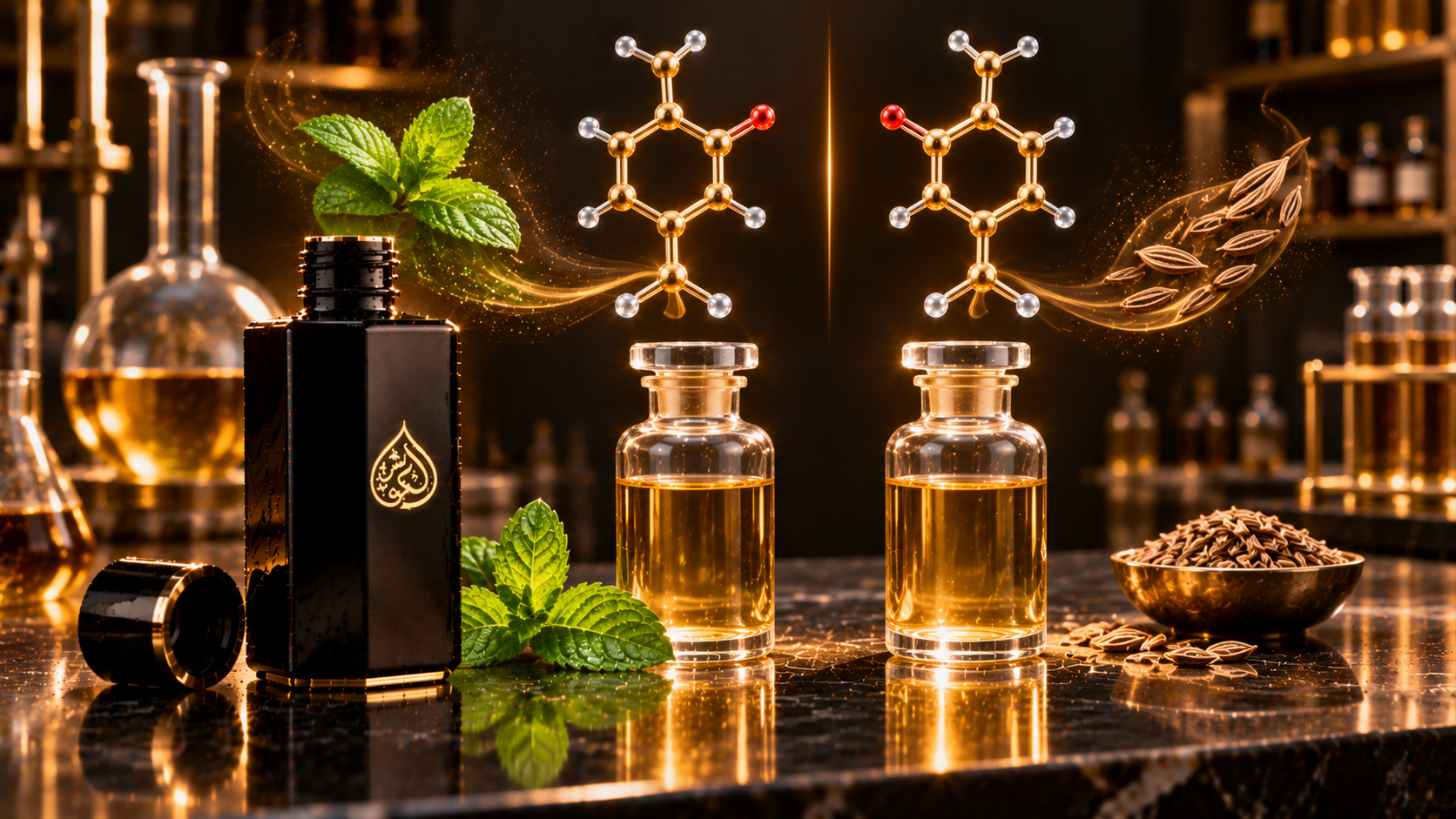
Why Can Two Perfume Molecules Look Almost Identical but Smell Completely Different?
Imagine holding two tiny bottles containing colourless liquids.
Both liquids have the same molecular formula.
Both contain the same types and numbers of atoms.
Even their molecular structures are extraordinarily similar.
Yet when you smell them, something remarkable happens.
One reminds you of fresh spearmint.
The other has a warm, spicy aroma resembling caraway seeds.
How can two molecules made from exactly the same atoms produce such different smells?
The answer reveals one of the most fascinating aspects of fragrance chemistry.
It involves the three-dimensional shape of molecules, the remarkable sensitivity of our olfactory receptors and a scientific phenomenon known as chirality.
Understanding this helps explain why perfumery is not simply about mixing pleasant-smelling ingredients.
It's also about the extraordinary relationship between molecular structure and the human sense of smell.
1. What Actually Makes a Molecule Smell?
When you smell a fragrance, volatile molecules travel through the air and enter your nasal cavity.
There, some of those molecules interact with specialised proteins known as olfactory receptors.
These receptors are found in sensory neurons within the olfactory epithelium.
When an odorant activates a receptor, it initiates a biological signalling process.
Your brain eventually interprets patterns of activity across many receptors as a particular smell.
But here's the interesting part.
Not every molecule activates the same receptors.
And even small differences in molecular structure can influence how strongly a molecule interacts with particular receptors.
This means that two chemically similar substances can produce surprisingly different odour experiences.
The smell of a molecule depends not only on which atoms it contains, but also on how those atoms are arranged.
2. What Is Molecular Structure?
Every aromatic compound has a particular molecular structure.
That structure describes how its atoms are connected and arranged in three-dimensional space.
Consider carbon, hydrogen and oxygen.
These elements appear in countless aromatic molecules.
Yet the resulting compounds can smell dramatically different.
One may smell fruity.
Another may smell floral.
A third may have a woody or herbal character.
The difference isn't simply the presence of carbon, hydrogen or oxygen.
It's the way those atoms form a particular molecule.
Molecular shape, functional groups, flexibility and other chemical properties can influence how an odorant interacts with olfactory receptors.
However, predicting smell from molecular structure alone remains a difficult scientific challenge.
3. What Is Chirality?
One of the most fascinating concepts in fragrance chemistry is chirality.
The word comes from the Greek word for hand.
Look at your left hand and your right hand.
They are mirror images of one another.
But they aren't identical in three-dimensional space.
You cannot perfectly place one over the other while keeping both palms facing the same direction.
Certain molecules behave similarly.
They exist in two mirror-image forms that cannot be superimposed.
These forms are called enantiomers.
Enantiomers have the same molecular formula and the same connectivity between atoms.
But their three-dimensional arrangements are mirror images.
In many ordinary physical measurements, they behave very similarly.
Yet they can interact differently with other chiral molecules, including proteins in the human body.
And that includes olfactory receptors.
This creates the possibility of two mirror-image molecules producing different smells.
4. The Fascinating Example of Carvone
One of the most famous examples of chirality in smell science involves a compound called carvone.
Carvone is a naturally occurring aromatic compound found in certain plants.
It exists in two enantiomeric forms.
Both have the molecular formula C₁₀H₁₄O.
Both contain the same atoms connected in the same order.
But their three-dimensional structures differ.
And remarkably, their odours can be quite different.
(R)-(−)-carvone is commonly associated with a spearmint-like smell.
(S)-(+)-carvone is commonly associated with a caraway-like smell.
Imagine that.
Two molecules with the same chemical formula and almost identical structures.
Yet one evokes a fresh minty character, while the other evokes a warm herbal spice.
This is a powerful demonstration of how molecular geometry can influence smell perception.
5. Why Does Your Nose Detect the Difference?
Olfactory receptors are proteins.
Proteins have complex three-dimensional structures.
Many biological proteins are themselves chiral.
This means their interactions with other molecules can depend on spatial arrangement.
Imagine trying to fit a key into a lock.
Two keys might be extremely similar.
But a small difference in their shape can influence how effectively they operate the lock.
The comparison isn't perfect, because olfactory receptors are flexible biological systems rather than rigid mechanical locks.
Nevertheless, it illustrates an important principle.
A molecule's shape influences how it interacts with a receptor.
Two enantiomers may activate different combinations of olfactory receptors or activate certain receptors to different degrees.
The resulting neural activity can produce different odour perceptions.
However, not all pairs of enantiomers smell dramatically different.
Some have similar odours.
Others differ mainly in intensity or particular aromatic nuances.
The relationship between chirality and smell is complex.
6. Are There Other Perfume Ingredients With Mirror-Image Forms?
Yes.
Chirality appears in numerous aromatic compounds used in fragrance chemistry.
One example is limonene, a compound associated with citrus and other plant aromas.
Limonene has two enantiomeric forms.
Both are used or encountered in fragrance-related chemistry.
Their reported odour characteristics can differ, although the exact impressions depend on purity, concentration and evaluation conditions.
Another important example is linalool, a widely occurring fragrance material associated with floral and herbal characteristics.
Linalool also exists in enantiomeric forms.
Differences between these forms can influence their sensory properties.
These examples show why chemists may need to consider more than a compound's name or molecular formula.
The exact form of a molecule can matter.
7. Does This Mean Natural and Synthetic Ingredients Smell Different?
Not necessarily.
This is an important misconception to address.
If a naturally extracted molecule and a synthetically manufactured molecule have exactly the same chemical structure, including the same stereochemistry, they are the same chemical substance.
Their origin alone does not give them a fundamentally different molecular identity.
However, natural extracts are often complex mixtures containing numerous compounds.
A synthetic ingredient may be supplied as a purified substance or as a mixture with a particular composition.
Differences in purity, accompanying substances and the proportions of enantiomers can affect the overall smell.
For example, a natural essential oil containing many aromatic constituents will not necessarily smell identical to a single purified compound associated with that oil.
But this doesn't mean nature produces a special version of the molecule that chemistry cannot reproduce.
A molecule's chemical identity matters more than whether it originated in a plant or a laboratory.
8. Can Two Molecules With Different Structures Smell Similar?
Absolutely.
The relationship between molecular structure and odour works in both directions.
Similar molecules can smell different.
And structurally different molecules can produce similar odour impressions.
For example, multiple unrelated aromatic compounds may contribute floral, musky or woody characteristics.
They don't necessarily share one simple molecular structure.
This happens because odour perception involves patterns of activity across many olfactory receptors.
Different compounds can sometimes generate partially overlapping sensory responses.
The result is that chemically different substances may remind us of similar smells.
This is particularly important in modern perfumery.
It allows perfumers to construct a desired aromatic impression using different combinations of ingredients.
9. Why Is Predicting Smell From Molecular Structure So Difficult?
Imagine giving a chemist the molecular structure of a completely unfamiliar compound.
Could they accurately predict exactly what it smells like?
Not necessarily.
Scientists have made considerable progress in studying relationships between molecular structure and odour.
Computational models can identify patterns and make useful predictions.
However, the relationship is highly complex.
A molecule's smell can depend on its interaction with multiple receptors.
Perceived odour also depends on concentration and mixture effects.
Individual genetic differences can influence sensitivity.
And human descriptions of smells are not always consistent.
One person may describe a material as green and herbal.
Another may perceive it as medicinal.
This makes predicting odour from structure an active and challenging area of scientific research.
10. How Do Perfumers Use This Knowledge?
Professional perfumers and fragrance chemists work with materials that have distinct chemical and sensory characteristics.
Understanding these materials helps them choose ingredients for particular effects.
A small structural modification to an aromatic compound may change its odour profile, volatility, stability or other properties.
This is one reason the development of new aroma chemicals is such a specialised field.
Chemists may synthesise and evaluate different compounds to identify useful fragrance characteristics.
Some materials are developed to provide particular odour effects.
Others may offer advantages involving stability, availability or formulation compatibility.
However, not every newly synthesised aromatic compound is suitable for cosmetic use.
Safety evaluation and applicable regulatory requirements remain essential.
11. Why Does This Matter for Perfume Lovers?
The next time you smell a fragrance containing a fresh minty note, a spicy herbal note or a bright citrus accord, remember that the experience begins at the molecular level.
Aromatic compounds aren't defined solely by the ingredients from which they originate.
Their three-dimensional structures help determine how they interact with your sense of smell.
And sometimes, an extraordinarily small difference in molecular arrangement can create a remarkable difference in perception.
This also helps explain why the world of fragrance contains such an enormous variety of aromatic materials.
Perfumery is not limited to a handful of basic smells.
It draws upon a vast chemical landscape in which molecular structure and sensory perception interact in fascinating ways.
The Bottom Line
Why can two perfume molecules with the same chemical formula smell completely different?
Because molecular identity involves more than simply counting atoms.
The three-dimensional arrangement of those atoms can influence how an aromatic compound interacts with olfactory receptors.
Chirality provides a particularly striking example.
The two enantiomers of carvone demonstrate how mirror-image molecules can produce recognisably different odour impressions.
At Al Kowthar Fragrances, we believe understanding the chemistry of scent makes perfumery even more extraordinary.
Behind every fragrance lies a world of molecular structures, biological interactions and scientific discoveries.
And sometimes, the difference between two completely different smells is nothing more than the way a molecule is arranged in space.
In perfumery, even a mirror image can tell a completely different aromatic story.
"Explore Al Kowthar Fragrances" (https://alkowtharfragrance.com/shop)