14 October 2026 · 8 min read
Why Do Some Perfumes Smell Like Petrol, Rubber or Plastic? The Chemistry of Unusual Fragrance Notes
Why do some perfumes smell like petrol, rubber or plastic? Discover the chemistry of unusual fragrance notes and why perfumers use them.
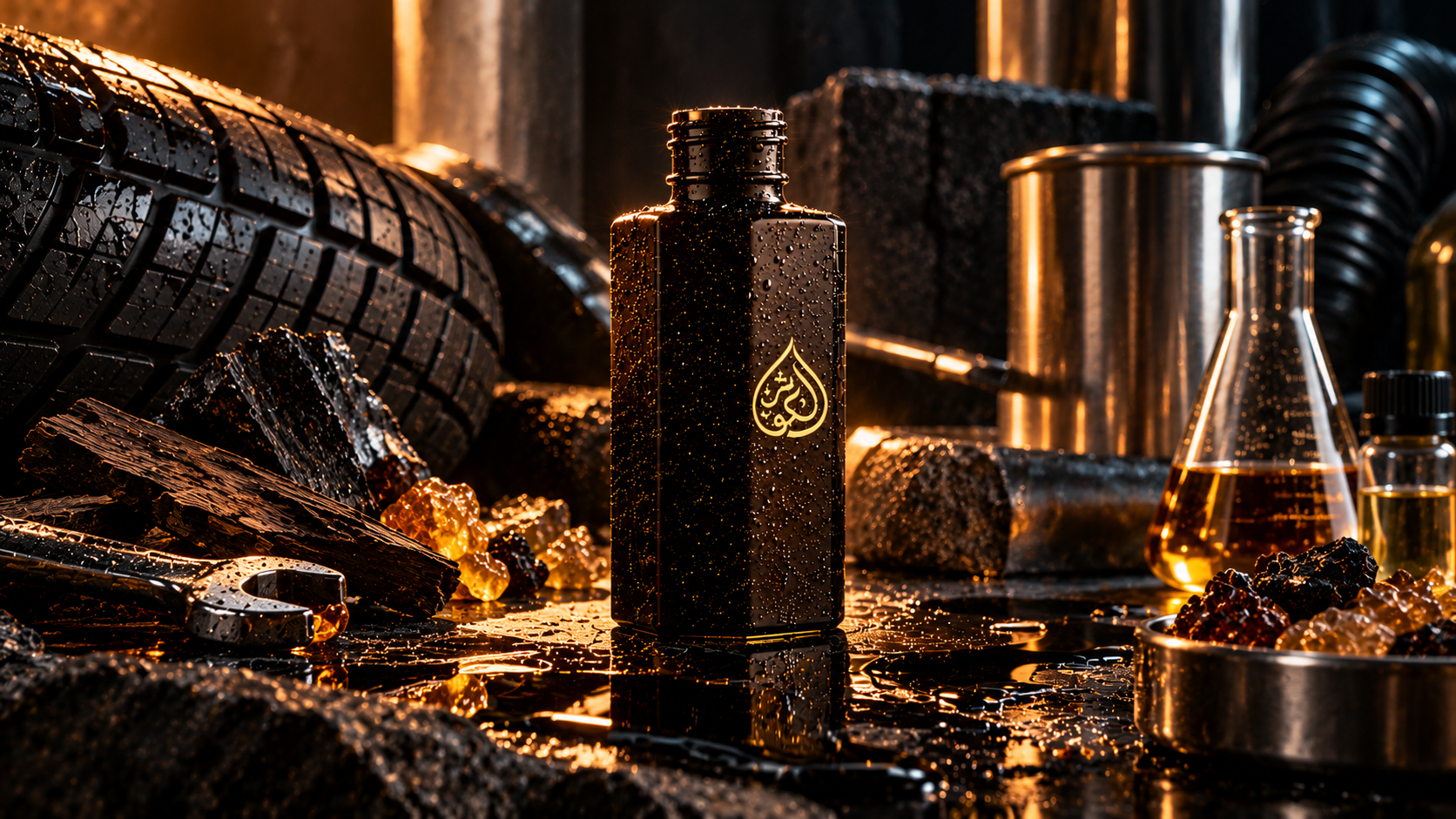
Imagine smelling a perfume for the first time.
You expect something floral, woody, fresh or sweet.
But instead, you notice something completely unexpected.
Petrol.
Or perhaps burnt rubber.
Maybe warm plastic, ink, metal or the smell of a newly opened electronic device.
Your first reaction might be:
"Why would anyone want a perfume that smells like that?"
But in modern perfumery, unusual smells can be surprisingly fascinating.
Some of the world's most creative fragrance compositions explore aromas that go far beyond traditional flowers, fruits and woods.
So why do certain perfumes smell like petrol, rubber or plastic?
And are these smells accidental or deliberately created?
Perfume Isn't Limited to Pleasant-Smelling Ingredients
One of the biggest misconceptions about perfume is that every ingredient must smell beautiful on its own.
In reality, perfumery is more complicated.
A fragrance may contain materials that smell sharp, earthy, medicinal, smoky, animalic or unusual when evaluated individually.
But when combined with other materials, they can contribute to a sophisticated composition.
Think about cooking.
An ingredient that tastes overpowering on its own may become essential when used in the right amount.
Perfumery can work in a similar way.
An unusual-smelling material can contribute something beautiful when placed in the right composition.
Why Does Some Perfume Smell Like Petrol?
A petrol-like impression can sometimes come from aromatic materials that remind the nose of fuel, solvents or petroleum-related odours.
One interesting example is the natural aroma of certain citrus fruits.
Some people describe aspects of grapefruit and other citrus materials as having slightly sulphurous or fuel-like nuances.
This doesn't mean the fragrance contains actual petrol.
It means certain aromatic characteristics can remind us of that smell.
In other compositions, a combination of woody, smoky, mineral or chemical-like notes may create a similar impression.
The important distinction is:
Smelling like petrol is not the same as containing petrol.
A perfumer can recreate or suggest an unusual odour through carefully selected fragrance materials.
What Makes a Fragrance Smell Like Rubber?
Rubbery notes can be particularly interesting.
Depending on the composition, a perfume may evoke:
- New tyres
- Warm rubber
- Leather
- Smoke
- Industrial materials
- Heated synthetic surfaces
These impressions can emerge from combinations of smoky, leathery, phenolic and other aromatic characteristics.
Certain phenolic materials, for example, can contribute smoky, medicinal or tar-like odours.
In appropriate combinations, these can create effects reminiscent of rubber or industrial materials.
But there is no single universal "rubber molecule" responsible for every rubber-like perfume.
The overall impression usually depends on the composition.
Why Would a Perfumer Want a Rubber Note?
Because fragrance is also a form of artistic expression.
Not every perfume is designed to smell clean, sweet or conventionally attractive.
Some fragrances are created to evoke:
- A leather workshop
- A racing garage
- A smoky industrial setting
- A futuristic city
- A newly manufactured object
- An unusual atmosphere or memory
A rubbery nuance can make a fragrance feel darker, more modern or more distinctive.
When used subtly, it can add character without making the entire perfume smell like a tyre.
Why Does Perfume Sometimes Smell Like Plastic?
Plastic-like impressions are another fascinating area of perfumery.
Different plastics and manufactured objects have different odours, so there isn't one single smell that represents all plastic.
A fragrance may remind someone of:
- A new plastic toy
- Vinyl
- A freshly opened electronic device
- Synthetic packaging
- Warm plastic
- A new car interior
These impressions may arise from combinations of sweet, solvent-like, powdery, rubbery or other aromatic characteristics.
Sometimes the effect is intentional.
Other times, it may be an unintended impression created by the interaction of several fragrance materials.
And occasionally, an unusual smell may be associated with packaging or product deterioration rather than the intended fragrance formula.
Context matters.
What Are Industrial Notes in Perfumery?
Industrial notes are fragrance effects inspired by manufactured materials and environments.
Rather than focusing exclusively on flowers, woods or fruits, these compositions may evoke things such as:
- Metal
- Ink
- Rubber
- Smoke
- Asphalt
- Leather
- Petrol-like aromas
- Machinery
- Mineral surfaces
These effects are often found in experimental or artistic perfumery.
They challenge the idea that fragrance must always imitate something traditionally beautiful.
Sometimes a perfume is designed to create an atmosphere rather than simply smell pleasant.
How Can Perfume Recreate a Smell Without Using the Actual Material?
This is one of the most fascinating aspects of modern fragrance chemistry.
Perfumers work with aromatic materials that produce particular odour impressions.
By combining these materials, they can create the impression of something that isn't physically present.
For example, a perfume described as smelling like leather does not necessarily contain leather.
A fragrance described as smelling like rain does not contain actual rain.
And a perfume with a petrol-like note does not need to contain petrol.
Instead, the perfumer constructs an olfactory accord.
An accord is a combination of aromatic materials designed to create a particular scent impression.
The finished result can remind us of a familiar object, place or experience.
What Is an Olfactory Accord?
Imagine trying to recreate the smell of a new car interior.
There isn't necessarily one ingredient that perfectly captures that experience.
Instead, a perfumer might combine several aromatic effects.
One may provide a leather-like impression.
Another may contribute a synthetic or vinyl-like nuance.
Another may add a warm, woody character.
Together, they create something that reminds the wearer of a particular environment.
The individual materials become part of a larger illusion.
That is one of the fundamental skills of perfumery.
Why Do People Smell Different Things in the Same Perfume?
Imagine two people testing the same unusual fragrance.
One says:
"This smells like petrol."
The other says:
"No, it smells like grapefruit."
A third person says:
"It reminds me of a new car."
How can the same perfume create three different impressions?
Because smell perception is influenced by more than the chemical composition alone.
Our experiences, memories, expectations and learned associations help shape how we interpret odours.
Two people may detect similar aromatic characteristics but describe them using completely different references.
That's why fragrance reviews can sometimes seem contradictory.
Are Petrol-Like or Plastic-Like Notes Dangerous?
An unusual odour impression does not, by itself, establish whether a fragrance is safe or unsafe.
A perfume that smells like petrol doesn't necessarily contain fuel.
A rubber-like note doesn't necessarily mean rubber has been added.
And a plastic-like impression doesn't automatically mean the product is contaminated.
Safety depends on the actual ingredients, their concentrations, the finished formulation and how the product is used.
Fragrance products should be formulated and assessed according to the applicable safety requirements.
However, if a familiar perfume suddenly develops an unexpected chemical, burnt or otherwise abnormal smell, that may warrant investigation.
In that situation, stop using the product until its condition can be assessed.
What Is the Difference Between an Unusual Note and a Damaged Perfume?
This distinction is important.
An unusual fragrance note may be an intentional part of the original composition.
A damaged or deteriorated fragrance may develop unexpected odours because its ingredients or packaging have changed over time.
For example:
Intentional unusual note: A fragrance designed around smoky, rubbery or industrial effects.
Possible deterioration: A perfume that previously smelled fresh and floral but now has a strong, unexpected off-odour.
The history of the product matters.
If the smell has always been present, it may simply be part of the fragrance.
If it appears suddenly, particularly alongside changes in colour, texture or clarity, consider contacting the manufacturer.
Why Are Unusual Notes Becoming Interesting to Fragrance Enthusiasts?
Many fragrance lovers begin their journey with familiar scent profiles.
Fresh citrus.
Sweet vanilla.
Soft florals.
Warm woods.
But as people explore more fragrances, some become interested in compositions that challenge their expectations.
They may begin appreciating smoky, mineral, animalic, metallic or industrial effects.
These unusual characteristics can make a fragrance memorable.
However, unconventional doesn't automatically mean better.
A perfume still needs balance, coherence and a clear creative purpose.
Can Unusual Notes Make a Perfume Smell Luxurious?
Absolutely, depending on how they are used and perceived.
Luxury isn't limited to sweetness or softness.
A subtle leather-like or smoky effect can add depth to a fragrance.
A mineral or metallic nuance can create a modern impression.
A carefully controlled industrial note can make a composition distinctive.
But the key is balance.
Too much of an unusual effect may overwhelm the rest of the perfume.
The skill lies in knowing how much to use and what to combine it with.
How Should You Test an Unusual Perfume?
If you encounter a fragrance that initially smells strange, don't judge it solely from the first few seconds.
Try these steps:
1. Smell it on a blotter first.
This allows you to explore the opening without immediately applying it to your skin.
2. Give it time to develop.
Some unusual effects may become less prominent as the fragrance evolves.
3. Pay attention to the drydown.
A sharp opening may eventually settle into a smoother woody, musky or amber-like composition.
4. Avoid forcing yourself to like it.
Fragrance is personal.
You don't need to enjoy every unusual scent simply because it is creative or expensive.
5. Learn to describe what you smell.
Ask yourself whether the impression is smoky, leathery, metallic, solvent-like, mineral or something else.
Developing your fragrance vocabulary makes the experience more interesting.
The Beauty of Unexpected Smells
Perfumery is an art built around aromatic materials.
And art doesn't always have to be predictable.
Sometimes a perfumer wants to recreate a rose garden.
Sometimes a forest.
Sometimes the warmth of amber and vanilla.
And sometimes something as unexpected as rubber, petrol or metal.
The goal may be to evoke a place, a memory or a feeling.
That is what makes modern perfumery so fascinating.
The Bottom Line
Some perfumes smell like petrol, rubber or plastic because their aromatic materials create impressions that remind us of those substances.
These effects may be intentional or arise from the interaction of different ingredients.
But an unusual smell doesn't automatically indicate poor quality or contamination.
At Al Kowthar Fragrances, we believe perfume becomes much more interesting when you understand how different aromatic materials work together.
The next time you smell something unexpected in a fragrance, don't immediately dismiss it.
Ask yourself:
"What is creating that impression?"
You may discover an entirely new side of perfumery.
Because sometimes the most fascinating fragrances are the ones that challenge what we expect perfume to smell like.
"Explore Al Kowthar Fragrances" (https://alkowtharfragrance.com/shop)