26 October 2026 · 9 min read
Why Does Perfume Smell Different in the Air Than on Your Skin?
Why does perfume smell different in the air than on your skin? Discover how evaporation diffusion and skin conditions change your fragrance experience
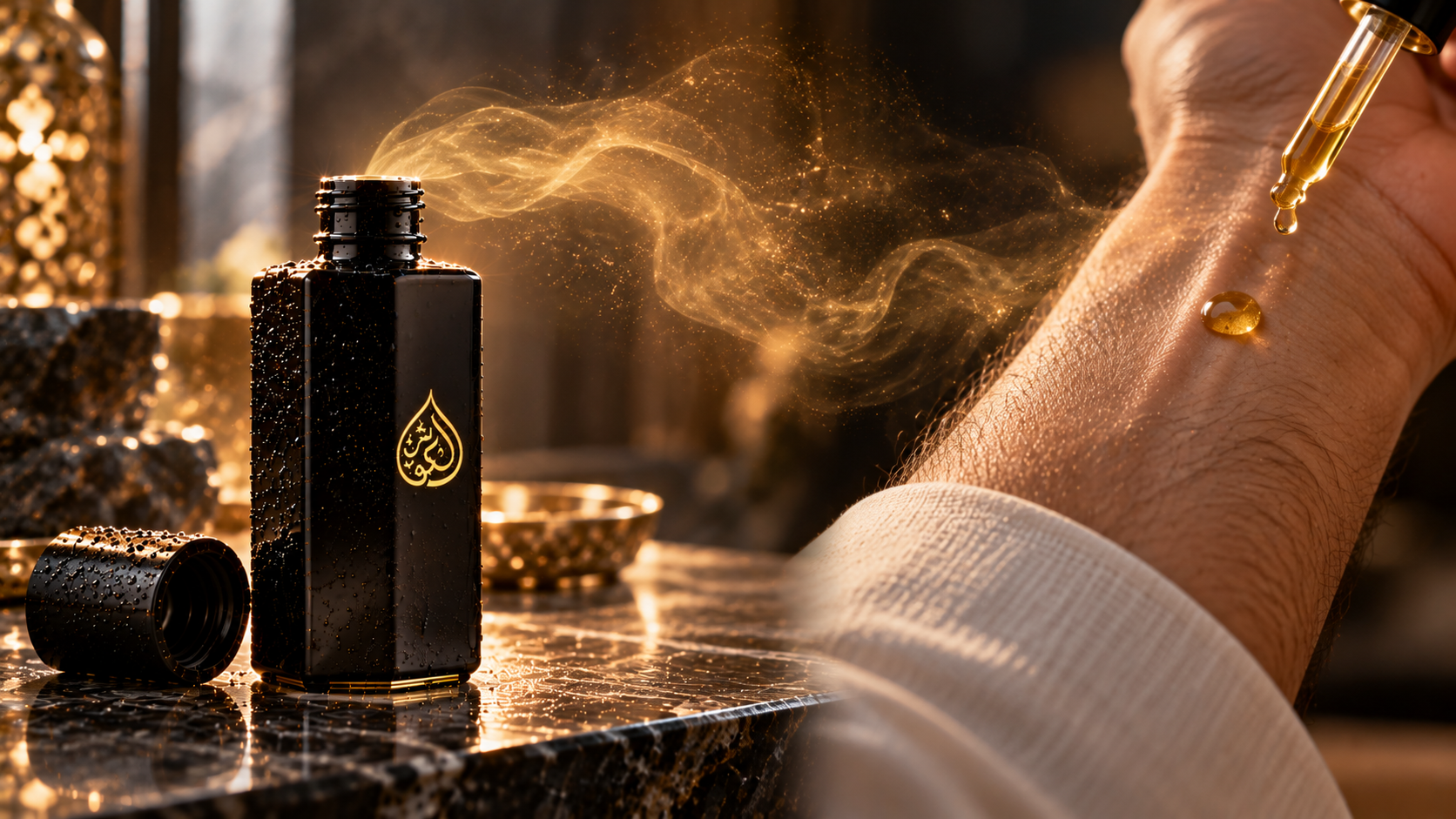
Have you ever experienced this?
Someone walks past you wearing an incredible fragrance.
It smells beautiful.
Smooth, elegant and perfectly balanced.
You ask them what they're wearing.
Later, you find the exact same perfume and apply it to your own skin.
But something seems different.
The fragrance doesn't smell quite the way you remember.
Perhaps it's sweeter.
Maybe it's sharper.
Or perhaps the beautiful woody scent you noticed in the air seems much less noticeable when you smell your wrist.
How can the same perfume smell different depending on whether you experience it in the air or directly on your skin?
The answer involves evaporation, diffusion, fragrance concentration and the remarkable way our noses interpret complex mixtures of aromatic molecules.
Let's explore the science.
Does Perfume Really Smell Different in the Air?
Yes. The same perfume can create different scent impressions depending on how and where you smell it.
However, this doesn't necessarily mean the perfume has chemically transformed into something completely different.
Often, the difference comes from which aromatic molecules reach your nose, in what proportions and at what concentrations.
Perfume is not one single aromatic substance.
It is a mixture of many ingredients.
Each ingredient has its own physical properties and odour characteristics.
When a perfume is applied to the skin, different components can evaporate and become airborne at different rates.
The mixture reaching your nose may therefore vary depending on your distance from the application area and how long the fragrance has been developing.
What Happens When Perfume Evaporates?
When you apply perfume, some aromatic molecules gradually leave the liquid or application surface and enter the surrounding air.
This process is called evaporation.
But different fragrance materials do not evaporate at identical rates.
Some are highly volatile.
Others are less volatile.
This helps explain why perfumes develop over time.
You may notice a bright opening immediately after application.
Later, different aromatic characteristics become more prominent.
Eventually, the fragrance may settle into a softer or richer drydown.
However, evaporation is not the only factor involved.
The way aromatic molecules mix with surrounding air also influences what reaches your nose.
Why Does Perfume Smell Different When Someone Walks Past?
Imagine someone wearing a fragrance containing citrus, rose, musk and amber-like materials.
When they walk past, you smell the fragrance carried through the surrounding air.
By the time it reaches you, the airborne mixture may not contain those aromatic components in exactly the same proportions as the liquid originally applied.
Some materials may have evaporated more readily.
Others may be present at lower concentrations.
The air also dilutes the fragrance.
As a result, you experience a particular balance of aromatic impressions.
Now imagine placing your nose very close to the person's wrist.
You may notice a different balance.
Certain characteristics could become more obvious because you are smelling the fragrance at a higher local concentration.
The perfume is the same, but the aromatic mixture reaching your nose can be different.
What Is Fragrance Diffusion?
Diffusion is the movement of molecules from areas of higher concentration toward areas of lower concentration.
When aromatic molecules enter the air, they spread through their surroundings.
In real environments, air currents and turbulence also play major roles in transporting those molecules.
Together, these processes influence how fragrance travels.
Close to the application area, aromatic concentrations may be relatively high.
Farther away, the fragrance is generally more diluted.
But this does not mean the smell simply becomes a weaker, perfectly identical version of itself.
Different aromatic compounds can behave differently as they evaporate and disperse.
This can change the overall scent impression.
Why Does Perfume Sometimes Smell Better in the Air?
This is one of the most interesting questions in perfumery.
Sometimes a fragrance smells more balanced or pleasant from a distance than it does when smelled directly from the skin.
There are several possible reasons.
1. Lower concentration
When you smell a fragrance from a distance, its airborne concentration is usually lower.
At lower concentrations, some intense or sharp characteristics may become less dominant.
This can allow other aspects of the composition to become more noticeable.
2. Different aromatic proportions
The airborne mixture reaching you may differ from the composition present on the skin.
Some fragrance materials may be more prominent in the surrounding air than others.
3. Perceptual interactions
Our sense of smell does not interpret every aromatic molecule independently.
Odours can influence how other odours are perceived.
Some may enhance, suppress or modify the impression of other components.
These interactions can make a fragrance smell different at different concentrations.
4. The surrounding environment
Background odours, airflow, temperature and other environmental conditions can influence the overall experience.
A fragrance smelled in a quiet perfume shop may create a different impression from the same fragrance encountered outdoors.
Why Does Perfume Smell Sharper When You Smell Your Wrist?
When you bring your nose close to an application area, you may encounter a higher local concentration of aromatic compounds.
This can make certain characteristics more intense.
For example, a fragrance may seem sharper, sweeter or more pungent when smelled directly from the skin.
From a distance, those characteristics may become less dominant.
However, not every fragrance behaves this way.
Some compositions retain a very similar character across different concentrations.
Others change noticeably.
The effect depends on the particular aromatic materials and how your nose responds to them.
What Role Does Skin Temperature Play?
Skin temperature can influence how fragrance materials evaporate.
Warmer application surfaces may increase the release of certain volatile compounds.
But the relationship between skin temperature and perfume performance is complex.
The finished formulation, amount applied and surrounding environment also matter.
A warmer application area may make some aromatic characteristics more noticeable.
A cooler surface may produce a different release pattern.
This is one reason the same fragrance can behave differently under different conditions.
However, temperature alone does not explain every difference between perfume smelled in the air and perfume smelled directly on the skin.
Does Skin Chemistry Change the Smell of Perfume?
Skin conditions can influence fragrance behaviour.
For example, skin moisture, surface lipids, temperature and products already applied to the skin may affect how fragrance materials spread, evaporate or interact with the application surface.
However, the popular idea that everyone's skin completely transforms perfume through mysterious chemical reactions is exaggerated.
In many situations, differences in evaporation, application conditions and perception provide more useful explanations.
A fragrance may smell different on two people without undergoing dramatic chemical transformations.
Skin influences the fragrance experience, but it doesn't necessarily rewrite the entire formula.
Why Does Perfume Smell Different on a Testing Strip?
Perfume testing strips, often called blotters, provide a different application surface from human skin.
Paper and skin have different physical properties.
A blotter absorbs and retains fragrance materials differently from skin.
It also lacks the warmth, moisture and surface lipids associated with living skin.
These differences can influence how the fragrance develops.
A perfume may smell beautiful on a blotter but noticeably different when worn.
This doesn't mean the blotter is useless.
It simply provides a different way of evaluating the fragrance.
Should You Test Perfume on Paper or Skin?
Ideally, both.
Testing on paper is useful for exploring the initial scent profile.
It allows you to compare several fragrances without immediately applying them all to your skin.
Once you find something interesting, testing it on suitable skin can help you understand how it behaves when worn.
Allow the fragrance time to develop.
Avoid judging it exclusively from the first few seconds.
A fragrance that seems ordinary at first may reveal a more interesting character later.
And a fragrance that smells wonderful on paper may not produce the same experience on your skin.
Why Does Perfume Sometimes Smell Sweeter in the Air?
Perceived sweetness depends on the aromatic materials present and how they interact with our sense of smell.
At different concentrations, the balance between sweet, woody, floral, spicy and other characteristics can shift.
For example, an intense sharp note may dominate when smelled close to the skin.
As the fragrance becomes more diluted, that note may become less prominent.
This can make the overall composition seem softer or sweeter.
However, the opposite can also happen.
A fragrance may smell sweeter directly on the skin than it does in the surrounding air.
There is no universal rule.
Why Can You Smell a Fragrance on Someone Else but Not on Yourself?
This is partly related to olfactory adaptation, sometimes called nose blindness.
When you experience the same smell continuously, your sensory system may become less responsive to it.
Someone wearing a fragrance throughout the day may gradually stop noticing it.
But another person encountering that fragrance for the first time may detect it immediately.
This can create the impression that the fragrance behaves differently for different people.
Sometimes the difference is not the fragrance itself.
It's the way each person's sensory system is responding.
Are Perfume Oils Different From Sprays in the Air?
Perfume oils and sprays can produce different scent experiences because of their delivery systems.
An alcohol-based spray distributes fine droplets over a relatively large area.
This can create a noticeable initial fragrance cloud.
Perfume oils are usually applied directly to specific areas of the skin.
Depending on the formulation, they may create a more localised scent experience.
However, the same principles of evaporation, diffusion and odour perception apply to both formats.
A powerful perfume oil can release aromatic compounds into the surrounding air.
And an alcohol-based spray can remain relatively close to the skin.
The fragrance formula matters just as much as the delivery method.
Why Does Perfume Sometimes Smell Better on Clothes?
Fabric provides another application surface with different properties from skin.
Some fragrance materials may be retained by textile fibres and released gradually.
This can change how the fragrance develops and how it is perceived.
However, fabric application is not always appropriate.
Certain perfume ingredients, particularly in oil-based fragrances, may leave visible marks or stains.
Always follow the product's intended-use instructions.
If you want to learn more about this subject, explore our article on why perfume can stain clothing.
How Can You Properly Evaluate a Perfume?
Here are five useful steps.
1. Start with a testing strip
Smell the fragrance from a comfortable distance.
Pay attention to its overall character rather than immediately trying to identify every note.
2. Give the fragrance time
Allow the opening to develop.
Different aromatic characteristics may become noticeable as the fragrance evolves.
3. Test it on suitable skin
If the fragrance interests you, apply a small amount according to the product instructions.
4. Smell it at different distances
Notice how the fragrance behaves when smelled close to the application area.
Then observe how it smells naturally as you move throughout the day.
5. Avoid repeatedly smelling the same spot
Constantly bringing your nose close to the fragrance may contribute to olfactory adaptation.
Give yourself occasional breaks.
This can make it easier to appreciate the fragrance's development.
Is the Smell in the Air the True Smell of a Perfume?
This is a fascinating question.
But the idea that a perfume has only one completely correct smell is misleading.
A fragrance is a complex mixture.
Its perceived character depends on how aromatic molecules are released, transported and detected.
The smell close to the skin is one part of the experience.
The smell in the surrounding air is another.
The fragrance's opening and drydown may also differ.
Rather than asking which one is the true smell, it may be more useful to appreciate how the fragrance behaves under different conditions.
The Bottom Line
Why does perfume sometimes smell different in the air than on your skin?
Because the aromatic molecules reaching your nose can vary in concentration and relative proportion.
Evaporation, diffusion, skin conditions, temperature and odour perception all contribute to the experience.
The same perfume can therefore seem sharper up close, softer from a distance or more balanced when encountered in the surrounding air.
At Al Kowthar Fragrances, we believe understanding perfume means appreciating how fragrance behaves beyond its initial application.
A perfume isn't simply one fixed smell.
It's an experience that develops as aromatic molecules move through the air and interact with our senses.
Sometimes the most beautiful part of a fragrance is not what you smell directly on your wrist, but what you experience in the air around you.
"Explore Al Kowthar Fragrances" (https://alkowtharfragrance.com/shop)