26 October 2026 · 8 min read
Why Can You Smell Someone's Perfume After They've Left the Room?
Discover why perfume lingers after someone leaves a room. Explore fragrance molecules, airflow, scent trails and the science behind lingering smells.
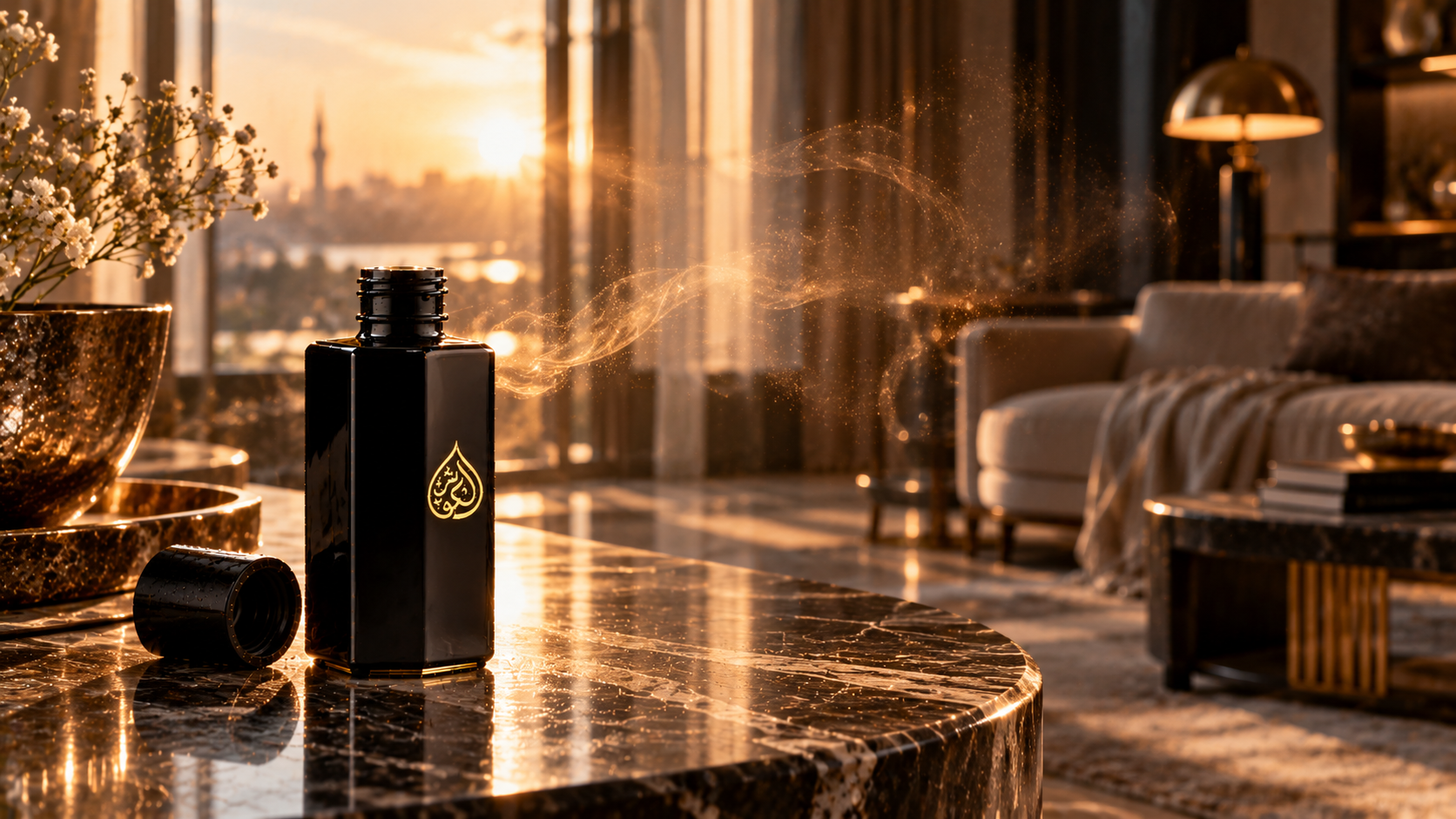
Imagine this.
Someone walks into a room wearing a beautiful fragrance.
Perhaps it's a rich oud, a warm vanilla or a powerful floral perfume.
They stay for a few minutes, have a conversation and eventually leave.
But something interesting happens.
Their perfume stays behind.
Five minutes later, you can still smell it.
Sometimes, the fragrance seems to remain in the room long after the person has disappeared.
But how is that possible?
If the person wearing the perfume is no longer there, what exactly are you smelling?
The answer involves fragrance chemistry, molecular movement, airflow and the fascinating behaviour of aromatic substances.
Let's explore the science.
What Actually Happens When Someone Wears Perfume?
Perfume contains aromatic compounds that can gradually enter the surrounding air.
These compounds are known as volatile organic compounds, or VOCs.
Volatile simply means that a substance can evaporate into the air under ordinary conditions.
When someone applies perfume, some aromatic molecules leave the skin, clothing or other application surfaces.
Once airborne, they can move through the surrounding environment.
Some eventually reach the olfactory receptors inside your nose.
Your brain processes the resulting signals, allowing you to recognise the fragrance.
And here's the interesting part.
Those molecules don't automatically disappear when the person wearing the perfume leaves.
Some may remain suspended in the air or temporarily interact with surfaces in the room.
That's why a fragrance can outlast someone's physical presence.
Why Does Perfume Linger in a Room?
A lingering perfume smell usually involves several processes happening together.
1. Fragrance molecules remain in the air
Once aromatic compounds evaporate, they become part of the surrounding air.
They may remain detectable until they are diluted, removed through ventilation, deposited onto surfaces or transformed through chemical reactions.
Different aromatic compounds behave differently.
Some disappear from the air relatively quickly.
Others can remain detectable for longer.
2. Airflow spreads the fragrance
Air is constantly moving, even when we cannot feel it.
People walking, doors opening, ventilation systems operating and temperature differences can all influence air movement.
These movements transport aromatic molecules around a room.
As a result, you might smell someone's perfume in an area where that person never stood.
3. Surfaces can temporarily retain fragrance
Some fragrance compounds can interact with fabrics, furnishings and other indoor surfaces.
Depending on the material and the aromatic compound, some of those substances may later return to the air.
This can contribute to lingering indoor odours.
However, the extent of this effect depends on the fragrance, the surface and environmental conditions.
What Is the Difference Between Sillage and Lingering Perfume?
These two concepts are related, but they are not exactly the same.
Sillage describes the scent trail associated with someone wearing fragrance as they move.
Imagine someone walking past you and leaving a noticeable aroma behind.
That is a classic example of sillage.
Lingering fragrance, however, refers more broadly to a smell remaining detectable in an environment after its source has moved away or been removed.
A fragrance can produce a noticeable scent trail without necessarily remaining detectable in a room for an extended period.
Likewise, a smell may linger in a poorly ventilated space even if the fragrance did not create an especially dramatic scent trail.
The difference is subtle but important.
Sillage is about the scent trail. Lingering is about what remains detectable afterward.
Why Do Some Perfumes Linger Longer Than Others?
Not every perfume behaves the same way.
Some fragrances create a powerful impression that quickly fades.
Others remain noticeable in an environment for a surprisingly long time.
Several factors contribute to these differences.
The aromatic materials
Fragrance ingredients vary in their volatility and other physical properties.
Some aromatic compounds readily enter the air.
Others evaporate more slowly.
But evaporation speed alone does not determine how long a fragrance remains noticeable.
Odour detection thresholds
Here's something particularly fascinating.
Humans can detect certain aromatic compounds at extremely low concentrations.
This is known as an odour detection threshold.
Some fragrance materials can remain noticeable even after their airborne concentration has become very small.
Others require higher concentrations before we can detect them.
This means a fragrance does not necessarily need a large quantity of airborne molecules to remain perceptible.
The amount of fragrance applied
Applying more fragrance can increase the amount of aromatic material available to enter the surrounding environment.
However, doubling the amount of perfume does not necessarily double its perceived strength or the time it remains detectable.
Smell perception is more complicated than that.
The formulation
The combination of ingredients influences how a perfume evaporates, diffuses and develops.
Two fragrances with similar concentrations may behave very differently because their aromatic compositions are different.
Why Does Oud Sometimes Leave Such a Noticeable Scent?
Oud fragrances are often associated with rich, woody, smoky, leathery and resinous characteristics.
Some oud compositions contain highly impactful aromatic materials that can remain noticeable at low concentrations.
This may contribute to the impression of a fragrance lingering after its wearer has left.
However, not every oud fragrance behaves this way.
Some oud compositions are relatively soft and intimate.
Others are designed to create a powerful surrounding scent.
The name of a fragrance note does not determine its performance. The actual formulation matters.
The same principle applies to amber, musk, vanilla and other fragrance families.
Does Room Temperature Affect Lingering Perfume?
Yes, temperature can influence fragrance behaviour.
In general, higher temperatures can increase the tendency of many aromatic materials to evaporate.
But the relationship between temperature and how long a perfume remains noticeable in a room is not straightforward.
Temperature also influences air movement, while ventilation affects how quickly aromatic compounds are removed or diluted.
A warm room may encourage fragrance evaporation.
A cool room may slow certain evaporation processes.
But neither situation guarantees that a fragrance will linger longer.
The complete environment matters.
Why Does Perfume Sometimes Stay Longer in a Small Room?
Imagine someone wearing a strong fragrance inside a small lift.
The fragrance may become very noticeable.
Now imagine the same person standing outdoors in an open field.
The experience may be completely different.
Why?
Because indoor spaces can restrict how quickly aromatic compounds disperse into a larger volume of air.
In a small, poorly ventilated room, fragrance molecules may accumulate or remain detectable for longer.
Outdoors, moving air can dilute and transport those molecules away much more rapidly.
This is why a perfume that seems perfectly comfortable outside may feel overwhelming in an enclosed environment.
Can Perfume Stick to Curtains, Sofas and Furniture?
Certain aromatic compounds can be absorbed or adsorbed by indoor materials.
These are two different processes.
Absorption involves a substance entering another material.
Adsorption involves molecules attaching to a surface.
Fabrics, upholstery and other materials may temporarily retain some fragrance compounds.
Depending on the conditions, some of those compounds can later be released back into the surrounding air.
This is one reason indoor smells can sometimes persist after their original source has disappeared.
However, the effect varies considerably between materials and fragrance ingredients.
Why Can You Smell a Perfume but Not See It?
Because the aromatic molecules responsible for the smell are far too small to see individually.
When fragrance evaporates, its volatile compounds enter the air as molecules.
They do not need to form a visible cloud for your nose to detect them.
In fact, most airborne fragrance molecules are completely invisible.
The mist you see immediately after spraying perfume is different.
That visible mist consists of tiny liquid droplets.
As the droplets evaporate, aromatic molecules can enter the air and become detectable through smell.
A fragrance can be completely invisible and still be unmistakably present.
Does Perfume Oil Linger in a Room Like Spray Perfume?
Perfume oils and alcohol-based sprays can behave differently because of their application methods and formulations.
A spray distributes fine droplets over a relatively large area.
This can create a noticeable initial release of fragrance into the surrounding air.
Perfume oil is usually applied more locally to the skin.
As a result, some oil-based fragrances may produce a more intimate scent experience.
However, powerful perfume oils can still release enough aromatic material to become noticeable in the surrounding environment.
There is no universal rule that perfume oils cannot leave a scent trail or linger in a room.
It depends on the formulation, amount applied and environmental conditions.
Why Can You Sometimes Recognise Who Was in a Room Just by Their Perfume?
This is where fragrance becomes particularly interesting.
Our sense of smell is closely connected with systems involved in memory and recognition.
When someone consistently wears the same fragrance, you may begin associating that aroma with them.
Eventually, detecting the fragrance can remind you of the person even when they are not present.
The smell becomes part of how you recognise them.
You might walk into a room and immediately think:
"Someone I know was here."
Not because you saw them.
But because you recognised their fragrance.
Of course, recognising a familiar perfume does not prove that a particular person was present.
Other people may wear the same fragrance.
Nevertheless, scent can create remarkably strong personal associations.
Can You Make Your Perfume Linger Longer?
There is no guaranteed method for making every fragrance leave a lasting impression in a room.
Performance depends heavily on the formulation.
However, the amount applied, application method and surrounding environment can influence how noticeable a fragrance becomes.
It's also worth remembering that a powerful scent trail is not always desirable.
In offices, classrooms, public transport and other shared environments, strong lingering fragrance can be uncomfortable for people who are sensitive to odours.
Sometimes a softer fragrance experience is more appropriate.
The Bottom Line
Why can you smell someone's perfume after they've left the room?
Because aromatic molecules released from their fragrance can remain in the surrounding air, move with airflow and interact with indoor surfaces.
Some compounds are also detectable by the human nose at remarkably low concentrations.
Together, these factors can allow a fragrance to remain noticeable after its wearer has departed.
At Al Kowthar Fragrances, we believe understanding perfume means looking beyond the bottle.
Fragrance is not simply a liquid applied to the skin.
It's a collection of aromatic molecules interacting with the world around us.
And sometimes, those invisible molecules can leave a remarkable impression.
A person may leave the room, but their fragrance can remain.
"Explore Al Kowthar Fragrances" (https://alkowtharfragrance.com/shop)