7 November 2026 · 9 min read
Why Are Some Perfume Ingredients Banned or Restricted?
Why are some perfume ingredients restricted? Discover the science behind fragrance allergies, phototoxicity and cosmetic safety regulations.
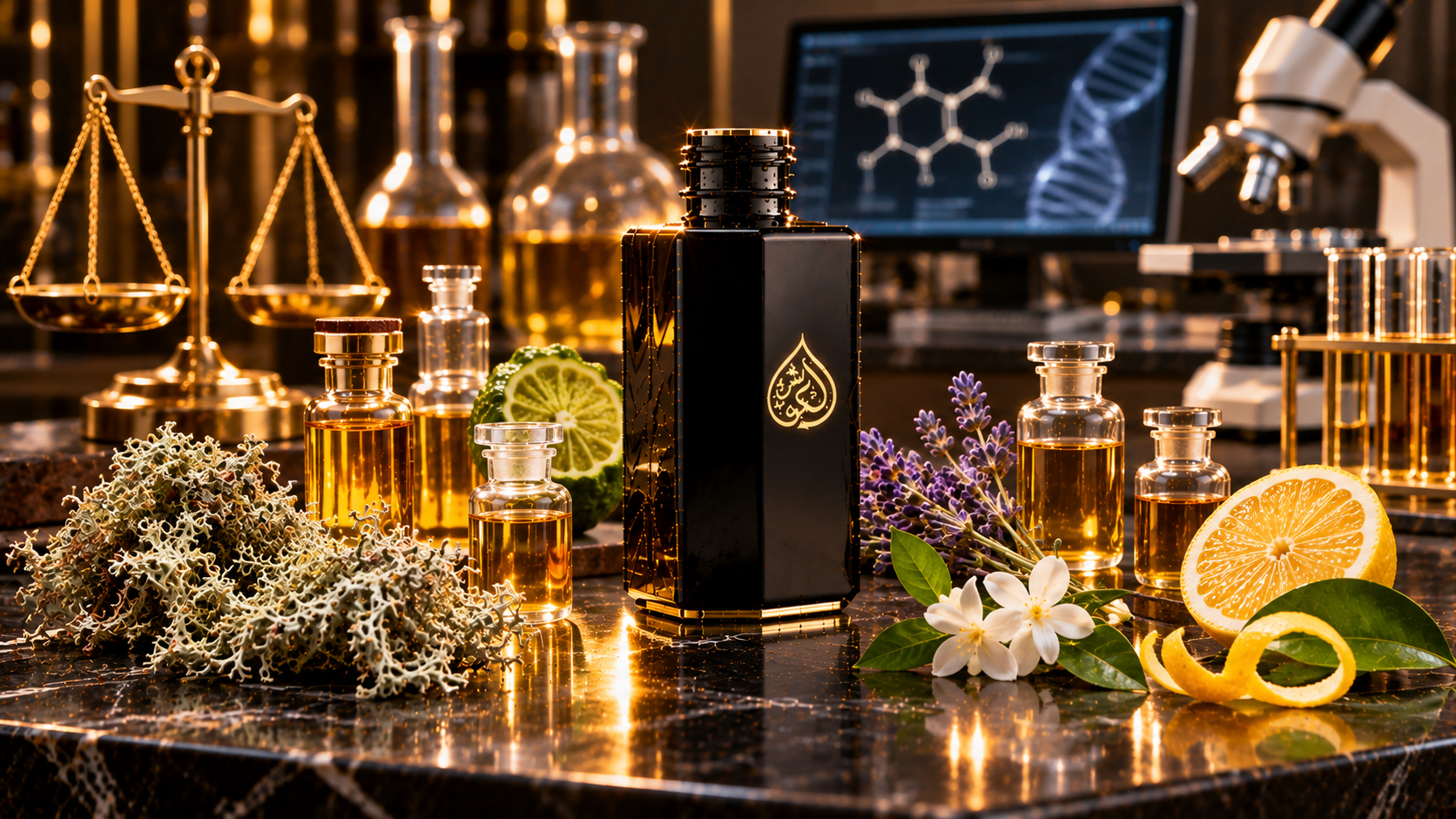
Why Are Some Perfume Ingredients Banned or Restricted? The Science Behind Fragrance Safety
Imagine discovering an ancient perfume recipe.
It contains beautiful aromatic materials: rich oakmoss, fragrant citrus oils, warm spices and rare botanical extracts.
For centuries, perfumers have used ingredients like these to create extraordinary fragrances.
But here's something surprising.
Some materials that were once common in perfumery are now restricted or prohibited in certain cosmetic products.
Why?
Have these ingredients suddenly become dangerous?
Were earlier perfumers unaware of their effects?
Or has modern science revealed something that wasn't previously understood?
The answer involves toxicology, human biology, chemical reactions and the evolution of cosmetic safety standards.
Understanding these subjects reveals an important truth about perfumery.
Creating a beautiful fragrance is only one part of the process. Ensuring that it is appropriately safe for its intended use is equally important.
1. Why Do Perfume Ingredients Become Restricted?
Fragrance ingredients are evaluated for potential risks associated with their use.
These risks can depend on several factors, including the chemical properties of the ingredient, the amount used, the route of exposure and the frequency of contact.
A substance may present little concern under certain conditions but create unacceptable risks under others.
For example, an ingredient might be permitted at a low concentration in a particular cosmetic product but restricted at higher concentrations.
Another material may be prohibited entirely for certain uses.
Regulators and scientific organisations consider toxicological evidence when establishing these limits.
As new research becomes available, existing restrictions may be reviewed or updated.
This is why the rules governing fragrance ingredients can change over time.
2. What Is Skin Sensitisation?
One of the most important safety concerns in perfumery is skin sensitisation.
Skin sensitisation occurs when the immune system develops an allergic response to a particular substance.
After sensitisation has developed, later exposure to that substance may trigger allergic contact dermatitis.
Symptoms can include itching, redness, inflammation or other skin reactions.
Importantly, sensitisation is different from simple irritation.
Irritation can occur through direct effects on the skin without involving an acquired allergic immune response.
Allergic contact dermatitis involves an immune mechanism.
Some fragrance ingredients are recognised contact allergens.
The risk of developing sensitisation depends on the substance, exposure conditions and individual susceptibility.
This is one reason fragrance safety assessments consider how much of an ingredient may come into contact with the skin.
3. Why Can Someone Use a Perfume for Years and Then Develop an Allergy?
This is a question many people find confusing.
Someone may use a fragranced product repeatedly without any obvious problem.
Then, at some point, they develop an allergic reaction.
How is that possible?
With allergic contact sensitisation, the immune system may become sensitised following previous exposures.
A person may therefore tolerate earlier contact but react after sensitisation has developed.
However, the timing and likelihood of sensitisation vary.
Not everyone exposed to a fragrance allergen becomes allergic.
And a reaction to a finished perfume does not automatically identify which ingredient caused it.
Medical assessment, sometimes including patch testing by an appropriate clinician, may be needed to investigate suspected contact allergy.
This is why it is important not to assume that an ingredient is harmless simply because someone has used it previously without problems.
4. What Is Phototoxicity?
Another fascinating safety issue involves the interaction between certain chemicals and light.
Some substances can cause phototoxic reactions when they are present on the skin and exposed to ultraviolet radiation.
Certain naturally occurring compounds called furocoumarins are particularly relevant.
Some expressed citrus oils can contain phototoxic furocoumarins.
Under suitable conditions, exposure to these substances followed by UV radiation may cause skin damage.
The resulting reaction can resemble a severe sunburn and may lead to pigmentation changes.
This is one reason the composition and production method of citrus-derived fragrance ingredients matter.
For example, some citrus oils undergo processing to reduce or remove particular phototoxic constituents.
However, a citrus fragrance is not automatically phototoxic.
The risk depends on the actual ingredients, their concentrations and the conditions of use.
5. Why Is Oakmoss Such a Famous Example?
Oakmoss has played an important role in the history of perfumery.
Derived from the lichen Evernia prunastri, oakmoss extracts have contributed earthy, mossy and forest-like characteristics to many traditional fragrances.
They are especially associated with classic chypre compositions.
However, certain constituents found in oakmoss extracts have raised concerns about skin sensitisation.
Two notable substances are atranol and chloroatranol.
These compounds have been identified as potent contact allergens.
In the European Union, atranol and chloroatranol are prohibited in cosmetic products.
This has influenced how perfumers work with oakmoss-derived materials.
Some suppliers offer specially processed extracts designed to reduce particular unwanted constituents.
Nevertheless, any material must still comply with applicable restrictions and safety requirements.
The important lesson is that a historically treasured ingredient can contain substances that modern toxicology identifies as problematic.
Traditional use does not automatically establish safety.
6. Are Natural Perfume Ingredients Safer Than Synthetic Ones?
Not necessarily.
This is one of the most persistent misconceptions in the fragrance industry.
Many people associate the word natural with safety.
But natural materials are chemical substances too.
Essential oils can contain compounds capable of causing irritation, sensitisation or other adverse effects.
Some naturally occurring substances are highly biologically active.
Likewise, synthetic fragrance ingredients vary widely in their properties.
Some have well-characterised safety profiles and can be used appropriately in cosmetic formulations.
Others require restrictions or may not be suitable for particular applications.
The relevant question is not simply whether an ingredient came from nature or a laboratory.
It is whether the ingredient is suitable for its intended use at the proposed concentration and exposure.
7. What Is IFRA?
IFRA stands for the International Fragrance Association.
It is an industry association that develops standards for the safe use of fragrance ingredients.
The IFRA Standards may prohibit, restrict or specify conditions for the use of particular fragrance materials.
These standards are informed by scientific safety assessments and an established industry process.
An important point is that IFRA Standards distinguish between different types of products.
A fragrance used in a rinse-off product may be subject to different exposure considerations from a leave-on skin product.
Likewise, a product intended for the lips may require different limits from one intended for other areas of the body.
Therefore, an ingredient's permitted concentration can depend on the finished product category.
There is no single universal IFRA concentration limit that applies to every fragrance ingredient in every cosmetic product.
8. Is IFRA the Same as EU Cosmetic Law?
No.
This distinction is particularly important.
IFRA Standards are industry standards.
European Union cosmetic regulations are legally binding requirements.
A cosmetic product placed on the EU market must comply with the applicable provisions of Regulation (EC) No 1223/2009 and related requirements.
These include restrictions and prohibitions on certain substances.
The regulation also establishes responsibilities concerning cosmetic product safety, documentation and labelling.
Following relevant IFRA Standards can support responsible fragrance formulation.
However, an IFRA certificate does not replace compliance with applicable cosmetic law.
And it does not replace a finished-product safety assessment.
A perfume business must consider both the relevant legal requirements and the safety of its actual finished formulation.
9. Why Does the Type of Perfume Matter?
Imagine two products containing the same fragrance concentrate.
One is an alcohol-based spray.
The other is a roll-on perfume oil.
Would the safety assessment necessarily be identical?
No.
The finished formulations and their intended use can influence exposure.
Factors may include the concentration of fragrance ingredients, amount applied, frequency of use and area of skin contact.
Different product types may also have different exposure characteristics.
For example, a leave-on product remains in contact with the skin rather than being rinsed away.
This is why a fragrance concentrate cannot be assumed suitable for every cosmetic application at the same concentration.
A supplier's fragrance documentation must be interpreted in relation to the actual product being manufactured.
10. What Is a Cosmetic Product Safety Report?
In the European Union, cosmetic products require a safety assessment before being placed on the market.
The resulting Cosmetic Product Safety Report, commonly abbreviated to CPSR, forms part of the Product Information File.
The safety assessment considers the finished cosmetic product.
It is not simply an evaluation of the fragrance concentrate in isolation.
Relevant information can include the product's qualitative and quantitative composition, ingredient toxicology, exposure, impurities, packaging and other safety considerations.
The assessment must be performed by a suitably qualified safety assessor.
This is particularly important when a fragrance concentrate is blended with additional carriers or other ingredients.
Changing the finished formulation can affect the information required for its safety assessment.
11. Why Are Fragrance Allergens Listed on Cosmetic Labels?
Certain fragrance allergens must be declared individually on cosmetic product labels when their concentrations exceed applicable thresholds.
This helps consumers who are allergic to particular substances identify products containing them.
In the EU, fragrance allergen labelling requirements have been expanded through regulatory amendments, with transition periods for affected products.
The applicable requirements depend on the product and relevant implementation dates.
However, allergen labelling should not be misunderstood.
The presence of a listed fragrance allergen does not mean every consumer will experience a reaction.
Similarly, the absence of a particular allergen name from the label does not guarantee that no person could react to the product.
Labelling provides information to support informed choices, particularly for people with known allergies.
12. Does a Banned Ingredient Mean Every Perfume Containing It Was Dangerous?
Not necessarily.
Regulatory decisions concern particular substances, uses and exposure conditions.
A restriction may be introduced to reduce a risk identified through scientific evaluation.
It does not necessarily mean that every historical exposure caused harm.
Likewise, a material being permitted under certain conditions does not guarantee that every individual will tolerate it.
Cosmetic safety involves assessing risks under intended and reasonably foreseeable conditions of use.
The purpose of restrictions is to establish acceptable conditions for products placed on the market.
13. How Do Perfumers Replace Restricted Ingredients?
When an ingredient becomes restricted, perfumers may need to reformulate.
This can be a difficult creative challenge.
Imagine a fragrance built around a distinctive mossy material.
If that material can no longer be used in the same way, the perfumer may need to reconstruct the desired aromatic impression using other suitable ingredients.
The replacement might involve several materials rather than one direct substitute.
A reformulation must consider both odour and technical performance.
It must also meet relevant safety and regulatory requirements.
This is one reason fragrance formulation is an evolving discipline.
Perfumers continuously balance artistic goals with scientific knowledge and practical constraints.
14. What Should Perfume Customers Understand?
The existence of ingredient restrictions should not automatically create fear about fragrance products.
Instead, it demonstrates why cosmetic safety science matters.
Modern perfumery involves evaluating ingredients, controlling concentrations, assessing finished products and providing appropriate information.
Customers should also understand that marketing terms such as natural, pure or traditional are not substitutes for safety assessment.
If you experience a suspected reaction to a fragrance, discontinue use and seek appropriate medical advice.
For businesses, responsible formulation means obtaining reliable ingredient information and ensuring that finished products meet the requirements of their intended markets.
The Bottom Line
Why are some perfume ingredients banned or restricted?
Because scientific evidence may identify risks associated with particular substances or exposure conditions.
Skin sensitisation, phototoxicity and other toxicological concerns can influence how ingredients are regulated.
The story of oakmoss illustrates how a treasured traditional material can become subject to modern safety restrictions.
At Al Kowthar Fragrances, we believe that understanding fragrance safety is an important part of appreciating perfumery.
A beautiful scent is the result of creativity.
But a responsibly developed fragrance also requires chemistry, toxicology and careful formulation.
The true art of perfumery is not simply creating something that smells extraordinary. It is creating something that can be enjoyed within appropriate safety standards.
"Explore Al Kowthar Fragrances" (https://alkowtharfragrance.com/shop)