10 October 2026 · 7 min read
Why Does Perfume Leave an Oily or Sticky Feeling on Your Skin?
Does your perfume leave your skin oily, sticky, greasy? Discover why different fragrance formulas feel different and how to apply perfume comfortably.
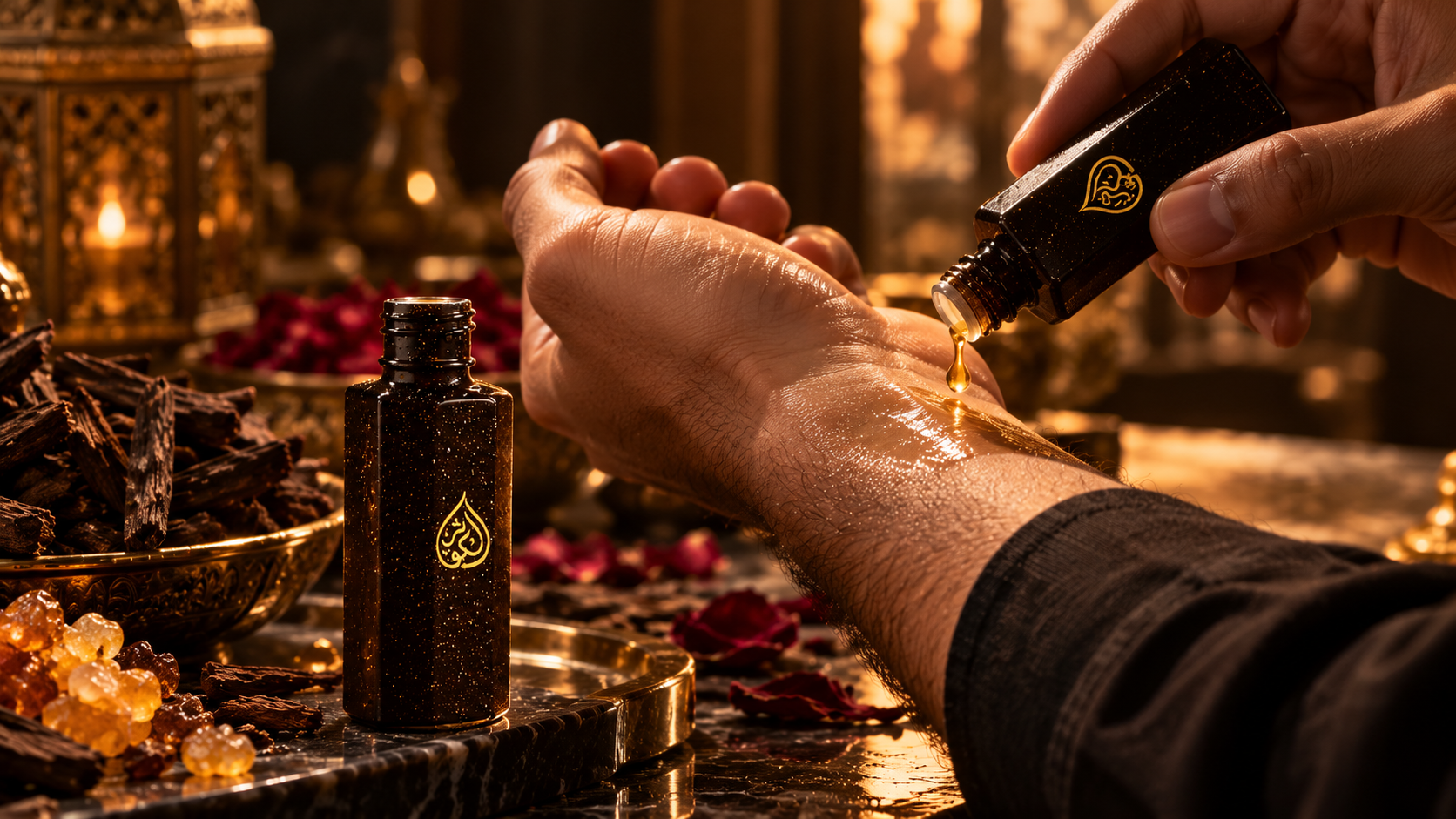
You apply your favourite fragrance, enjoy the smell and wait for it to settle.
But something feels different.
Your skin feels oily. Perhaps it feels sticky, greasy or slightly wet long after application.
Is that normal? Does it mean the perfume is poor quality? And why do some fragrances disappear into the skin's surface while others seem to sit on top?
The answer depends on the fragrance formula, the amount applied and the condition of your skin.
Let's break it down.
Why Does Perfume Sometimes Feel Oily?
The first thing to understand is that not all perfumes use the same base.
Traditional perfume oils and alcohol-based spray perfumes can feel very different because their formulations are different.
Oil-based perfume
Oil-based fragrances use an oily base or carrier system to deliver the aromatic ingredients. Depending on the product, this may include suitable carrier oils or other fragrance-compatible materials.
Because these ingredients don't evaporate in the same way as alcohol, some of the base can remain on the skin after application.
That can create a smooth, moisturising or slightly greasy sensation.
The amount of residue depends on the particular formula and how much you apply.
Alcohol-based spray perfume
Many conventional spray perfumes use alcohol as their primary solvent.
Alcohol evaporates relatively quickly after application, so the skin may feel less oily once the spray has dried.
However, spray perfumes can still contain ingredients that leave a residue, depending on their composition.
The format alone doesn't tell you exactly how a fragrance will feel. The formula matters.
Why Does Perfume Oil Sometimes Feel Sticky?
A sticky sensation can occur when the liquid leaves a noticeable film on the skin.
Several factors may contribute:
- The amount applied: Using more product than necessary can leave excess material on the surface.
- The base formulation: Some oils and other ingredients feel heavier or tackier than others.
- The fragrance composition: The aromatic ingredients themselves can influence the texture of the finished product.
- Heat and humidity: Warm, humid conditions can make residue feel more noticeable.
- Other skincare products: Moisturisers, body oils and lotions can mix with fragrance and change how the combination feels.
This doesn't automatically mean that the perfume is defective.
A slight oily sensation can be expected from some oil-based fragrances.
But an unusually sticky texture, especially if it appears suddenly or changes over time, deserves closer attention.
Does Oily Mean Low Quality?
No. An oily texture alone does not determine perfume quality.
A perfume oil is designed around an oil-based delivery format, so some surface residue may be entirely normal.
Quality depends on much more than how quickly a fragrance disappears from the skin.
Relevant considerations include the quality and suitability of the ingredients, formulation, stability, scent character and how the product performs when used as intended.
At the same time, an oily texture should not automatically be treated as proof of superior concentration or quality.
A product can feel light and elegant while being well formulated. Another can feel heavier without necessarily being better.
The goal is to create a fragrance that smells and performs as intended while providing a comfortable application experience.
Why Does Some Perfume Absorb Quickly While Others Sit on the Skin?
People often describe perfume oil as being absorbed into the skin.
However, that description can be misleading.
Fragrance ingredients don't necessarily disappear because the skin has absorbed them. Some ingredients remain on the surface, while volatile aromatic materials gradually evaporate into the surrounding air.
The way a fragrance feels depends on the physical properties of its ingredients and how they interact with the skin's surface.
A lightweight-feeling formula may leave little noticeable residue.
A richer or heavier formula may remain detectable as a film for longer.
Neither sensation, by itself, tells you how long the fragrance will last or how strongly it will project.
Does Applying Too Much Perfume Make It Stickier?
Yes, it can.
Even a well-formulated perfume oil may feel greasy if you apply more than you need.
A larger amount leaves more liquid on the surface, making the residue more noticeable.
Try applying a small amount to one or two areas first.
Allow it to settle, then assess both the fragrance and the feel on your skin.
You may discover that a smaller application gives you the experience you want without leaving an uncomfortable film.
With concentrated fragrance, starting small is often the best approach.
Does Your Skin Type Make a Difference?
Your skin's condition can influence how a fragrance feels after application.
For example, someone who already uses a rich body lotion or body oil may notice that perfume feels heavier when applied on top.
Dry skin, oily skin and the skincare products you use can all affect the overall experience.
However, skin type doesn't provide a perfect prediction of how every perfume will behave.
Two people can apply the same fragrance in the same amount and experience different results.
If you find your fragrance consistently feels too heavy, try using less and applying it to clean, dry skin without layering it over several other products.
Why Does Perfume Feel Stickier in Hot Weather?
Heat and humidity can change how comfortable a fragrance feels.
In hot weather, your skin may already feel warm or slightly damp. Adding an oily product can make that surface sensation more noticeable.
Humidity can also make the combination of sweat, skincare products and fragrance feel heavier.
This doesn't mean every perfume becomes chemically sticky in hot weather.
Rather, the conditions can make a residue that was already present more noticeable to you.
During warmer months, consider applying a smaller amount and choosing a formula whose texture feels comfortable in your climate.
Can an Oily Perfume Block Your Pores?
It's not possible to answer this for every perfume oil.
Whether a product contributes to clogged pores or irritation depends on its ingredients, formulation and how your skin responds.
An oily sensation does not automatically mean that a product is comedogenic, and the term oil-based alone isn't enough to determine whether a product will cause breakouts.
If you have acne-prone or sensitive skin, check the product's ingredient information where available and test cautiously.
Avoid applying fragrance to irritated or broken skin. If a product consistently causes breakouts or discomfort, stop using it.
What If Your Perfume Suddenly Becomes Sticky?
This is different from a fragrance that has always had a slightly oily texture.
If a perfume that previously felt normal suddenly becomes unusually sticky, thick, cloudy or different in smell, don't immediately assume that the change is harmless.
Possible explanations include changes in storage conditions, evaporation, ingredient compatibility or product deterioration.
Keep the bottle away from excessive heat and sunlight, and ensure that its cap is properly closed.
If the product has changed significantly, contact the manufacturer or seller before continuing to use it.
How Can You Apply Perfume Oil Without Feeling Greasy?
You don't need a complicated routine.
Try these simple steps:
1. Start with a small amount.
Apply a little to your chosen area rather than covering a large section of skin.
2. Use clean, dry skin.
This helps you understand how the perfume feels on its own, without mixing it with sweat or other products.
3. Avoid layering too many oils.
If you already use body oil or a rich moisturiser, applying perfume directly over it may make the combination feel heavier.
4. Give it time to settle.
Assess the texture after application rather than immediately adding more product.
5. Keep perfume away from delicate clothing.
Oil-based fragrance can leave marks on some fabrics. Allow it to settle before dressing, and avoid direct contact with delicate or light-coloured materials.
Should You Rub Perfume Oil Into Your Skin?
There is generally no need to rub perfume oil vigorously after applying it.
Apply a small amount and let it settle naturally.
Rubbing does not simply destroy fragrance molecules, as is sometimes claimed, but it can spread or remove some of the product from the original application area.
A gentle application is usually sufficient.
Does a Sticky Perfume Last Longer?
Not necessarily.
A fragrance that leaves a noticeable oily film isn't automatically longer-lasting than one that feels dry or lightweight.
Longevity depends on the composition, the aromatic materials used, the application amount, skin conditions and the surrounding environment.
Similarly, a fragrance that feels light doesn't necessarily disappear quickly.
Texture, longevity and projection are three different things.
The best way to evaluate a fragrance is to consider its scent, performance and comfort together.
The Bottom Line
Perfume can feel oily or sticky because of its base ingredients, the amount applied, the interaction with skincare products and environmental conditions.
For oil-based fragrances, some residue is often a normal part of the format.
But excessive stickiness, sudden texture changes or skin irritation shouldn't be ignored.
At Al Kowthar Fragrances, we believe fragrance education should help you understand not just how a perfume smells, but also how it behaves when you wear it.
A good fragrance experience involves more than the scent itself.
It includes the application, the texture, the development and the comfort of wearing it.
The goal isn't to apply the most fragrance. It's to find the right amount and enjoy the experience.
"Explore Al Kowthar Fragrances" (https://alkowtharfragrance.com/shop)