30 October 2026 · 9 min read
Why Do Perfume Companies Spend Years Developing a Single Fragrance?
Why can creating one perfume take years? Discover the hidden process behind fragrance development, from the first formula to the finished bottle.
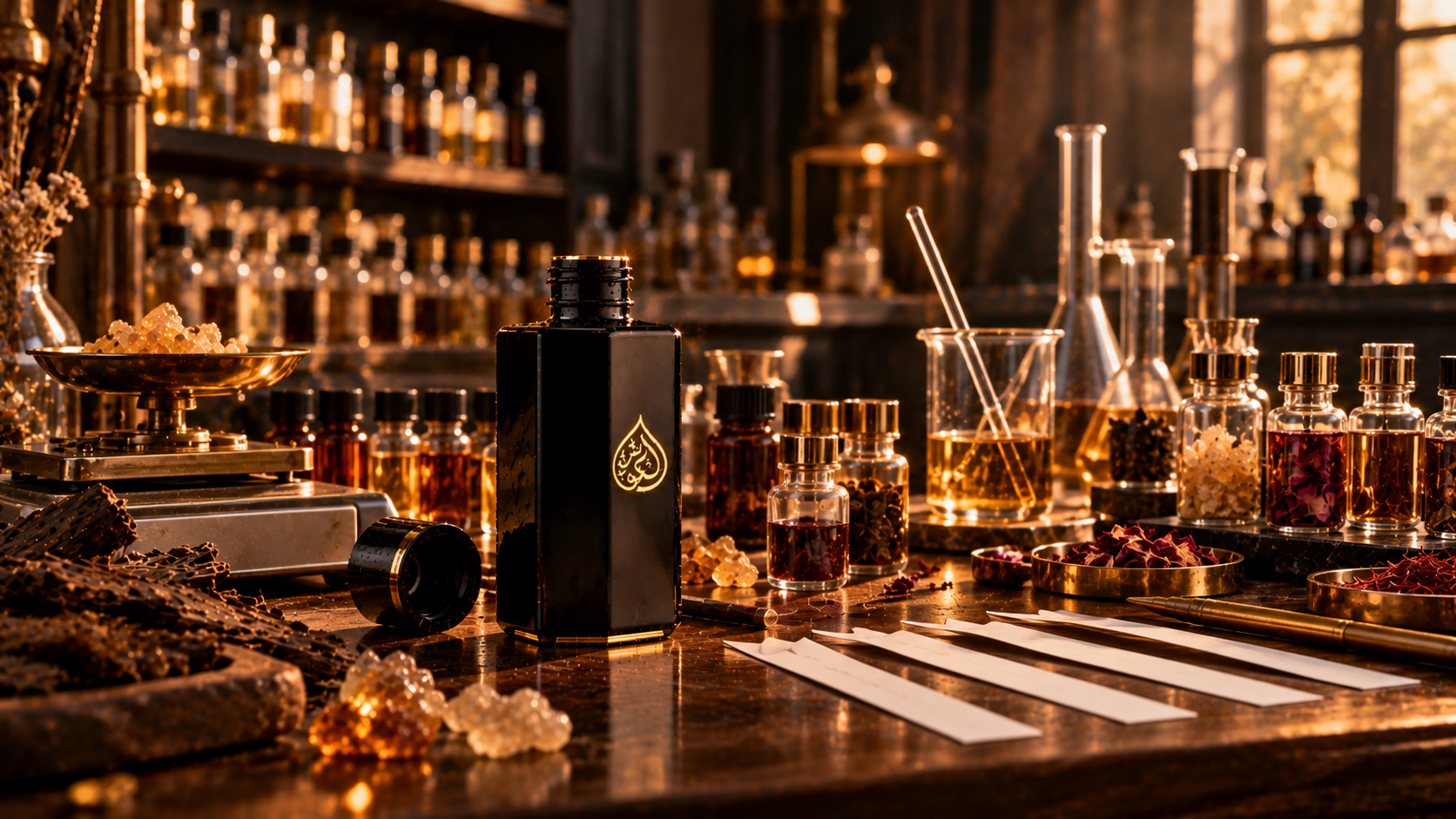
Imagine walking into a perfume shop.
Hundreds of beautiful bottles line the shelves.
You pick up one, spray it onto a testing strip and immediately fall in love with the fragrance.
Perhaps it's a rich oud, a warm amber or a beautifully balanced floral composition.
The experience lasts only a few seconds.
But here's something fascinating.
The perfume you just smelled might have taken years to develop.
Behind that elegant bottle could be hundreds of experiments, countless adjustments, laboratory tests and difficult creative decisions.
Some fragrances are developed relatively quickly. Others require months or even years before they reach the market.
But why?
If a perfumer already knows how to combine aromatic ingredients, why can creating a single fragrance take so long?
The answer reveals a fascinating world where chemistry, creativity, business and human psychology come together.
Let's explore how a perfume goes from an idea to a finished product.
1. Every Perfume Begins With an Idea
Before a perfumer begins mixing ingredients, there is usually a concept.
In the fragrance industry, this concept is often communicated through something called a perfume brief.
A brief explains what the brand wants the fragrance to achieve.
It may describe the desired scent character, intended audience, price range and overall creative direction.
For example, a brand might request:
A sophisticated woody fragrance inspired by a peaceful evening in an Arabian courtyard, combining warm amber, soft spices and a luxurious oud character.
This sounds simple.
But how does a perfumer translate that description into an actual smell?
What exactly does a peaceful evening smell like?
How should the oud behave?
Should the fragrance feel powerful or intimate?
Should the amber be sweet, smoky or resinous?
These questions mark the beginning of the creative process.
A perfume begins as an idea that must somehow be translated into aromatic molecules.
2. The Perfumer Begins Building the Formula
Once the creative direction is established, the perfumer starts selecting aromatic materials.
Modern perfumers may work with hundreds or even thousands of available ingredients.
These include natural extracts and synthetic aroma chemicals.
Each material contributes particular aromatic characteristics.
But creating a perfume isn't simply about combining ingredients that smell pleasant individually.
A perfumer must consider how the materials behave together.
Some ingredients can dominate a composition.
Others may be barely noticeable on their own but become important when combined with other materials.
A small change in concentration can sometimes make a noticeable difference.
For example, increasing one ingredient might make a fragrance sweeter.
Reducing another could allow a floral characteristic to become more prominent.
Adding a trace of a powerful material might change the overall impression.
The challenge is achieving the intended balance.
3. Why Do Perfumers Create So Many Versions?
Imagine a perfumer developing a woody amber fragrance.
The first version smells beautiful.
But the brand thinks it's too sweet.
The perfumer reduces certain sweet materials and adjusts the woody components.
The second version is more balanced.
However, the opening now feels too sharp.
Another adjustment is made.
The third version has a wonderful opening but doesn't develop in the desired way.
The process continues.
In professional perfumery, these adjustments are often called modifications, or simply mods.
Each modification represents a revised version of the formula.
Some commercial projects involve numerous modifications.
Others may require relatively few.
There is no universal number of trials needed to create a successful perfume.
The process depends on the complexity of the brief, the working relationship between the perfumer and the brand, and the technical requirements.
The challenge isn't necessarily making a perfume that smells good. It's making a perfume that smells exactly right for its intended purpose.
4. What Is a Perfume Evaluator?
Here's something many fragrance enthusiasts don't realise.
The person creating the fragrance is not always the only person deciding whether it works.
Large fragrance companies may employ specialists known as fragrance evaluators.
These professionals assess fragrance compositions and help guide their development.
They may compare different modifications, identify differences and communicate feedback to the perfumer.
An evaluator might notice that one version has a more attractive opening, while another has a smoother drydown.
They may also consider how well the fragrance matches the original brief.
The relationship between perfumer and evaluator can be an important part of the creative process.
One person constructs the fragrance.
Another helps assess how effectively it communicates the intended concept.
Of course, smaller perfume businesses may organise these responsibilities differently.
A single perfumer or founder may perform several of these roles.
5. Why Does a Perfume Need to Be Tested Over Time?
A perfume doesn't always smell the same immediately after application as it does several hours later.
Different aromatic compounds evaporate at different rates.
This contributes to the changing scent profile commonly described through top, heart and base notes.
When developing a fragrance, perfumers must evaluate more than its initial impression.
A composition may have a beautiful opening but an unbalanced drydown.
Another may develop wonderfully but fail to create the desired first impression.
Testing over time helps identify these differences.
The development team may evaluate the fragrance on suitable testing materials and, where appropriate, through controlled wear testing.
They may also assess how the fragrance behaves under different conditions.
The goal is to understand the complete scent experience rather than judge the formula from one quick smell.
6. What Happens When a Perfume Smells Perfect but Fails Testing?
This is where perfume development becomes particularly interesting.
Imagine a perfumer creates a fragrance that everyone loves.
The scent is beautiful.
The brand approves it.
But during stability testing, the liquid begins changing colour.
Or the fragrance develops an unwanted smell after exposure to certain conditions.
Perhaps the formula becomes cloudy.
Now the development team faces a problem.
A perfume must do more than smell attractive when freshly prepared.
It also needs to remain appropriately stable throughout its intended shelf life.
What is perfume stability testing?
Stability testing investigates how a formulation behaves under selected conditions.
Depending on the product, testing may involve examining:
- Changes in colour.
- Changes in odour.
- Cloudiness or precipitation.
- Physical separation.
- Compatibility with the intended packaging.
- Behaviour under different storage temperatures.
Testing conditions and acceptance criteria depend on the product and its intended market.
A fragrance that performs poorly may require reformulation.
That can mean returning to the laboratory even after the creative team thought the perfume was finished.
7. Why Does the Bottle Matter?
You might assume that once a perfume formula is complete, the manufacturer can simply pour it into any attractive bottle.
But packaging is more complicated than that.
Fragrance formulations can interact with certain packaging materials.
Depending on the ingredients and container, manufacturers may need to assess compatibility with seals, liners, applicators, coatings and other components.
For example, a perfume containing particular solvents may behave differently with packaging materials than an oil-based formulation.
A beautiful bottle is not automatically suitable for every fragrance.
What about perfume oils?
Perfume oils may require particular attention to applicators, closures and materials that remain in contact with the formulation.
Compatibility testing helps determine whether the chosen packaging performs appropriately.
This is one reason selecting bottles, caps and applicators can be an important part of product development.
The packaging must protect the fragrance, not simply make it look beautiful.
8. Why Does Perfume Safety Testing Take Time?
A perfume intended for cosmetic use must meet applicable safety requirements.
In the European Union, cosmetic products must undergo a safety assessment before being placed on the market.
The responsible person must also ensure that the relevant regulatory obligations are fulfilled.
For example, an EU cosmetic product generally requires a Cosmetic Product Safety Report as part of its Product Information File.
The product must also meet applicable ingredient restrictions and labelling requirements.
These obligations can influence fragrance development.
A formula may need to be adjusted if certain ingredients exceed permitted limits or create other safety concerns.
Importantly, a fragrance being natural does not automatically make it safe.
Natural and synthetic aromatic materials must both be evaluated appropriately.
Safety and regulatory requirements are therefore an important part of turning a creative formula into a market-ready cosmetic product.
9. Why Is Manufacturing a Large Batch Different From Making a Small Sample?
Imagine a perfumer creates a beautiful 10 ml laboratory sample.
Everything works perfectly.
Now the company wants to manufacture 10,000 bottles.
The process becomes more demanding.
Manufacturers must ensure that ingredients are accurately measured and mixed.
They must also maintain appropriate production controls.
Some materials may require particular handling or processing conditions.
Quality-control procedures help ensure that the finished product meets its specifications.
The goal is consistency.
A customer purchasing a fragrance today should receive a product that meets the same established quality standards as another customer purchasing it later.
Scaling production is therefore not simply a matter of multiplying every ingredient by a larger number.
The manufacturing process must be suitable for the larger batch.
10. Why Do Some Perfumes Get Rejected?
Not every fragrance that smells beautiful becomes a commercial product.
A composition might be rejected for several reasons.
Perhaps it doesn't match the brand's identity.
Maybe the ingredients make it too expensive for the intended selling price.
The fragrance might be too similar to another product in the collection.
Or consumer testing may reveal that the intended audience prefers a different direction.
Sometimes a project changes because of commercial priorities.
This means a technically excellent perfume can remain unreleased.
A fragrance can succeed artistically without being selected commercially.
11. How Much Does It Cost to Develop a Perfume?
There is no single answer.
Development costs vary enormously.
A small independent perfumer working with an existing collection of raw materials may develop a fragrance relatively economically.
A large international launch can involve extensive creative development, consumer research, testing, packaging design, regulatory work and manufacturing preparation.
Marketing and distribution can add substantial costs beyond the fragrance formula itself.
This is why the retail price of a perfume cannot be explained solely by the cost of its aromatic ingredients.
The finished product represents a much larger process.
However, a high retail price does not automatically prove that a fragrance required years of development or unusually expensive ingredients.
12. Can a Perfume Really Take Years to Develop?
Yes.
Some fragrance projects take years because of repeated creative revisions, testing, manufacturing preparation or changing commercial requirements.
However, not every perfume requires such a long development period.
Experienced perfumers can sometimes create successful compositions relatively quickly.
The timeline depends on the project's goals and constraints.
A straightforward fragrance developed using an established formula may require less work than a completely new composition with demanding technical specifications.
The time spent developing a perfume is not, by itself, a reliable measure of its quality.
13. Is Perfume Creation More Science or Art?
The answer is both.
Chemistry helps explain how aromatic compounds behave.
Technical knowledge helps perfumers understand volatility, solubility, stability and formulation.
But creativity is equally important.
A perfumer must decide how the finished fragrance should feel.
Should it be comforting?
Mysterious?
Fresh?
Elegant?
Powerful?
Two perfumers working with the same ingredients may create completely different compositions.
Their choices reflect experience, personal taste and artistic judgement.
This is what makes perfumery such a fascinating discipline.
Science provides the materials and understanding. Creativity determines what those materials become.
The Bottom Line
Why do perfume companies sometimes spend years developing a single fragrance?
Because creating a successful perfume involves far more than mixing pleasant-smelling ingredients.
The process can include creative briefs, formula development, repeated modifications, professional evaluation, stability testing, safety assessments, packaging compatibility and manufacturing preparation.
Each stage contributes to transforming an idea into a finished product.
Some fragrances reach completion quickly.
Others require years of refinement.
At Al Kowthar Fragrances, we believe understanding this process makes the world of perfumery even more interesting.
The next time you open a bottle of your favourite fragrance, remember that the liquid inside may represent an extraordinary amount of experimentation, knowledge and creative decision-making.
A beautiful perfume may take seconds to appreciate, but creating it can be a journey measured in years.
"Explore Al Kowthar Fragrances" (https://alkowtharfragrance.com/shop)