30 October 2026 · 8 min read
Why Does Perfume Turn Cloudy? The Science Behind Fragrance Separation
Why does perfume sometimes turn cloudy or develop crystals? Discover the chemistry behind fragrance separation and what it means.
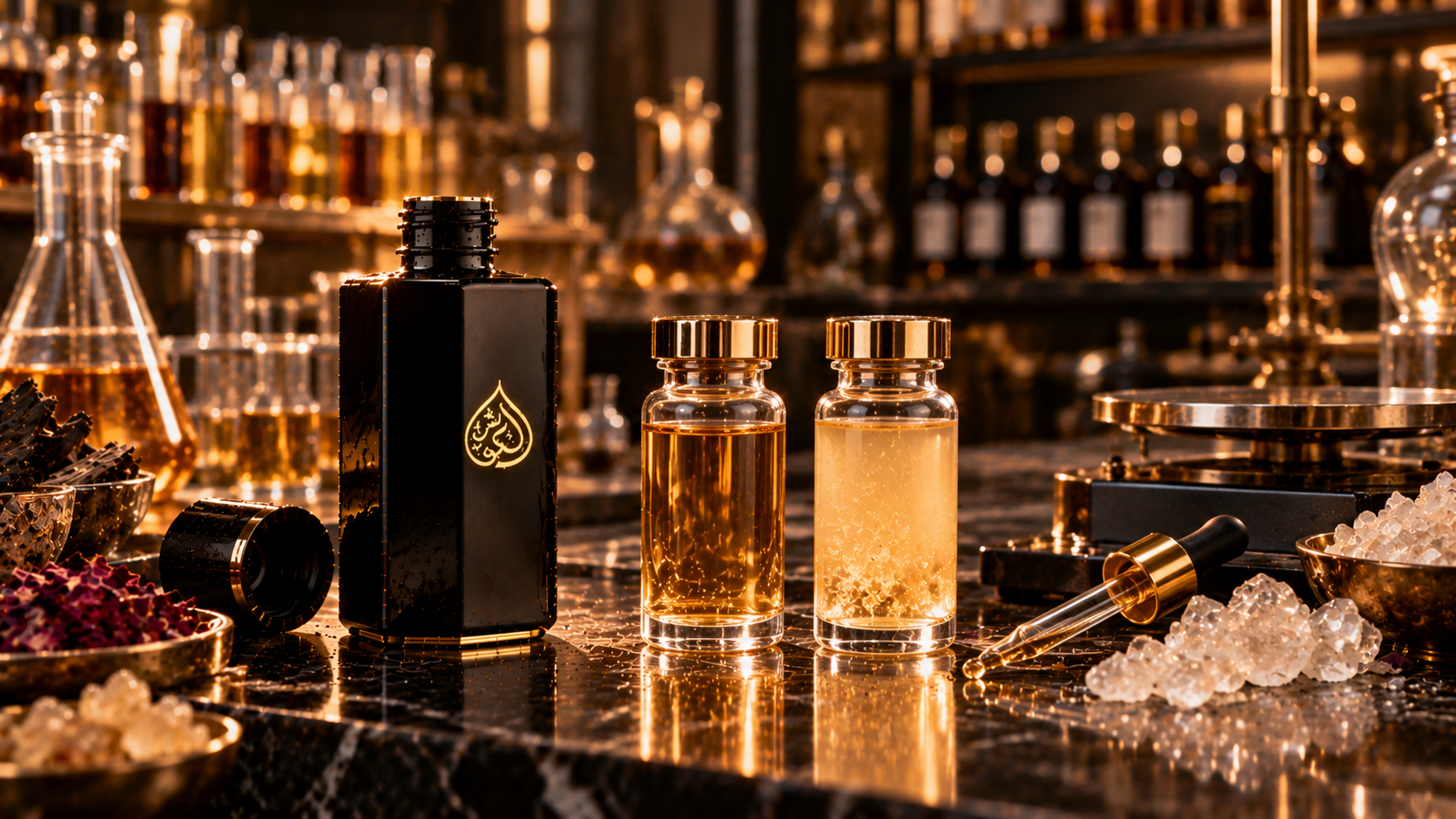
Why Does Perfume Turn Cloudy? The Science Behind Fragrance Separation
Imagine picking up a bottle of your favourite perfume oil.
When you first purchased it, the liquid was perfectly clear. But several weeks later, you notice something unusual.
The fragrance has become slightly cloudy.
Perhaps tiny particles are floating inside. Maybe a small amount of sediment has collected at the bottom.
Naturally, you begin to wonder:
Has my perfume gone bad? Is it contaminated? Or is something happening to the ingredients?
The answer is surprisingly interesting.
Perfumes are complex chemical mixtures, and their appearance can sometimes change because of temperature, ingredient solubility, crystallisation or instability.
However, cloudiness can also indicate a genuine quality problem.
To understand the difference, we need to explore the science of fragrance formulation.
1. What Is Perfume Actually Made Of?
Many people imagine perfume as a simple mixture of scented oils.
In reality, fragrance formulations can contain numerous aromatic compounds with different chemical properties.
Depending on the product, these materials may be dissolved or blended into a suitable carrier.
Common formulation types include:
- Alcohol-based perfumes: Fragrance materials dissolved in an alcohol-based system.
- Oil-based perfumes: Fragrance materials blended with a suitable oil or other compatible carrier.
- Water-containing fragrance products: Formulations that may require additional ingredients to keep fragrance materials appropriately dispersed or solubilised.
Each formulation has its own technical challenges.
A fragrance that remains clear in one carrier may not behave the same way in another.
This brings us to one of the most important concepts in perfume chemistry.
2. What Is Solubility?
Solubility describes how well one substance can dissolve in another.
Think about adding sugar to a cup of tea.
Initially, the sugar dissolves.
But if you keep adding more, you eventually reach a point where the liquid cannot dissolve all of it under those conditions.
Some sugar may remain at the bottom.
A similar principle applies to fragrance ingredients.
Each aromatic material has particular solubility characteristics.
An ingredient may dissolve easily in one solvent but poorly in another.
Even when a material is compatible with a carrier, there may be a limit to how much can remain dissolved.
If that limit is exceeded, the mixture may become cloudy or form visible particles.
A perfume can contain high-quality ingredients and still develop problems if those ingredients are not properly compatible with the formulation.
3. Why Does Cold Weather Sometimes Make Perfume Cloudy?
Temperature can affect solubility.
In some formulations, cooling reduces the amount of certain materials that can remain dissolved.
Imagine a fragrance containing a material that stays dissolved at room temperature.
Now place the bottle somewhere considerably colder.
As the temperature drops, some of that material may begin separating from the liquid.
This can create:
- A cloudy appearance.
- Small suspended particles.
- Visible crystals.
- Sediment at the bottom of the bottle.
In certain cases, warming the product gently back to normal room temperature may allow the material to dissolve again.
However, this depends on the formulation and the reason for the change.
Never assume that all cloudy perfumes can be restored by warming them.
Avoid heating perfume directly or exposing it to high temperatures, as this can damage the fragrance and create additional safety risks.
4. Can Natural Perfume Ingredients Form Sediment?
Yes.
Some natural aromatic materials contain complex mixtures of chemical compounds.
Unlike a single purified aroma chemical, a natural extract may contain numerous constituents with different physical properties.
Certain natural extracts may include waxes or other substances that become less soluble under particular conditions.
These can contribute to cloudiness or sediment.
For example, some botanical extracts require additional processing to improve their clarity or stability.
This is one reason perfumers and manufacturers pay close attention to the quality and specifications of natural raw materials.
However, an important distinction must be made.
Sediment is not automatically proof that a perfume contains natural ingredients.
Synthetic materials can also crystallise or separate.
Similarly, a properly manufactured fragrance containing natural ingredients may remain completely clear.
Appearance alone cannot reliably establish whether a perfume is natural, synthetic or high quality.
5. Why Do Crystals Sometimes Appear Inside Perfume?
One of the most fascinating causes of visible particles is crystallisation.
Certain fragrance ingredients can form crystals when conditions allow their molecules to organise into a solid structure.
Vanillin is one example of a crystalline aromatic material used in perfumery.
It contributes a recognisable vanilla-like odour.
Under unsuitable formulation or storage conditions, vanillin may crystallise rather than remain fully dissolved.
Other fragrance materials can behave similarly.
Whether crystallisation occurs depends on several factors, including:
- The ingredient's concentration.
- The solvent or carrier.
- Temperature.
- The presence of other formulation ingredients.
- Storage conditions.
This is why professional perfume formulation requires more than simply combining ingredients that smell pleasant together.
The ingredients must also remain physically compatible.
6. Can Water Make Perfume Cloudy?
Water can influence the appearance of certain perfume formulations.
Many fragrance materials have limited solubility in water.
In an alcohol-based perfume, adding enough water can sometimes reduce the ability of the solvent system to keep particular aromatic materials dissolved.
The result may be cloudiness.
In an oil-based fragrance, water contamination can create other problems because water and many oils do not mix readily.
Depending on the formulation, droplets or separate phases may become visible.
However, not every water-containing perfume is unstable.
Professional formulators can develop stable fragrance products containing water by selecting suitable ingredients and manufacturing methods.
The important factor is whether the formulation has been designed and tested for its intended composition.
7. Is Cloudy Perfume Dangerous?
Not necessarily, but it should not be ignored.
Cloudiness can have several possible causes.
Some are primarily physical, such as temperature-related crystallisation.
Others may indicate formulation instability, contamination or deterioration.
Unfortunately, it is not always possible to distinguish between these causes simply by looking at the bottle.
For example, a cloudy appearance does not tell you whether an ingredient has separated harmlessly or whether the product has developed a more serious quality issue.
The safest approach is to consider the product's history.
Has it always looked this way?
Was it exposed to unusual temperatures?
Has its smell changed significantly?
Is the packaging damaged?
Did the cloudiness appear unexpectedly?
If a perfume develops unexplained cloudiness, unusual sediment, separation or a significant change in smell, stop using it and contact the manufacturer or retailer.
Do not assume that a perfume is safe simply because it still smells pleasant.
8. Why Do Manufacturers Test Perfume Stability?
Before a cosmetic fragrance is sold, manufacturers need to understand how the formulation behaves under appropriate conditions.
Stability testing helps investigate whether the product maintains its intended characteristics over time.
Depending on the formulation, testing may examine:
Appearance: Does the liquid remain clear or maintain its expected appearance?
Colour: Does the colour change unexpectedly?
Odour: Does the fragrance develop unwanted characteristics?
Physical stability: Do ingredients separate, crystallise or form sediment?
Packaging compatibility: Does the formulation interact adversely with its bottle, cap, seal or applicator?
Temperature sensitivity: How does the product behave under selected storage conditions?
These tests help manufacturers identify problems before products reach customers.
A fragrance that smells beautiful immediately after mixing may still require adjustments to improve its stability.
9. What Is Chill Filtration?
Some fragrance manufacturing processes use cooling and filtration to help remove materials that might otherwise cause cloudiness.
This is sometimes described as chill filtration.
The basic principle involves cooling a formulation under controlled conditions so that certain poorly soluble materials become easier to separate.
The mixture can then be filtered using an appropriate process.
However, this method is not suitable for every fragrance.
The effectiveness and suitability of filtration depend on the formulation and the materials involved.
Manufacturers must also consider whether the process changes the intended fragrance characteristics.
Chill filtration is therefore a technical manufacturing option, not a universal solution.
10. Does Cloudiness Mean a Perfume Is Low Quality?
Not automatically.
A change in appearance can occur for different reasons, and not all of them indicate poor-quality ingredients.
However, unexpected cloudiness may reveal a formulation or storage issue that deserves investigation.
A well-developed fragrance should meet appropriate specifications for its intended appearance and stability.
If a product is designed to be clear, persistent cloudiness may mean it is no longer meeting those specifications.
Likewise, some products are intentionally opaque or contain suspended materials as part of their design.
The key distinction is whether the appearance is expected and supported by appropriate product testing.
Quality is not determined by clarity alone. It depends on whether the product performs safely and consistently as intended.
11. How Should You Store Perfume to Reduce Problems?
Good storage practices can help protect fragrance quality.
Keep your perfume:
- Away from direct sunlight.
- Away from radiators and other heat sources.
- Away from unnecessary temperature fluctuations.
- Properly closed when not in use.
- In accordance with the manufacturer's storage instructions.
Avoid leaving fragrance bottles in cars where temperatures can become extremely hot or cold.
Also avoid attempting to repair a cloudy perfume by adding water, alcohol or other ingredients.
Changing the formulation can create further instability and may affect product safety.
If you notice an unexpected change, contact the supplier rather than experimenting with the contents.
The Bottom Line
Why does perfume turn cloudy?
The answer often lies in the chemistry of the formulation.
Temperature changes, limited solubility, crystallisation, natural extract constituents and water interactions can all influence a fragrance's appearance.
Sometimes these changes are physical and reversible.
In other cases, they may indicate instability or another quality concern.
The important lesson is that a perfume must do more than smell beautiful. Its ingredients must also work together as a stable formulation.
At Al Kowthar Fragrances, we believe understanding the science behind fragrance helps customers appreciate the craftsmanship involved in perfumery.
The next time you look through a bottle of perfume, remember that its appearance is the result of a carefully balanced mixture of ingredients.
And maintaining that balance is an important part of the perfumer's work.
"Explore Al Kowthar Fragrances" (https://alkowtharfragrance.com/shop)