22 October 2026 · 7 min read
Why Does Perfume Stain Clothes? Causes, Prevention & How to Remove Stains
Does perfume stain clothes? Discover why perfume oils and sprays leave marks on fabrics, how to remove stains and ways to prevent them.
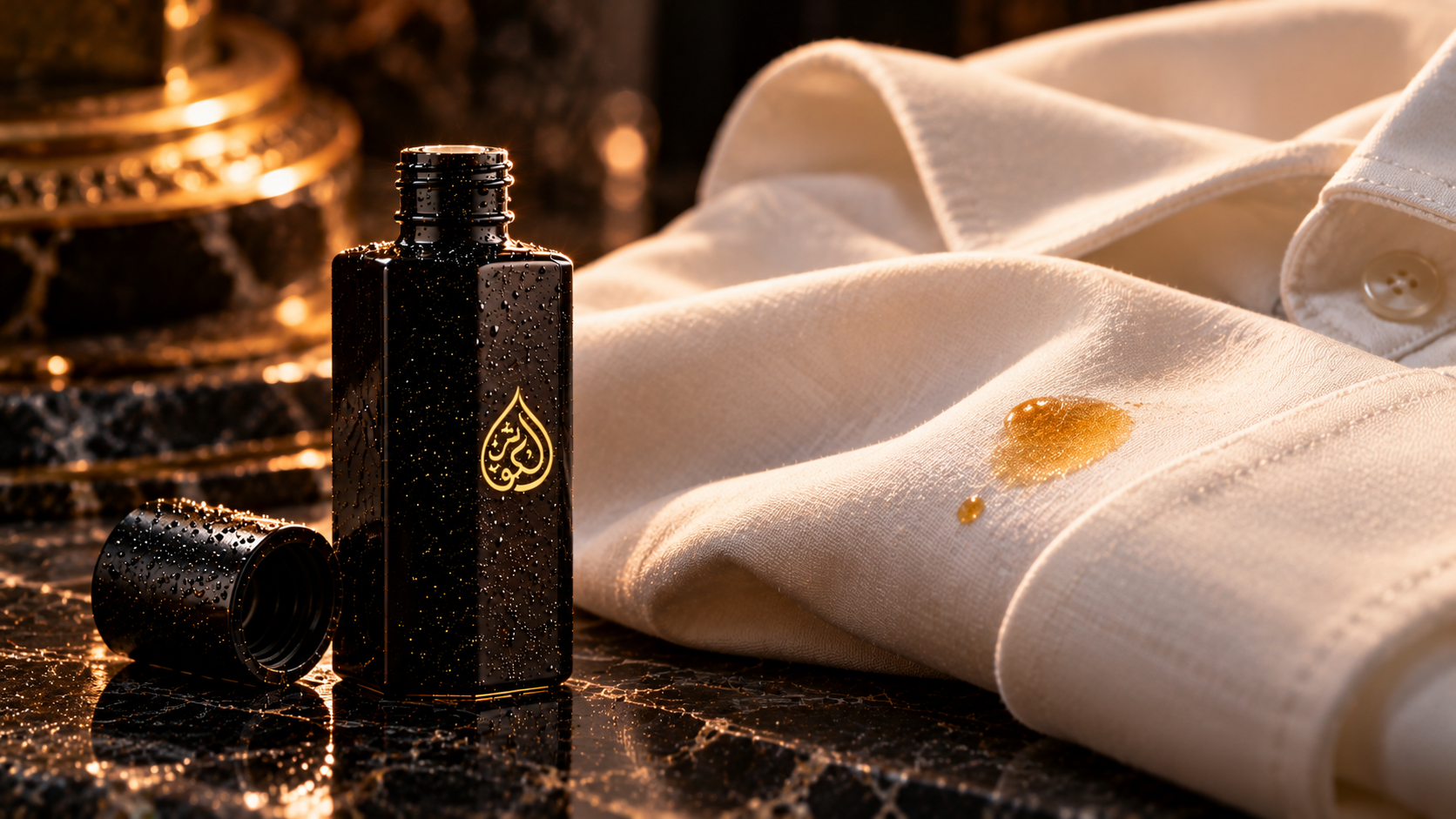
You've just put on your favourite outfit.
Everything looks perfect.
You reach for your favourite perfume, apply a little fragrance and head out.
But later, you notice something unexpected.
A small yellow mark. An oily patch. Or a darker spot on your clothing.
Could your perfume be responsible?
And if it is, can the stain actually be removed?
The answer depends on the perfume's ingredients, the type of fabric and how quickly the stain is treated.
Let's explore the science behind perfume stains and how to avoid them.
Can Perfume Really Stain Clothes?
Yes. Both perfume oils and alcohol-based spray perfumes can leave marks on certain fabrics.
However, not every fragrance will stain every material.
The likelihood of staining depends on several factors:
- The fragrance formulation
- The type of carrier or solvent
- The amount applied
- The colour of the perfume
- The fabric's composition
- Whether the product contains colourants or other residue-forming ingredients
- How the fragrance is applied
A clear, lightweight spray may leave little visible residue on some fabrics.
A concentrated perfume oil may leave a more noticeable mark.
But the format alone does not guarantee whether staining will occur.
Why Do Perfume Oils Leave Oily Marks?
Perfume oils are formulated with aromatic ingredients and a suitable oil-based or non-alcoholic carrier system.
Unlike the alcohol in many conventional spray perfumes, some of these materials evaporate slowly or remain on the surface.
When perfume oil comes into contact with clothing, it can penetrate the spaces between fabric fibres.
This may create a darker-looking patch, especially on light-coloured or delicate materials.
The mark may resemble a cooking-oil stain, although fragrance formulations can behave differently from ordinary household oils.
An oily mark does not automatically mean the perfume is poor quality.
It may simply reflect the physical properties of the formulation.
Can Alcohol-Based Perfumes Also Stain Clothes?
Yes.
Many spray perfumes contain a high proportion of ethanol, which evaporates relatively quickly.
But ethanol is not necessarily the only ingredient in the bottle.
The fragrance concentrate may contain aromatic compounds, colourants and other materials that can remain after the alcohol evaporates.
These residual ingredients may leave visible marks on certain fabrics.
Alcohol can also affect some dyes or fabric finishes.
So even if a perfume feels dry on your skin, that does not mean it is automatically safe to spray directly onto every garment.
Why Do Some Perfume Stains Look Yellow?
Yellowish or amber-coloured marks may be associated with coloured fragrance materials, dyes or other ingredients that remain on the fabric.
Certain natural extracts and aromatic materials have noticeable colours.
For example, some resins and essential oils may appear yellow, amber or brown.
However, the colour of the liquid alone is not a reliable prediction of staining.
A lightly coloured fragrance may still leave a residue, while a darker fragrance may not visibly mark every fabric.
The fabric itself also matters.
Which Fabrics Are Most Vulnerable?
Some fabrics are more difficult to clean or more sensitive to fragrance ingredients than others.
Silk
Silk can be particularly vulnerable to visible marks and water spotting.
It often requires specialised care.
Satin
Satin describes a weave rather than one specific fibre.
Depending on whether it is made from silk, polyester or another material, it may react differently to liquids and cleaning treatments.
Wool
Wool can be sensitive to aggressive cleaning methods and excessive rubbing.
Cotton
Cotton is generally more washable than many delicate fabrics, but oils and coloured residues can still leave marks.
Polyester and synthetic blends
Some synthetic fibres can retain oily substances, making certain stains difficult to remove.
No fabric should be assumed completely stain-proof simply because it is durable.
Why Does Perfume Sometimes Leave Marks on White Clothes?
White and light-coloured garments make discolouration easier to notice.
A small amount of amber-coloured residue may be almost invisible on dark fabric but obvious on a white shirt.
Oily patches can also alter the way light passes through or reflects from the fabric, making the affected area appear darker.
This is why applying concentrated perfume directly onto a white shirt, abaya, thobe or other light-coloured garment may be risky.
Can Perfume Stains Be Removed?
Sometimes, yes.
But successful removal depends on the ingredients involved, the fabric and how long the stain has been present.
A fresh oily mark on washable cotton may be easier to treat than an old stain on silk.
Before attempting any cleaning, always check the garment's care label.
If the fabric is delicate, expensive, dyed or marked dry clean only, professional cleaning is usually the safer option.
How to Remove Perfume Stains From Washable Clothes
For washable garments, the following approach may help with some oily perfume stains.
Step 1: Blot the area gently
If the perfume is still wet, use a clean, absorbent cloth to blot excess liquid.
Avoid rubbing aggressively, as this can spread the stain or damage the fabric.
Step 2: Check the care label
Make sure the garment can be washed and treated with water.
Do not apply household stain treatments to dry-clean-only fabrics.
Step 3: Test a suitable stain remover
Use a laundry stain remover intended for oily marks and compatible with the fabric.
Test it on a hidden area first to check for discolouration or damage.
Step 4: Follow the product instructions
Apply the treatment as directed, respecting the recommended contact time.
Avoid combining different cleaning chemicals.
Step 5: Wash according to the garment label
Use the permitted washing method and temperature.
Step 6: Check before drying
Inspect the garment after washing.
If the stain remains, avoid tumble-drying or ironing it until you have decided on the next treatment.
Heat can make some stains more difficult to remove.
These steps may help, but they cannot guarantee removal of every perfume stain.
Should You Use Vinegar or Baking Soda?
You may have seen online advice recommending vinegar, baking soda or other household ingredients for perfume stains.
However, these methods are not universally appropriate.
Their effectiveness depends on the type of stain and the fabric.
Some materials and dyes may react poorly to acidic or alkaline treatments.
For valuable or delicate clothing, using an appropriate fabric-specific cleaning product or consulting a professional cleaner is generally more reliable than experimenting with household mixtures.
How Do You Remove Perfume Stains From Silk?
Silk requires particular care.
Avoid aggressive rubbing, soaking or applying strong cleaning products without checking the garment's instructions.
If perfume oil has stained a silk garment, a professional cleaner experienced with delicate fabrics is often the best option.
Attempting to remove the mark yourself may create a larger water stain or damage the fabric's appearance.
Does Perfume Permanently Damage Clothes?
Not always.
Some marks are removable residues.
Others may involve changes to the fabric dye, finish or fibres.
These situations are different.
Removing an oily residue may restore the fabric's appearance.
But if a product has altered the dye or damaged the material, ordinary stain removal may not reverse the change.
This is another reason prevention is better than treatment.
How Can You Prevent Perfume Stains?
The simplest approach is to avoid unnecessary contact between perfume and clothing.
1. Apply perfume to suitable areas of skin.
For perfume oils, use a small amount on clean, intact skin, following the product instructions.
2. Allow the product to settle before dressing.
This can reduce the amount of liquid transferred onto clothing, although it does not guarantee that transfer will not occur.
3. Avoid applying oil directly to delicate fabrics.
Be particularly careful with silk, satin and light-coloured garments.
4. Use a controlled amount.
Applying excessive fragrance increases the amount of material that could transfer onto fabric.
5. Be careful with collars and cuffs.
These areas frequently come into contact with fragranced skin.
6. Test fabric compatibility when appropriate.
If a fragrance is intended for use on clothing, follow the manufacturer's instructions and test an inconspicuous area first.
Is It Better to Apply Perfume to Skin or Clothes?
There is no universal answer for every fragrance.
Some people enjoy applying suitable spray perfumes to clothing because certain fabrics can retain fragrance materials for extended periods.
However, applying perfume directly to fabric also creates a risk of staining or damage.
Perfume oils are generally better applied according to their intended use rather than assumed safe for fabric application.
If you want to protect your clothing, applying a controlled amount to appropriate areas of skin is often the more cautious choice.
Does More Expensive Perfume Stain Less?
Not necessarily.
A perfume's price does not reliably indicate whether it will stain clothing.
An expensive fragrance may contain richly coloured natural materials or ingredients that leave residue.
A more affordable fragrance may have a lighter-feeling formulation.
Staining depends on chemistry and fabric compatibility, not simply price or luxury branding.
The Bottom Line
Perfume can stain clothes because certain aromatic ingredients, carrier materials, colourants or other components may remain on fabric after application.
Both perfume oils and alcohol-based sprays can cause marks under certain conditions.
Some stains can be removed, while others may be difficult or impossible to reverse.
The best approach is prevention.
At Al Kowthar Fragrances, we believe understanding fragrance means knowing not only how to enjoy it, but also how to apply it responsibly.
A beautiful perfume should complement your outfit, not leave an unwanted mark on it.
Wear the fragrance. Protect the fabric. Enjoy the experience.
"Explore Al Kowthar Fragrances" (https://alkowtharfragrance.com/shop)