27 September 2026 · 7 min read
What Is Perfume Oil? The Complete Guide to Fragrance Oils
Discover what perfume oil is, how it works, how to apply it and why this ancient form of fragrance remains so special today.
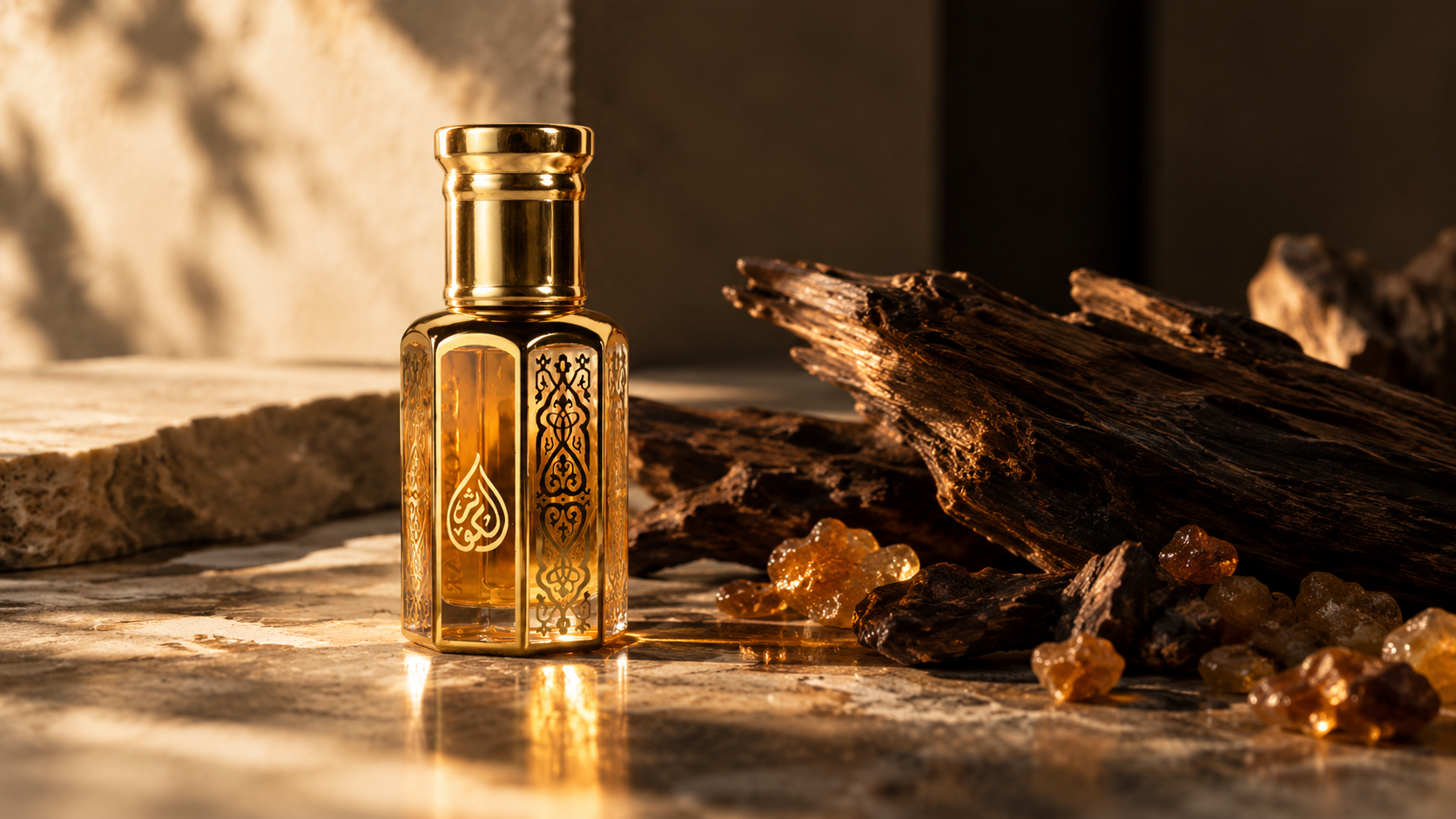
Perfume does not have to be sprayed.
Long before the modern atomiser became the standard way of wearing fragrance, people used aromatic oils, woods, flowers, resins and spices to scent themselves.
Today, perfume oil remains one of the most intimate and fascinating ways to experience fragrance.
But what exactly is perfume oil? Why does it behave differently from a spray? Does it really last longer? And how should you apply it?
Let's explore the world of perfume oils.
What Is Perfume Oil?
Perfume oil is fragrance worn in an oil-based format rather than the familiar alcohol-based spray format.
The fragrance itself may be created from natural extracts, modern aroma molecules, or a combination of both.
The major difference is how the fragrance is delivered and how it behaves after application.
A spray perfume is atomised into thousands of tiny droplets. This spreads fragrance over a large area and helps volatile aromatic molecules enter the surrounding air quickly.
Perfume oil is different.
It is normally applied directly to specific areas of the skin. Instead of producing an immediate cloud of fragrance, it tends to create a more concentrated and intimate scent experience.
Perfume Oil vs Spray Perfume
Neither format is automatically better.
They simply offer different experiences.
A spray fragrance is excellent at diffusion. The atomiser spreads fragrance across a wide surface area, producing the familiar cloud of scent around the wearer.
Perfume oil is generally more intimate.
Because it is applied directly to the skin rather than sprayed through the air, its scent can remain concentrated around the application area.
A simple way to understand the difference is:
Spray fragrance is designed to travel.
Perfume oil is designed to sit with you.
And this introduces an important lesson about fragrance:
Projection and longevity are not the same thing.
Longevity, Projection and Sillage
These three words are often confused.
Longevity is how long a fragrance remains detectable.
Projection describes how far the fragrance radiates from your body.
Sillage is the scent trail a fragrance leaves behind as you move.
A fragrance can therefore project powerfully but disappear relatively quickly.
Another can remain much closer to the skin while still being detectable many hours later.
Perfume oils often shine in this more intimate style of fragrance.
Sometimes fragrance does not need to announce your arrival from across the room.
Sometimes its beauty is discovered when somebody comes closer.
Why Can Perfume Oils Last So Long?
Fragrance works through evaporation.
Aromatic molecules gradually leave your skin and enter the surrounding air. When some of those molecules reach our noses, we perceive them as scent.
But fragrance materials do not all evaporate at the same speed.
Fresh citrus materials are often highly volatile and can appear strongly at the beginning before fading relatively quickly.
Many woods, musks, amber materials, resins and other heavier materials can remain perceptible for much longer.
Perfume oil also behaves differently from an atomised spray because it remains concentrated around the areas where it has been applied.
However, there is an important misconception to avoid:
Not every perfume oil automatically lasts longer than every spray perfume.
Longevity depends on many factors:
- The fragrance formula
- The materials used
- Concentration
- How much you apply
- Your skin
- Temperature
- Humidity
- Where you apply it
A light citrus perfume oil may disappear before a powerful woody spray.
The composition matters just as much as the format.
Why Does Perfume Change After You Apply It?
Have you ever smelled a perfume immediately after applying it and then noticed that it smells completely different an hour later?
That is part of the beauty of perfumery.
Fragrances are built from materials with different evaporation characteristics.
The opening may reveal bright citrus, fruits or aromatic notes.
As those materials become less prominent, floral, spicy or woody characteristics may become clearer.
Eventually, longer-lasting materials such as woods, musks, amber, vanilla or resins may dominate.
This later stage is often called the drydown.
And sometimes the drydown is where a fragrance reveals its most beautiful character.
So never judge a perfume from its first few seconds.
Give fragrance time to tell its story.
Where Should You Apply Perfume Oil?
Perfume oil is normally applied in small amounts directly to the skin.
Popular areas include:
- Wrists
- Sides of the neck
- Behind the ears
- Inner elbows
- Collarbone area
You do not need to cover every pulse point.
Start with a small amount on one or two areas and see how the fragrance performs.
You can always apply more later.
Should You Rub Your Wrists Together?
You have probably seen someone apply fragrance to both wrists and immediately rub them together.
There is usually no need.
You may also have heard that rubbing your wrists "destroys the perfume molecules." That explanation is an exaggeration.
Normal rubbing does not simply smash fragrance molecules apart.
However, rubbing can spread or remove some fragrance from the original application area, while friction and warmth may affect how quickly the most volatile materials are perceived.
The easiest approach is simple:
Apply it. Leave it. Let the fragrance develop naturally.
Does Moisturised Skin Help Perfume Last Longer?
Skin condition can influence how fragrance performs.
If your skin is particularly dry and you find fragrance disappearing quickly, try applying an unscented moisturiser before your perfume.
Once the moisturiser has settled, apply your fragrance normally.
Why unscented?
Because a strongly scented lotion may interfere with the perfume you actually want to smell.
Everyone's skin behaves differently, so experiment and discover what works for you.
Are Perfume Oils Stronger Than Sprays?
It depends what you mean by "stronger."
If you mean:
Which produces the biggest immediate scent cloud?
A spray often has the advantage because atomisation distributes fragrance across a much larger area.
But if you mean:
Which remains noticeable close to the skin for a long time?
A well-made perfume oil can perform exceptionally well.
This is why concentration, longevity and projection should never be treated as the same thing.
A fragrance can be loud but short-lived.
Another can be quiet but incredibly persistent.
Are Perfume Oils Only Oud and Musk?
Absolutely not.
Perfume oil is a format, not a fragrance family.
An oil can smell fresh and citrusy.
It can be floral or fruity.
It can smell like vanilla, caramel or coffee.
It can be woody, spicy, smoky, musky or amber-like.
And, of course, it can feature oud.
Oil-based fragrance has deep historical connections with Middle Eastern and South Asian fragrance traditions, which helps explain the strong association between perfume oils, oud and musk.
But modern perfume oils can explore almost any fragrance direction imaginable.
Are Perfume Oils Natural?
Not necessarily.
Another common misconception is that "perfume oil" automatically means "100% natural."
It doesn't.
Modern perfumery uses an enormous palette of materials.
A perfume oil may contain:
- Natural aromatic materials
- Synthetic aroma molecules
- Or a combination of both
And synthetic does not automatically mean inferior.
Modern aroma chemistry allows perfumers to create smells and effects that may be extremely difficult, expensive, unsustainable or even impossible to obtain directly from nature.
Natural ingredients and modern aroma molecules are not necessarily competitors.
In fine perfumery, they often work together.
How Much Perfume Oil Should You Use?
There is no perfect number of drops for every fragrance.
Some compositions are incredibly powerful. Others are deliberately soft.
Start small.
Apply a little fragrance to one or two areas and allow it to develop.
Remember that your nose can gradually become accustomed to a smell you have been wearing.
You may think your fragrance has disappeared while people around you can still smell it.
So before applying more and more:
Give your nose time.
How Should You Store Perfume Oil?
Fragrance does not like extreme conditions.
To protect your perfume:
- Keep it away from direct sunlight
- Avoid excessive heat
- Avoid constant temperature changes
- Keep the bottle properly closed
- Store it somewhere cool and dark
A drawer, cupboard or closed shelf can be an excellent place for a fragrance collection.
Your bathroom window?
Probably not.
Why We Love Perfume Oils at Al Kowthar Fragrances
At Al Kowthar Fragrances, perfume oils are at the heart of what we do.
We love the precision of applying a small amount directly to the skin.
We love how an oil can sit quietly and reveal itself throughout the day.
We love the intimacy of a fragrance that does not need to fill an entire room to make an impression.
But above all, we believe people should understand fragrance, not simply buy it.
Perfume becomes far more interesting when you stop asking only:
"Does this smell good?"
And start asking:
Why does this smell the way it does?
Why does it change after an hour?
Why can someone else smell my perfume when I cannot?
Why do some ingredients disappear quickly while others remain for hours?
Why does the same perfume behave differently in summer and winter?
Behind every bottle is a world of chemistry, nature, culture, memory and craftsmanship.
That is the world we want to explore with you.
Begin Your Fragrance Journey
This is only the beginning of the Al Kowthar Fragrance Journal.
Next, we will answer one of the biggest questions in perfumery:
What actually makes a perfume last longer?
From fragrance concentration and molecular volatility to skin, temperature and ingredients, we will explore the science behind fragrance longevity.
Until then, explore the world of Al Kowthar Fragrances and discover fragrance in its most concentrated and intimate form.