5 October 2026 · 6 min read
What is a Mukhallat? Understanding Traditional Fragrance Blends
What is mukhallat? Discover the tradition behind these complex fragrance blends and how oud, rose, amber, musk and other materials come together.
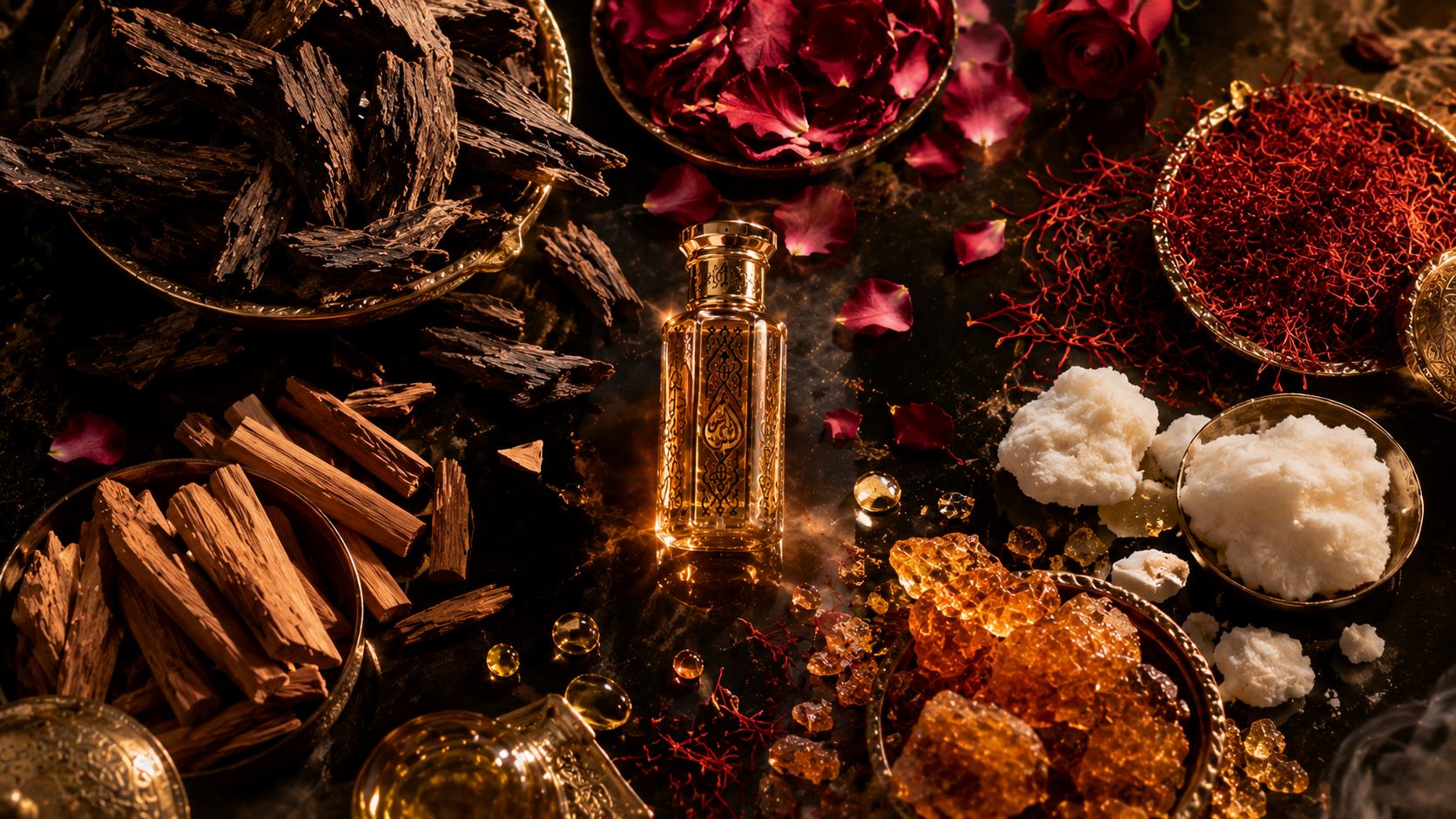
Some fragrances are built around a single idea.
Others are built around an entire world of aromas.
Mukhallat belongs to the second category.
Rich, layered and deeply connected to Middle Eastern fragrance culture, mukhallat refers broadly to a blend or mixture of aromatic materials.
But what makes a mukhallat different from an ordinary perfume?
And why can two mukhallats smell completely different from one another?
Let's explore.
What Does Mukhallat Mean?
The word mukhallat comes from Arabic and broadly refers to something that has been mixed or blended.
In perfumery, it commonly describes a carefully composed mixture of fragrance materials, often in an oil-based format.
A mukhallat may combine materials such as:
- Oud
- Rose
- Musk
- Amber
- Saffron
- Sandalwood
- Spices
- Floral materials
- Resins
- Other aromatic oils
There isn't one fixed recipe.
That's important.
Mukhallat is a style of blending, not a single fragrance formula.
Why Are Mukhallats So Complex?
Imagine smelling rose on its own.
Beautiful.
Now imagine adding oud.
Then a touch of saffron.
Then musk.
Then a warm amber-like accord.
Then a creamy woody element.
Each material changes the way you perceive the others.
This is one of the fundamental ideas behind fragrance blending:
The whole can smell different from the individual parts.
A skilled perfumer can combine materials to create something that feels completely new.
Mukhallat vs Single-Note Attar
A traditional attar may be centred around a particular aromatic theme or material.
For example, a fragrance may strongly emphasise rose, sandalwood or another specific character.
A mukhallat, by contrast, is intentionally built around a blend of multiple aromatic directions.
However, the terminology isn't always used identically by every fragrance house or region.
That means you shouldn't assume that every product labelled "mukhallat" follows one universal formula.
The name describes the concept of blending.
What Can Be Inside a Mukhallat?
Almost anything suitable for the intended fragrance composition can potentially contribute.
A traditional Middle Eastern-inspired blend might include:
Oud
For depth, woodiness and character.
Rose
For floral richness and elegance.
Musk
For softness, warmth and diffusion.
Amber
For warmth, sweetness and resinous depth.
Saffron
For spice, warmth and distinctive character.
Sandalwood
For creamy, smooth woodiness.
The possibilities are enormous.
Why Is Oud Often Used in Mukhallats?
Oud has an extraordinary ability to anchor a composition.
Its deep woody character can provide a foundation for lighter or sweeter materials.
Rose can soften it.
Saffron can sharpen it.
Musk can smooth it.
Amber can add warmth.
This makes oud particularly useful in rich Middle Eastern fragrance compositions.
But oud doesn't have to dominate.
In a well-balanced mukhallat, it may sit underneath the other materials, appearing gradually as the fragrance develops.
Rose & Oud: A Classic Combination
Rose and oud are among the most recognisable combinations in Middle Eastern perfumery.
At first glance, they seem almost opposite.
Rose is floral and delicate.
Oud can be dark, woody and powerful.
But that's precisely what makes the pairing interesting.
The floral brightness of rose can contrast with the depth of oud.
The oud gives the rose weight.
The rose gives the oud lift.
Together, they can create an exceptionally rich fragrance profile.
Sweet Mukhallats
Not every mukhallat is dark and woody.
Some are designed around sweetness.
They may incorporate:
- Vanilla
- Amber
- Tonka-like effects
- Sweet woods
- Fruits
- Florals
- Resins
These blends can feel warm, creamy and inviting.
They're particularly appealing to people who enjoy richer gourmand or amber-style fragrances.
Fresh Mukhallats
Mukhallat doesn't necessarily mean heavy.
A skilled blend can also be fresh and airy.
Citrus, herbs, green notes and lighter florals can be combined with woods or musk to create a fragrance that feels considerably fresher.
This is an important misconception to avoid:
Mukhallat is about blending—not about being heavy.
Why Can Mukhallats Smell Different on Different People?
Like other fragrances, a mukhallat interacts with the surface on which it is applied.
Skin temperature, moisture, natural oils and individual perception can all influence the experience.
The same blend may therefore feel:
- Sweeter on one person
- Woodier on another
- More floral on someone else
- Warmer or softer depending on the environment
That's why sampling a fragrance personally is so valuable.
Why Do Mukhallats Develop Over Time?
A mukhallat can contain many different aromatic materials.
These materials don't necessarily evaporate at the same rate.
Some become noticeable quickly.
Others emerge later.
This creates movement within the composition.
You might initially notice saffron and rose.
Later, the oud becomes more prominent.
Eventually, musk, woods and amber may dominate the drydown.
The fragrance isn't changing randomly.
You're experiencing different aspects of the blend becoming more noticeable.
Mukhallat Is About Balance
The biggest misconception about complex fragrance is that more ingredients automatically mean a better perfume.
They don't.
A blend containing 30 materials isn't necessarily better than one containing 10.
What matters is how those materials work together.
A skilled perfumer considers:
- Balance
- Contrast
- Harmony
- Diffusion
- Texture
- Longevity
- Development
- Overall character
Sometimes the smallest adjustment can completely change the fragrance.
Why Are Mukhallats Often Oil-Based?
Oil is a traditional and highly effective format for presenting concentrated fragrance blends.
It allows the fragrance to be applied directly to the skin without relying on an aerosol spray.
Oil-based fragrances can also create a more intimate wearing experience.
Instead of producing a large cloud immediately, the fragrance can remain closer to the skin while gradually developing.
Of course, performance varies from one formula to another.
There is no universal rule that every oil fragrance must perform in exactly the same way.
How Should You Apply a Mukhallat?
Because many mukhallats are concentrated, a little can go a long way.
Try a small amount on areas such as:
- Wrists
- Inner elbows
- Behind the ears
- Neck
- Collarbone area
Then give the fragrance time to develop.
Don't judge it immediately.
The opening may be very different from the drydown.
And because mukhallats can contain richly coloured oils or ingredients, take care when applying them near light-coloured clothing.
Can You Layer a Mukhallat?
Absolutely—but carefully.
Mukhallats are already blends.
Adding another strong fragrance on top can create an overwhelming result if the compositions clash.
If you want to experiment, start with complementary profiles.
For example:
A soft musk can potentially pair beautifully with a woody fragrance.
A rose-focused blend can complement another floral composition.
A clean fragrance can contrast with a deeper oud.
The key is restraint.
Layering should create harmony, not competition.
Why Every Mukhallat Tells a Different Story
One mukhallat might transport you toward a rose garden.
Another might feel like warm oud wood and saffron.
Another might smell creamy, sweet and musky.
Another might be fresh, green and surprisingly light.
That's because there is no single "mukhallat smell."
There is only the art of combining materials into a cohesive fragrance.
Mukhallat Is More Than Mixing Oils
Anyone can mix fragrance materials together.
Creating a beautiful mukhallat is different.
The goal isn't simply to put many ingredients in the same bottle.
The goal is to create relationship between them.
One material should support another.
One should provide contrast.
Another may add depth.
Another may create lift.
And eventually, all of them should feel like they belong together.
That is the artistry behind a great blend.
The Tradition Continues
Mukhallat represents something special in fragrance culture.
It brings together the richness of materials such as oud, rose, musk, woods, spices and resins and turns them into something personal.
It connects traditional fragrance practices with modern perfumery.
And perhaps most importantly, it reminds us that fragrance doesn't have to be simple.
Sometimes the beauty is in the layers.
At Al Kowthar Fragrances, we believe every great fragrance should give you something new to discover.
A mukhallat doesn't simply give you one smell.
It gives you a composition.
A beginning.
A development.
And a drydown.
The more you smell, the more you discover.