3 October 2026 · 6 min read
Top, Middle & Base Notes Explained: How Perfume Actually Develops
What are top, middle and base notes? Discover how perfume changes on your skin and why the fragrance you smell first isn't the whole story.
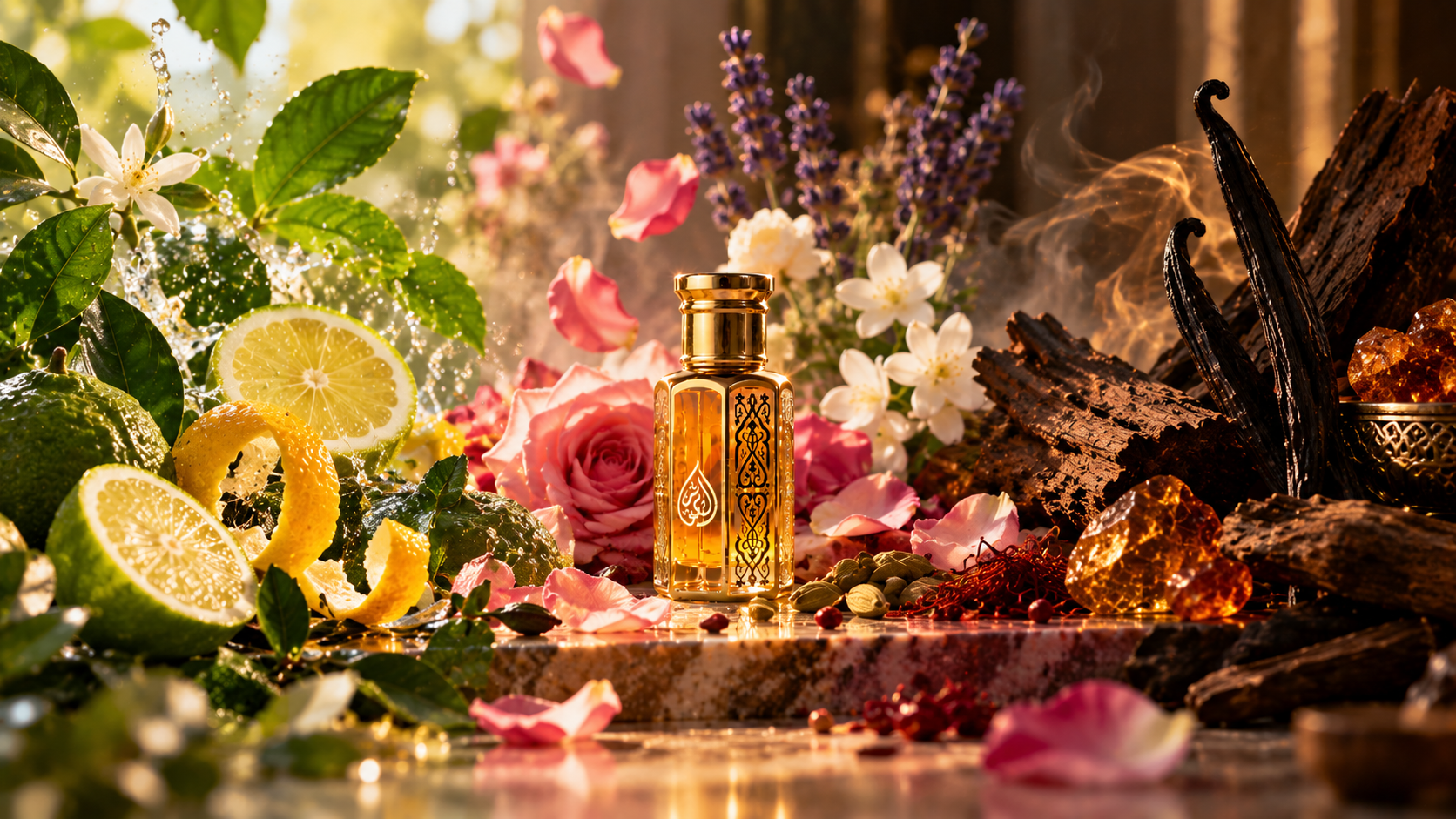
Have you ever smelled a perfume for the first time and thought:
“I'm not sure about this.”
Then 30 minutes later...
You couldn't stop smelling your wrist.
That transformation is one of the most fascinating parts of perfumery.
A fragrance isn't necessarily a single smell that remains identical from the moment you apply it until it disappears.
It develops.
Some materials become noticeable immediately.
Others reveal themselves later.
And some can remain on your skin long after the opening has disappeared.
This is where the famous idea of top notes, middle notes and base notes comes from.
But there's more happening than a simple three-layer pyramid.
What Are Perfume Notes?
When perfumers and fragrance brands talk about "notes," they are describing the smells, ingredients or olfactory impressions that you can perceive within a fragrance.
You might see a perfume described with notes such as:
- Bergamot
- Rose
- Jasmine
- Vanilla
- Oud
- Musk
- Sandalwood
- Amber
But a listed "note" does not always mean the perfume literally contains that exact natural ingredient.
A perfumer can create the impression of a particular smell using several different aromatic materials.
So a perfume note is often better understood as:
What the fragrance is designed to smell like — not necessarily a complete ingredient list.
What Are Top Notes?
Top notes are the aromas you tend to notice first.
They create the perfume's opening impression.
Common top-note effects include:
- Citrus
- Bergamot
- Lemon
- Grapefruit
- Fresh herbs
- Light fruits
- Green notes
- Aromatic notes
Many materials associated with the opening of a fragrance are relatively volatile.
That means they readily enter the air.
This can make them feel extremely bright and noticeable when the fragrance is first applied.
But that same volatility also means many of them don't dominate forever.
The opening begins to change.
And the perfume starts revealing what lies underneath.
Why Do Top Notes Disappear So Quickly?
Perfume works because aromatic molecules enter the surrounding air and eventually reach your nose.
Different fragrance materials have different physical and chemical properties.
Some are more volatile than others.
Highly volatile materials tend to evaporate more readily, which is one reason many fresh and citrus-like effects can appear prominently at the beginning of a fragrance.
As time passes, their contribution becomes less dominant.
Other, less volatile materials become easier to notice.
This gradual change is a major reason perfume develops over time.
What Are Middle Notes?
Middle notes are often called the heart notes.
They become increasingly noticeable as the opening begins to settle.
The heart can contain effects such as:
- Rose
- Jasmine
- Orange blossom
- Lavender
- Spices
- Fruits
- Aromatic materials
- Green notes
The heart often gives a fragrance much of its recognisable character.
Imagine the opening as the introduction to a story.
The middle is where the story begins to reveal what it is really about.
But while we describe perfume in separate stages, these stages don't necessarily switch on and off like lights.
The fragrance is continuously evolving.
Top, middle and base materials can overlap.
What Are Base Notes?
Base notes are associated with the deeper, often longer-lasting part of a fragrance.
Common base-note effects include:
- Woods
- Musk
- Vanilla
- Amber-like materials
- Oud
- Patchouli
- Resins
- Sandalwood
- Tonka-like notes
Many materials used to create these effects are less volatile than bright opening materials.
As the more volatile parts of the perfume become less prominent, the base can become increasingly noticeable.
This later stage is often called the drydown.
And for many fragrance lovers, the drydown is the best part.
What Is the Drydown?
The drydown is the later stage of a perfume's development.
The bright opening has faded.
The heart has evolved.
And the deeper character of the fragrance becomes clearer.
A perfume that initially smelled citrusy might eventually become woody.
A spicy opening might settle into warm vanilla.
A fruity fragrance might reveal musk and amber underneath.
This is why judging a perfume immediately after applying it can be misleading.
You have only met the introduction.
You haven't experienced the entire fragrance yet.
Is the Fragrance Pyramid Literally Three Layers?
Not exactly.
The familiar diagram showing:
TOP
MIDDLE
BASE
is extremely useful for explaining how perfume develops.
But perfume isn't physically sitting inside the bottle in three perfectly separated layers.
Everything is mixed together.
When you apply the fragrance, many aromatic materials begin contributing to the smell simultaneously.
The apparent stages emerge partly because different materials evaporate and are perceived differently over time.
So the fragrance pyramid should be understood as a useful model, not a literal diagram of what is physically happening inside the bottle.
Do Top Notes Always Last Only a Few Minutes?
Be careful with exact rules.
You'll sometimes see charts claiming:
"Top notes last exactly 15 minutes."
"Middle notes last exactly three hours."
"Base notes begin after four hours."
Real perfumery is not that precise.
Different materials behave differently.
Different formulas behave differently.
Temperature changes evaporation.
Application amount matters.
Skin can influence the experience.
And different aroma molecules can have dramatically different persistence.
The top-heart-base structure describes a general progression.
It isn't a stopwatch.
Why Does Perfume Smell Different After 30 Minutes?
Now we can answer the question.
When you first apply perfume, highly volatile materials can dominate your perception.
As the fragrance sits on your skin, its balance changes.
Some materials become less prominent.
Others become easier to perceive.
The fragrance moves towards its heart and eventually its drydown.
That's why a perfume can smell sharp when first applied but become smooth later.
Or fresh at first and creamy afterwards.
Or sweet in the opening but surprisingly woody several hours later.
You're experiencing the evolution of the composition.
Why You Shouldn't Judge Perfume From the Bottle
Smelling directly from the bottle can give you useful information.
But it cannot tell you the entire story.
Even a paper blotter doesn't perfectly reproduce the experience of wearing fragrance on skin.
If you're seriously considering a fragrance:
Apply it.
Wait.
Experience the opening.
Experience the heart.
Then return several hours later and smell the drydown.
A perfume you initially disliked might surprise you.
And a spectacular opening may occasionally develop into a base you don't enjoy.
Give fragrance time to tell its story.
Are Base Notes What Make Perfume Last?
Base materials can contribute significantly to persistence, but fragrance longevity is more complicated than simply adding "base notes."
Longevity depends on factors including:
- The materials used
- Their volatility and substantivity
- Concentration
- The overall formula
- Application amount
- Skin
- Temperature
- Environment
A perfumer cannot simply pour in more vanilla or wood and automatically create a perfect 24-hour fragrance.
Perfumery is about balance.
Do Perfume Oils Have Top, Middle and Base Notes?
Absolutely.
Oil-based fragrance can develop through an opening, heart and drydown just like other fragrance formats.
However, the way you perceive that development may differ.
An alcohol-based spray atomises fragrance across a wide area and can create a rapid burst of volatile material.
Perfume oil is applied more locally to the skin.
That can make the opening feel less explosive and the development more intimate.
But the underlying principle remains:
Different aromatic materials reveal themselves differently over time.
The Next Time You Test a Perfume...
Don't ask only:
“Do I like this?”
Ask:
“What stage am I smelling?”
Give it 20 minutes.
Come back later.
Then smell it again after several hours.
Pay attention to what disappeared.
Notice what appeared.
Notice what remained.
You may begin recognising the architecture behind the fragrance.
And that's when perfume becomes much more interesting.
Perfume Is Designed to Move
At Al Kowthar Fragrances, we believe one of the greatest mistakes people make with perfume is judging it too quickly.
A fragrance isn't always a photograph.
Sometimes it is more like a film.
The opening introduces you.
The heart develops the character.
The drydown leaves the final impression.
Understanding top, middle and base notes helps you stop simply smelling perfume...
and start reading it.