3 October 2026 · 7 min read
Why Does Perfume Last Longer on Clothes Than on Skin?
Why can perfume remain on clothes for days but disappear from skin in hours? Discover how fabric, body heat and evaporation affect fragrance.
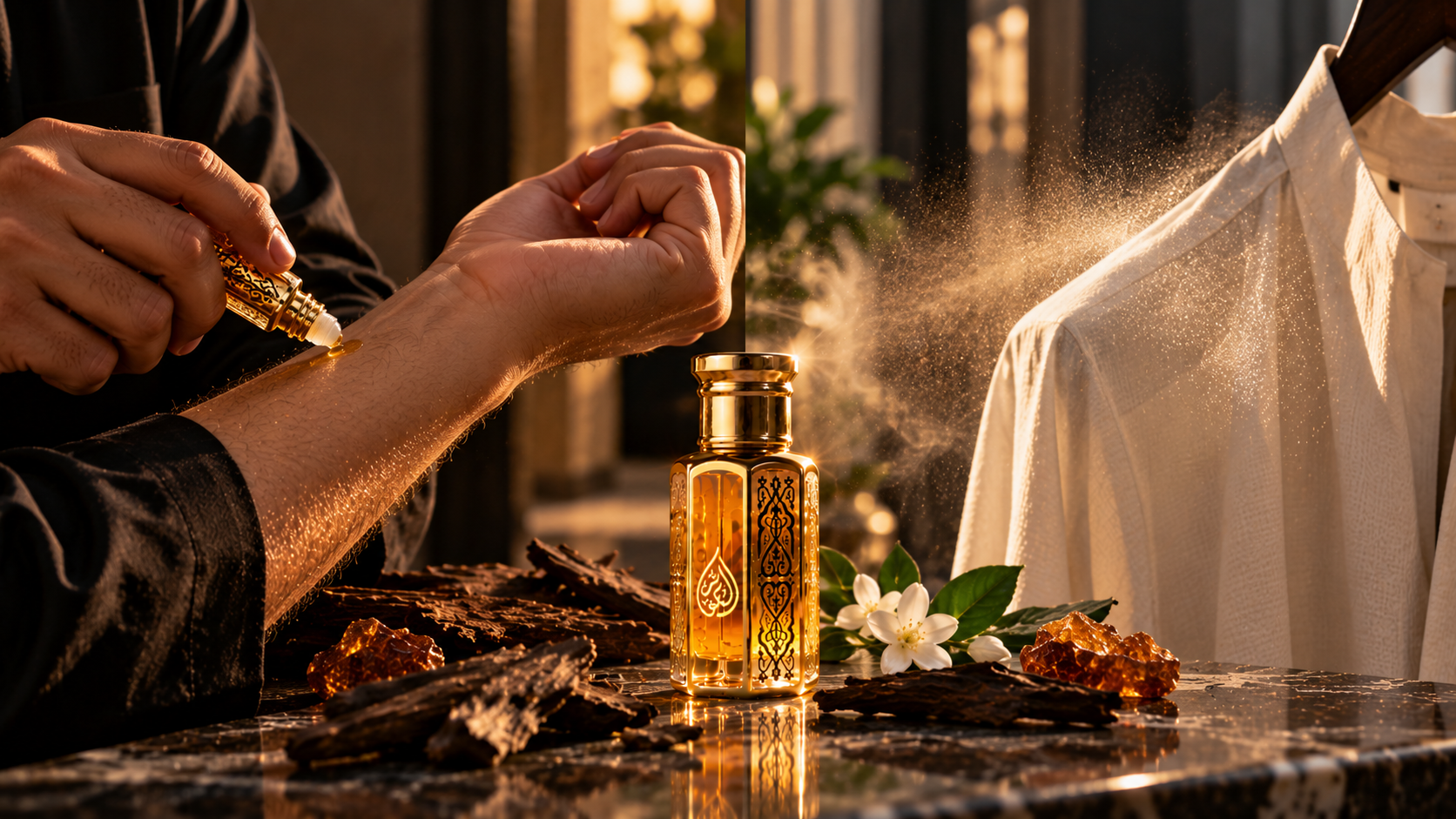
You apply perfume to your skin in the morning.
By evening, you can barely detect it.
Then the next morning, you pick up yesterday's jacket...
And the perfume is still there.
Sometimes it smells so clear that you'd think you had just applied it.
Why?
Why can fragrance disappear from your skin within hours but remain trapped in clothing for a day — or sometimes even longer?
The answer comes down to heat, evaporation, skin and fabric.
Why Does Perfume Often Last Longer on Clothes?
Your skin and your clothing are completely different environments.
Skin is warm.
It produces oils and moisture.
It moves.
It is washed.
It comes into contact with other surfaces.
And its temperature encourages volatile fragrance materials to enter the surrounding air.
Fabric behaves differently.
Fragrance materials can become trapped within or adsorbed onto fibres, where some of them may be released more slowly.
This can allow traces of a fragrance to remain noticeable on clothing long after the same perfume has become difficult to detect on skin.
Your Skin Is Warm
Fragrance depends on volatility.
Aromatic molecules need to enter the air before they can reach your nose.
Temperature influences how readily many volatile materials evaporate.
Your skin is warm.
That warmth can help a fragrance bloom beautifully when you apply it.
It's one reason perfume can seem to come alive on the body.
But there is another side to that.
The same warmth that helps fragrance radiate can also encourage volatile materials to leave the skin.
Your clothing generally doesn't maintain the same warm biological environment.
As a result, fragrance can sometimes evaporate differently from fabric.
Fabric Can Hold Fragrance
Think about the structure of clothing.
Textile fibres provide an enormous surface with which fragrance materials can interact.
Some aromatic compounds can cling to or become retained within those fibres.
Rather than immediately entering the air, portions of the fragrance may remain on the material and be released gradually.
This is why you can sometimes open a wardrobe and immediately recognise yesterday's perfume.
The fragrance has been sitting quietly in the fabric.
Does That Mean Perfume Is Better on Clothes?
Not necessarily.
Longer-lasting does not automatically mean better.
Skin gives fragrance something fabric cannot perfectly reproduce:
a living, warm surface.
The warmth of your body can help fragrance diffuse.
Movement can create little waves of scent.
And a fragrance may develop differently on skin compared with cloth.
Fabric may preserve certain aspects of the fragrance for longer, but that doesn't necessarily mean it presents the perfume exactly as the perfumer intended.
Think of them as two different experiences.
Does Perfume Smell Different on Clothes?
It can.
When perfume is applied to skin, it encounters:
- Body heat
- Skin oils
- Moisture
- Your individual skin environment
Fabric provides a different surface.
The balance of evaporation and retention can therefore differ.
You may notice that a fragrance smells brighter on skin at first but remains more linear on clothing.
Or you may discover that certain base materials remain on a jumper long after the opening has disappeared.
That's part of what makes fragrance so interesting.
Why Does Perfume Sometimes Last for Days on a Jacket?
Some fragrance materials are extremely persistent.
Certain musks, woods, amber materials and other substantive aroma molecules can remain detectable for surprisingly long periods.
When these materials become retained by fabric, you may still smell them days later.
But what remains isn't necessarily the complete fragrance you originally applied.
The highly volatile opening may already be gone.
What you're smelling days later may primarily be the perfume's more persistent materials.
In other words:
You're smelling the survivors.
Should You Apply Perfume to Both Skin and Clothes?
Some people enjoy doing exactly that.
Applying fragrance to skin can provide warmth and development.
Applying an appropriate fragrance to clothing may help certain aspects remain detectable for longer.
But there is an important warning.
Not every fragrance should be sprayed or applied directly onto every fabric.
Some fragrance materials, colourants or oils can mark clothing.
This is particularly important with perfume oils.
Be Careful With Perfume Oil on Clothing
Perfume oil is exactly what the name suggests:
an oil-based fragrance format.
Applying oil directly to fabric can potentially leave a visible mark, particularly on:
- White clothing
- Light-coloured clothing
- Silk
- Delicate fabrics
- Certain absorbent materials
So don't assume that because fragrance lasts well on clothes, you should roll perfume oil directly across your favourite white shirt.
If you choose to apply an oil fragrance to fabric, test it first on a small, hidden area.
For valuable or delicate clothing, applying the oil to your skin instead is the safer approach.
What About Spray Perfume?
Sprays can also mark certain materials.
A clear alcohol-based fragrance may seem harmless, but formulations vary.
Some perfumes contain coloured materials.
Some natural extracts can be deeply coloured.
And delicate textiles can react differently to fragrance formulations.
If you're wearing expensive or sensitive fabric, caution is always sensible.
Does Perfume Last Longer on Dry or Moisturised Skin?
Skin condition can also affect fragrance performance.
People with particularly dry skin sometimes find that fragrance seems to disappear relatively quickly.
Applying an unscented moisturiser before fragrance may help some people achieve better performance.
Allow the moisturiser to settle and then apply your perfume normally.
The important word is unscented.
Otherwise your moisturiser may compete with the perfume you're trying to enjoy.
Why Does Perfume Project Better From Skin?
It doesn't universally project better, but warm skin can encourage fragrance materials to volatilise.
That's important because there is a trade-off in fragrance:
For you to smell a perfume, aromatic molecules need to leave the surface and enter the air.
If absolutely nothing evaporated, you wouldn't smell much.
So some evaporation is essential.
This gives us an important principle:
Longevity and projection are not the same thing.
Something can hold fragrance for a long time without projecting enormously.
Another surface may encourage rapid diffusion but lose some materials sooner.
Clothes vs Skin: Which Is Better for Projection?
There isn't one universal winner.
Skin temperature can help fragrance bloom.
Clothing can create a large scented surface and move through the air as you walk.
A scented jacket or scarf can therefore create noticeable fragrance movement.
But the result depends on:
- The fragrance
- The material
- Application amount
- Temperature
- Your movement
- The specific aromatic ingredients
Rather than searching for one perfect rule, experiment responsibly.
What About Your Hair?
Hair can also retain fragrance.
But repeatedly spraying conventional perfume directly onto hair isn't necessarily ideal, particularly if the formula contains a significant amount of alcohol and your hair is prone to dryness.
Products designed specifically for hair fragrance exist for this reason.
And with perfume oil, applying it directly throughout the hair can make it look greasy.
So again:
More fragrance doesn't automatically mean better fragrance.
Why Doesn't Perfume Last as Long on My Skin as Someone Else's?
Two people can wear the same perfume and perceive its performance differently.
Factors can include:
- Skin condition
- Application amount
- Body temperature
- Environment
- Climate
- Where the fragrance was applied
- Individual perception
- Olfactory adaptation
This is why fragrance performance isn't perfectly predictable from another person's review.
Someone saying:
“This lasts 12 hours on me.”
doesn't guarantee that you will experience exactly the same thing.
Is Perfume on Clothes a Good Way to Test Longevity?
Not if you're trying to determine how long it lasts on skin.
A fragrance surviving overnight on a jacket does not mean it has 24-hour skin longevity.
Those are different surfaces.
When reviewing a fragrance, it is useful to specify:
“I could still smell it on clothing the next morning.”
rather than simply saying:
“It lasted 24 hours.”
That distinction makes fragrance testing far more meaningful.
So Where Should You Apply Your Perfume?
If you're using perfume oil, skin is usually the most natural place to begin.
Common application areas include:
- Wrists
- Neck
- Behind the ears
- Inner elbows
- Collarbone area
You can then observe how the fragrance develops and performs.
For sprays, some people enjoy combining skin and clothing application, provided the fabric is suitable.
There isn't one perfect method for everyone.
The Simple Answer
So why does perfume often last longer on clothes?
Because fabric and skin treat fragrance differently.
Your warm skin encourages aromatic materials to enter the air.
Fabric fibres can retain some fragrance materials and release them more gradually.
That's why yesterday's jumper can sometimes smell stronger than today's wrist.
But remember:
Lasting longer doesn't automatically mean smelling better.
Skin gives fragrance warmth, movement and development.
Clothing can provide persistence.
Both can create beautiful fragrance experiences.
Understanding Where Your Fragrance Goes
At Al Kowthar Fragrances, we believe perfume becomes much more interesting when you understand what happens after you apply it.
Fragrance doesn't simply "stay" or "disappear."
It evaporates.
It diffuses.
It interacts with surfaces.
Some materials leave quickly.
Others remain.
And sometimes your clothing quietly holds onto the final chapter of a fragrance long after your skin has let it go.