1 October 2026 · 6 min read
Perfume Oil vs Attar: Are They Actually the Same Thing?
Is attar the same as perfume oil? Discover the differences between traditional attar, modern perfume oils and alcohol-based fragrance.
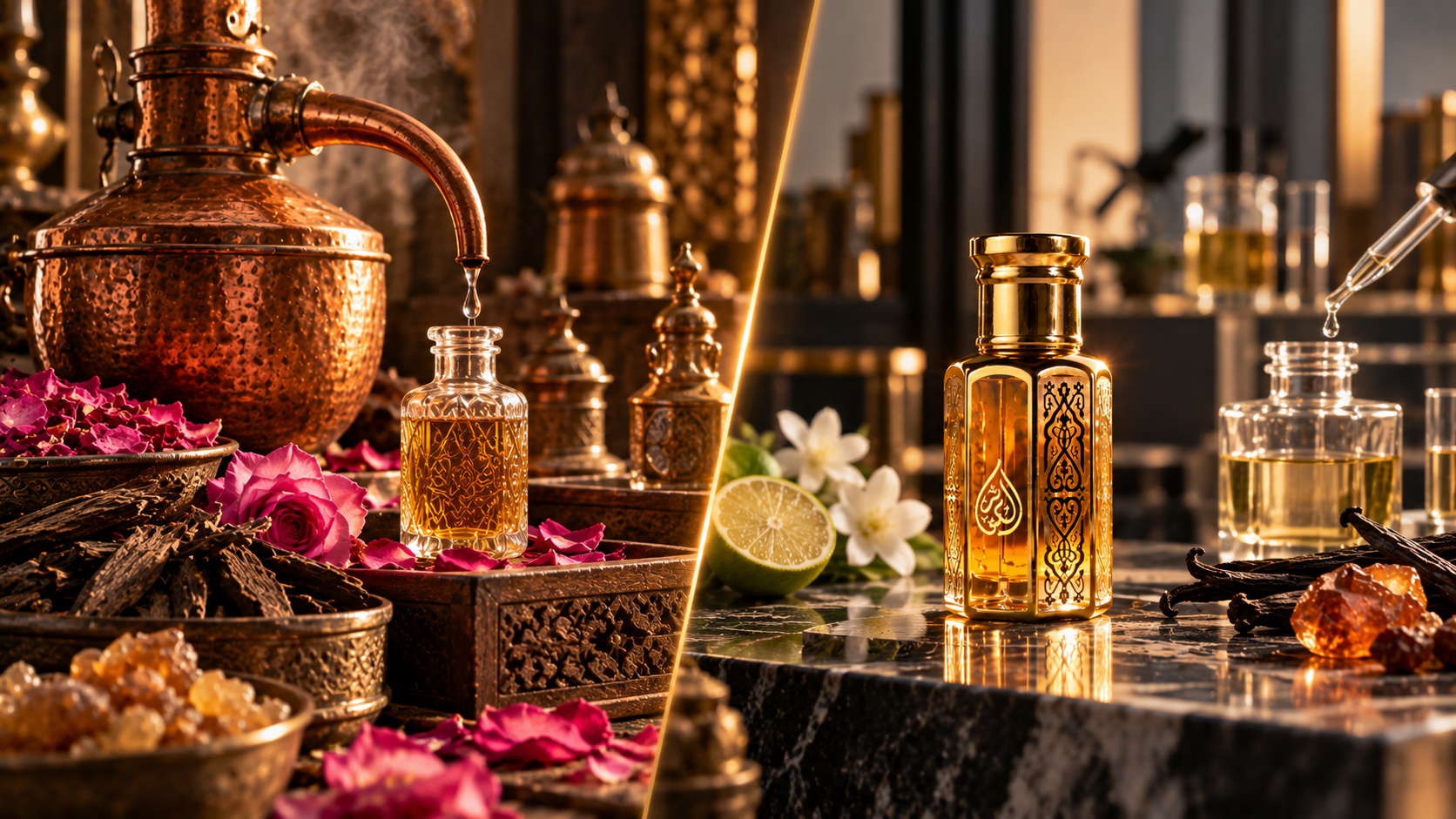
Attar.
Ittar.
Perfume oil.
Fragrance oil.
These words are often used as though they all mean exactly the same thing.
Walk into one fragrance shop and an "attar" might be a traditional botanical fragrance.
Walk into another and the same word may simply describe any concentrated roll-on perfume oil.
So who's right?
The answer is more interesting than it first appears.
Traditional attar and modern perfume oil can overlap — but they are not automatically the same thing.
Let's break down the difference.
What Is Attar?
The words attar and ittar are commonly associated with traditional perfumery, particularly across South Asia and the Middle East.
Historically, attars have been produced using aromatic natural materials such as:
- Flowers
- Woods
- Herbs
- Spices
- Roots
- Resins
Traditional methods can involve distilling aromatic materials and capturing their fragrant components in an oil base, historically often associated with sandalwood oil.
This creates something quite different from simply taking a modern fragrance concentrate and diluting it into a carrier.
Traditional attar is therefore not merely a concentration level.
It can describe an entire tradition and method of perfumery.
What Is Perfume Oil?
Perfume oil is a much broader term.
Generally, it describes a fragrance presented in an oil-based format rather than the familiar alcohol-based spray format.
Modern perfume oils can contain:
- Natural aromatic materials
- Synthetic aroma molecules
- Fragrance compounds
- Carrier materials
- Or combinations of these
The finished perfume is then applied directly rather than being atomised through a conventional spray.
This means a modern perfume oil could smell like almost anything.
Fresh citrus.
Vanilla.
Coffee.
Rose.
Musk.
Oud.
Fruits.
Marine notes.
Modern woods.
Or a fragrance inspired by contemporary fine perfumery.
Perfume oil describes the format more than it describes one traditional manufacturing method.
So Is Attar a Perfume Oil?
This is where things become confusing.
In everyday modern fragrance language, attar is often used as another name for perfume oil, particularly for concentrated oil fragrances sold in small bottles.
But historically and technically, traditional attar can refer to something more specific.
A useful way to think about it is:
Traditional attar can be a type of oil-based fragrance.
But:
Not every modern perfume oil is necessarily a traditionally produced attar.
That distinction matters.
Why Are the Terms Used Interchangeably?
Language changes.
Fragrance terminology also changes depending on country, culture and marketplace.
In some communities, asking for an "attar" simply means:
“I want an oil perfume rather than a spray.”
The customer may not be asking how it was distilled, what carrier was used or whether the fragrance contains modern aroma molecules.
They are describing the style of product they recognise.
As perfume oils became more widely available internationally, the words attar, ittar and perfume oil increasingly overlapped in everyday retail language.
That doesn't erase the history of traditional attar.
It simply means you need to understand the context in which the word is being used.
What Is Traditional Attar Made From?
Traditional attar production can involve botanical materials such as flowers, herbs, spices or woods.
The aromatic material is distilled, and the fragrant distillate can be absorbed into an oil base.
Sandalwood has historically been especially important because of its own aroma and its usefulness as a base material.
Different raw materials can produce dramatically different attars.
Rose attar will not smell like oud.
Vetiver will not smell like jasmine.
And traditional attar itself is an enormous world rather than one particular smell.
Are All Attars Natural?
You should be careful with this assumption.
A bottle being marketed today as attar does not automatically prove that it was produced entirely from natural botanical materials using a traditional distillation process.
Modern fragrance markets use terminology very broadly.
Some products labelled attar may use modern fragrance compounds or synthetic aroma materials.
Others may follow more traditional methods.
So if natural composition or traditional production matters to you, don't rely on the word attar alone.
Look at how the manufacturer describes the product.
Are Perfume Oils Natural?
Again, not necessarily.
Oil-based does not mean natural.
This is one of the biggest misconceptions surrounding perfume oils.
Modern perfume oils can contain natural extracts, synthetic aroma molecules or combinations of both.
And synthetic does not automatically mean cheap or inferior.
Modern perfumery depends heavily on aroma chemistry.
Synthetic materials can give perfumers access to scents, textures and effects that may be difficult, extremely expensive, environmentally problematic or impossible to obtain directly from nature.
The real question shouldn't simply be:
“Is it synthetic?”
A better question is:
“How well has the fragrance been created?”
What About Oud and Musk?
Attar is strongly associated with materials such as oud, musk, rose, amber and sandalwood.
That association comes partly from the fragrance cultures in which oil perfumery developed and flourished.
But perfume oil itself is not limited to those scent profiles.
A modern perfume oil can smell like:
- Pineapple
- Bergamot
- Coffee
- Vanilla
- Chocolate
- Marine air
- White flowers
- Leather
- Tobacco
- Fruits
- Modern amber
- Clean musk
Or practically any other direction a perfumer can construct.
Oil is a format — not a fragrance family.
Attar vs Spray Perfume
Another common misconception is that attar and perfume are opposites.
Attar is perfume.
The distinction people are normally trying to make is between an oil-based fragrance and an alcohol-based spray fragrance.
Sprays atomise fragrance into tiny droplets across a relatively large area.
That can create rapid diffusion and noticeable projection.
Oil fragrances are normally applied directly to specific areas of skin.
This often creates a more concentrated, intimate experience around the application point.
Neither approach is automatically superior.
They behave differently.
Does Attar Last Longer Than Perfume?
Sometimes.
But there is no universal rule saying every attar lasts longer than every spray.
Longevity depends heavily on the actual fragrance composition.
A rich woody, resinous or musky oil may remain detectable for a very long time.
A delicate oil dominated by highly volatile materials may fade sooner.
Likewise, some modern spray perfumes contain extremely persistent aroma molecules capable of remaining detectable for many hours.
So when comparing performance, don't look only at whether something is an oil or a spray.
Look at the composition itself.
Does Attar Project?
Yes, oil fragrance can project.
But projection can behave differently from an atomised spray.
A spray distributes fragrance across a wide surface area and releases material into the surrounding air immediately.
An oil remains concentrated around the areas where it has been applied.
This can produce a fragrance experience that feels closer and more intimate.
That is part of the beauty of perfume oils.
They don't always need to shout.
Sometimes the fragrance waits for someone to come closer.
Why Modern Perfume Oils Are So Interesting
Modern perfume oil sits at an interesting meeting point between old and new perfumery.
The method of applying fragrance directly to the skin connects us with a very old human relationship with aromatic oils.
But modern fragrance chemistry gives perfumers access to an enormous palette of materials and possibilities.
A modern oil fragrance can therefore combine:
an ancient style of wearing fragrance with modern perfumery.
That is part of what makes the format so fascinating.
Which Should You Choose?
You don't necessarily have to choose between "attar" and "perfume oil."
First understand what the seller means by those words.
If you're looking for a specifically traditional attar, ask:
- How was it produced?
- What materials were used?
- What is the oil base?
- Is it traditionally distilled?
- Does it contain modern fragrance compounds?
If you're simply looking for a beautiful oil-based fragrance, focus on:
- The scent
- The quality
- The performance
- The composition
- How it develops on your skin
Terminology matters.
But ultimately, the fragrance inside the bottle matters more.
Perfume Is Both Tradition and Science
At Al Kowthar Fragrances, our love for perfume oils comes from exactly this intersection.
Oil perfumery carries an extraordinary fragrance heritage.
At the same time, modern perfumery gives us an incredible world of aroma molecules, ingredients and scent possibilities.
Understanding both worlds allows us to appreciate perfume more deeply.
Because fragrance isn't simply about smelling good.
It is chemistry.
History.
Culture.
Craftsmanship.
Memory.
And sometimes, all of that can fit inside a tiny bottle of oil.