5 November 2026 · 11 min read
How Do Scientists Prove Where a Perfume Ingredient Really Comes From?
Is your oud, rose or sandalwood genuine? Discover how scientists investigate fragrance authenticity using chemistry, DNA and isotope analysis.
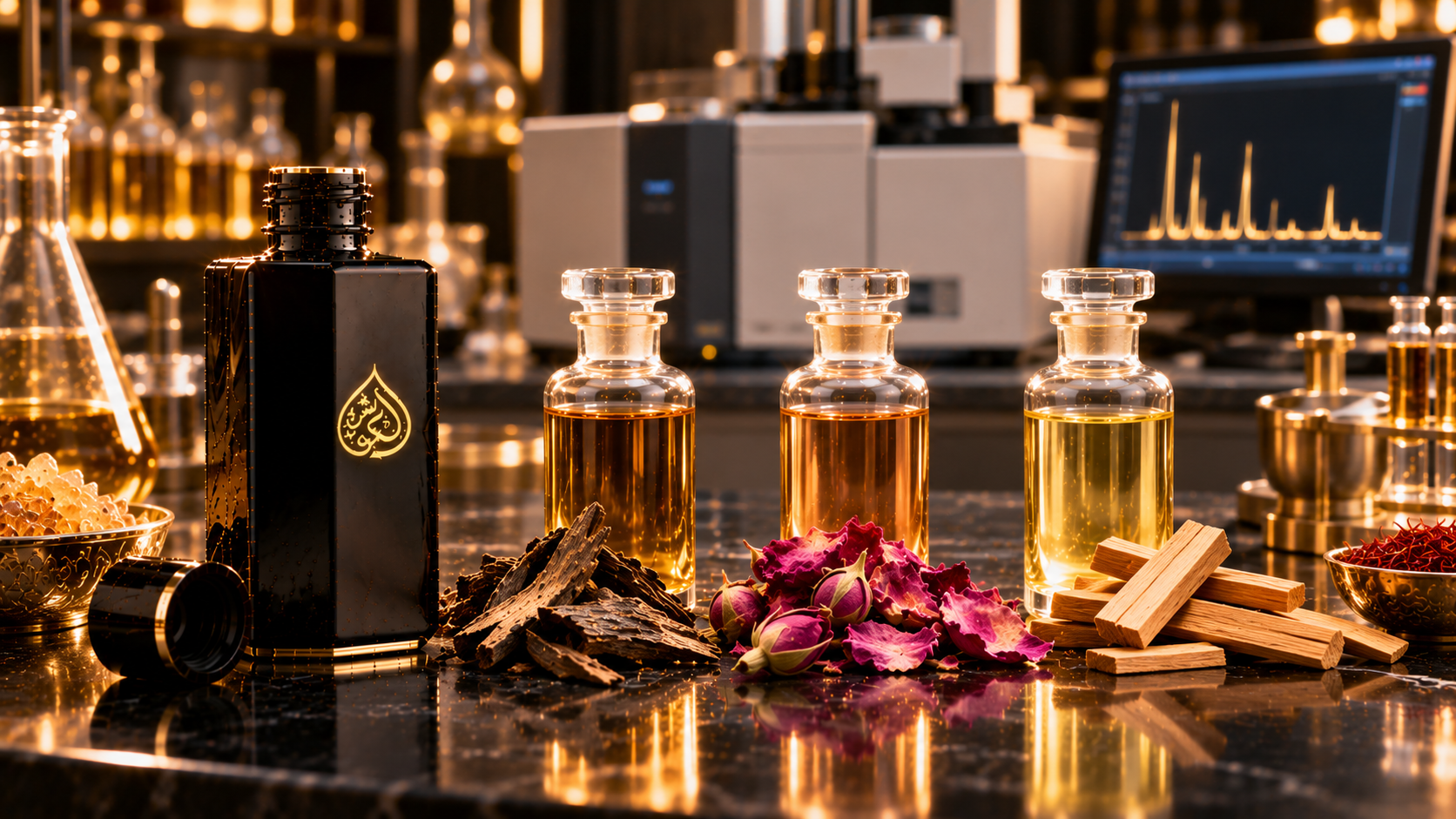
How Do Scientists Prove Where a Perfume Ingredient Really Comes From?
Imagine purchasing a tiny bottle of rose essential oil.
The supplier claims it was produced from roses grown in Bulgaria.
The price is high.
The aroma is beautiful.
And the accompanying documentation describes it as a premium natural ingredient.
But here's an interesting question.
How can anyone actually prove that the oil came from Bulgarian roses?
What if the oil was diluted with cheaper materials?
What if some of its aromatic compounds were manufactured synthetically?
Or what if the ingredient came from a completely different botanical source?
These questions are particularly important in the world of luxury perfumery, where natural ingredients such as oud, rose and sandalwood can command substantial prices.
Fortunately, scientists have developed sophisticated techniques for investigating the chemical composition and authenticity of fragrance materials.
But there's an important limitation.
No single laboratory test can prove every claim about an ingredient's origin.
Understanding what these tests can and cannot reveal provides a fascinating insight into the science behind perfume quality.
1. Why Does Ingredient Authenticity Matter?
Natural aromatic ingredients are often valued for their botanical origin, production method and distinctive chemical composition.
For example, a rose oil may be marketed according to the species of rose and the region where it was produced.
Sandalwood oils may be distinguished by botanical species.
Oud may be described according to the wood's origin, processing method or aromatic character.
These distinctions can influence price.
They may also influence consumer expectations.
However, expensive natural ingredients create opportunities for adulteration.
Adulteration occurs when a material is deliberately altered or substituted in a way that misrepresents its identity or composition.
For example, an expensive essential oil might be diluted with a cheaper oil or blended with additional aroma chemicals without appropriate disclosure.
The resulting material might still smell pleasant.
But it would not necessarily match the description under which it was sold.
2. Can You Identify a Genuine Ingredient Just by Smelling It?
Experienced perfumers can sometimes recognise characteristic differences between aromatic materials.
They may notice unusual sweetness, missing woody nuances or an unexpected chemical character.
Sensory evaluation can therefore provide useful clues.
However, smell alone cannot reliably prove botanical origin or purity.
A sophisticated blend of aromatic compounds may imitate the general odour profile of a natural material.
And genuine natural ingredients can vary considerably because of differences in growing conditions, harvesting, extraction and storage.
This means an unusual smell doesn't automatically prove adulteration.
Likewise, a convincing smell doesn't prove authenticity.
Professional authentication often requires analytical testing alongside reliable documentation.
3. What Is a Chemical Fingerprint?
Every natural aromatic extract contains a mixture of chemical compounds.
The proportions of these compounds can create a characteristic analytical profile.
Scientists sometimes refer to this as a chemical fingerprint.
Imagine examining an essential oil containing dozens of measurable substances.
Some compounds may occur in relatively high concentrations.
Others may appear only in trace amounts.
The overall pattern can provide useful information about the material.
Scientists can compare this pattern with authenticated reference samples.
If the composition differs substantially from what is expected, the result may raise questions about the material's identity, quality or possible adulteration.
However, natural variation must be considered.
Two genuine oils from the same plant species may not have identical chemical fingerprints.
4. How Does Gas Chromatography Work?
One of the most widely used analytical techniques in fragrance chemistry is gas chromatography, often abbreviated to GC.
Gas chromatography separates suitable volatile compounds within a mixture.
Imagine injecting a tiny amount of essential oil into a laboratory instrument.
The sample is vaporised under controlled conditions and carried through a specialised column.
Different compounds interact with the column differently.
As a result, they travel through it at different rates.
The instrument produces a chromatogram showing signals associated with compounds emerging from the column.
The position and size of these signals can provide useful analytical information.
A complex essential oil may produce numerous peaks.
Together, these peaks help describe its chemical composition.
But gas chromatography alone doesn't automatically reveal the identity of every compound.
For that, laboratories often combine it with another technique.
5. What Is GC-MS?
Gas chromatography–mass spectrometry, or GC-MS, combines two powerful analytical methods.
First, gas chromatography separates compounds within the sample.
Then mass spectrometry provides information that helps identify those compounds.
The instrument measures characteristics of ions produced from the analysed substances.
Scientists compare the resulting mass spectra and retention information with reference data.
This can help identify many volatile fragrance compounds.
For example, GC-MS may reveal whether a rose oil contains an expected range of aromatic constituents.
It may also detect certain unexpected compounds.
However, GC-MS has limitations.
Some compounds are difficult to distinguish using routine methods.
Certain substances may occur at concentrations below the method's detection limit.
And some forms of adulteration can be difficult to identify without specialised testing.
GC-MS is a powerful analytical tool, but it is not a universal authenticity detector.
6. How Do Scientists Investigate Rose Oil Authenticity?
Rose essential oil is an excellent example.
Natural rose oils contain complex mixtures of aromatic compounds.
Their composition depends on factors including botanical species, production method and growing conditions.
Laboratories may investigate the relative proportions of characteristic constituents.
They may also look for unexpected materials or unusual compositional patterns.
For example, an oil marketed as a particular type of rose essential oil may be compared with relevant standards and authenticated reference samples.
If its chemical profile is inconsistent with the claimed identity, further investigation may be necessary.
However, proving that a rose oil came from one specific country is more difficult than identifying its broad chemical composition.
Geographical origin claims often require additional evidence.
7. What Is Isotope-Ratio Analysis?
This is where fragrance authentication becomes particularly fascinating.
Atoms of the same chemical element can exist in different isotopic forms.
These forms have the same number of protons but different numbers of neutrons.
For example, carbon occurs naturally as different isotopes.
The relative abundance of stable isotopes in a material can be influenced by its biological and environmental history.
Scientists can measure certain isotope ratios using specialised instruments.
These measurements may provide information about how a material was produced or where it originated.
For example, isotope-ratio analysis can sometimes help distinguish materials derived from different production pathways.
In some circumstances, it can also contribute to geographical-origin investigations.
However, isotope ratios are not unique postal addresses.
Different regions may produce overlapping results.
And environmental conditions can vary from year to year.
Therefore, geographical authentication generally requires appropriate reference datasets and careful statistical interpretation.
8. Can Scientists Tell Whether an Ingredient Is Natural or Synthetic?
Sometimes, but the answer depends on the ingredient and the analytical methods available.
A molecule produced naturally and the same molecule produced synthetically have the same chemical identity.
For example, if both sources produce the same stereochemical form of a particular aromatic compound, its molecular structure is identical.
Ordinary GC-MS analysis may not distinguish the molecule's origin.
However, certain manufacturing pathways can leave detectable differences in isotopic composition or impurity profiles.
Specialised analytical techniques may therefore help investigate whether a material is consistent with a claimed natural origin.
But this isn't always straightforward.
Some synthetic materials may have analytical characteristics that overlap with naturally derived materials.
And not every origin claim can be resolved conclusively.
The correct scientific approach is to interpret several forms of evidence rather than assume that one instrument can provide a definitive answer.
9. Can DNA Testing Identify Perfume Ingredients?
DNA analysis can sometimes help identify the botanical source of plant materials.
For example, DNA testing may be useful when examining certain raw plant materials or minimally processed botanical products.
But essential oils present a major challenge.
Essential oils are generally produced through processes that separate volatile aromatic compounds from much of the original plant material.
As a result, they may contain little or no usable plant DNA.
Highly processed extracts can therefore be unsuitable for routine DNA identification.
This means DNA testing is not a universal solution for authenticating perfume oils.
For many essential oils, chemical analysis and supply-chain documentation are more practical.
10. How Do Scientists Authenticate Sandalwood?
Sandalwood is particularly interesting because different botanical species can produce oils with different chemical compositions.
Some sandalwood oils are valued for their characteristic santalol content.
However, products marketed as sandalwood may come from different species or contain blends.
Laboratories can analyse characteristic chemical constituents to investigate whether a sample is consistent with its claimed identity.
For example, the proportions of certain sesquiterpene alcohols may provide useful information.
But interpretation requires appropriate reference data.
A chemical profile may support the identification of a particular type of sandalwood oil without necessarily proving its exact geographical origin.
And a product containing genuine sandalwood oil may still be diluted or blended.
Therefore, authentication must consider the precise claim being tested.
11. Why Is Oud Especially Difficult to Authenticate?
Oud presents a particularly complex challenge.
Natural agarwood develops through biological processes involving certain trees, including species within the genus Aquilaria.
The resulting resinous wood can vary enormously.
Its chemical composition may be influenced by tree species, formation conditions, harvesting, extraction and processing.
Different oud oils can therefore have very different aromatic and analytical profiles.
Some contain characteristic groups of sesquiterpenes and other compounds.
However, there is no single universal chemical fingerprint that describes every genuine oud oil.
This creates challenges for authentication.
A laboratory may investigate whether a sample contains compounds consistent with particular types of agarwood oil.
It may also identify unexpected ingredients or evidence of dilution.
But proving that an oud oil came from a particular forest, tree or country can be much more difficult.
A convincing oud aroma is not proof of botanical origin, and a chemical analysis alone may not establish every aspect of an oud supplier's story.
12. What Is Adulteration?
Adulteration can take several forms.
An expensive essential oil may be diluted with a cheaper carrier.
A natural extract may be blended with isolated aromatic compounds.
A product may be substituted with oil from another botanical species.
Or the stated geographical origin may be inaccurate.
Importantly, not every blend is fraudulent.
Many legitimate fragrance products intentionally combine natural and synthetic aromatic materials.
The issue is whether the product is represented accurately.
A fragrance described as a blend should be evaluated according to that description.
A material sold as pure essential oil from a specific botanical source should meet the corresponding claims.
Transparency is therefore essential.
13. Can Laboratories Detect Every Form of Adulteration?
No.
This is an important limitation.
Some adulterants are relatively easy to detect.
Others are chemically similar to the authentic material.
A sophisticated adulteration may involve carefully adjusting the mixture to resemble expected analytical characteristics.
In such cases, routine testing may not be sufficient.
More specialised methods may be required.
These can include advanced chromatographic techniques, chiral analysis, isotope-ratio measurements or other targeted investigations.
Even then, conclusions depend on the quality of the reference data and the precise question being asked.
A laboratory report is only as meaningful as the methods used and the claims it actually supports.
14. What Documents Help Establish Ingredient Authenticity?
Laboratory analysis is only one part of ingredient verification.
Reliable supply-chain documentation is also important.
Depending on the ingredient and commercial context, useful records may include:
- Botanical name and plant part used.
- Country or region of origin.
- Extraction or production method.
- Supplier and batch identification.
- Certificate of Analysis.
- Relevant specifications and analytical reports.
- Traceability records.
- Appropriate regulatory or sustainability documentation.
A Certificate of Analysis can provide useful batch-specific information.
However, it does not automatically prove every marketing claim.
The value of a certificate depends on what was tested, how it was tested and whether the information is reliable.
Likewise, a supplier's declaration of origin is not the same thing as independent scientific verification.
For valuable natural materials, combining documentation with appropriate testing can provide stronger evidence.
15. What About Sustainability and Legal Sourcing?
Authenticity is not the same as sustainability.
An ingredient may be botanically genuine while still raising concerns about harvesting practices or legal sourcing.
This is particularly relevant to certain natural fragrance materials derived from threatened or regulated plant species.
For example, international trade in relevant agarwood-producing species may be subject to CITES controls.
Depending on the species, product and trade circumstances, appropriate documentation may be required.
A chemical analysis cannot replace legal supply-chain records.
Nor can a pleasant aroma demonstrate that a material was harvested responsibly.
This is why responsible ingredient sourcing involves more than identifying aromatic compounds.
16. Why Does This Matter to Perfume Customers?
The next time you see a fragrance ingredient described as rare, natural or sourced from a particular region, consider what that claim actually means.
Is it referring to botanical species?
Geographical origin?
Extraction method?
Purity?
Or simply the aromatic style of the material?
These are different claims.
And they require different forms of evidence.
For example, a perfume described as having a Bulgarian rose character may contain an accord inspired by that aroma.
That is not the same claim as saying it contains genuine Bulgarian rose essential oil.
Likewise, a fragrance with a rich Cambodian-style oud character is not necessarily made with oud oil physically sourced from Cambodia.
Understanding these distinctions helps customers interpret fragrance descriptions more accurately.
It also highlights the importance of transparent marketing.
The Bottom Line
How do scientists prove where perfume ingredients really come from?
They investigate the evidence.
Chemical fingerprinting can help characterise aromatic materials.
GC-MS can identify many compounds within a fragrance sample.
Isotope-ratio analysis may provide additional information about production pathways or geographical origin.
DNA testing can sometimes assist with botanical identification, although it has important limitations for highly processed essential oils.
And supply-chain records help establish information that chemistry alone cannot prove.
At Al Kowthar Fragrances, we believe that understanding ingredient authenticity is an important part of fragrance education.
The world of natural perfumery is fascinating precisely because aromatic materials are so chemically complex.
A single drop of rose oil, sandalwood oil or oud may contain a remarkable mixture of compounds.
But understanding where those materials came from requires more than appreciating their beautiful aromas.
The nose can tell us what an ingredient smells like. Science and reliable documentation help us investigate what it really is.
"Explore Al Kowthar Fragrances" (https://alkowtharfragrance.com/shop)