7 November 2026 · 10 min read
How Do Perfumers Recreate Smells That Cannot Be Extracted?
How do perfumers recreate leather, old books and cold stone? Discover the fascinating science and artistry behind unusual fragrance accords.
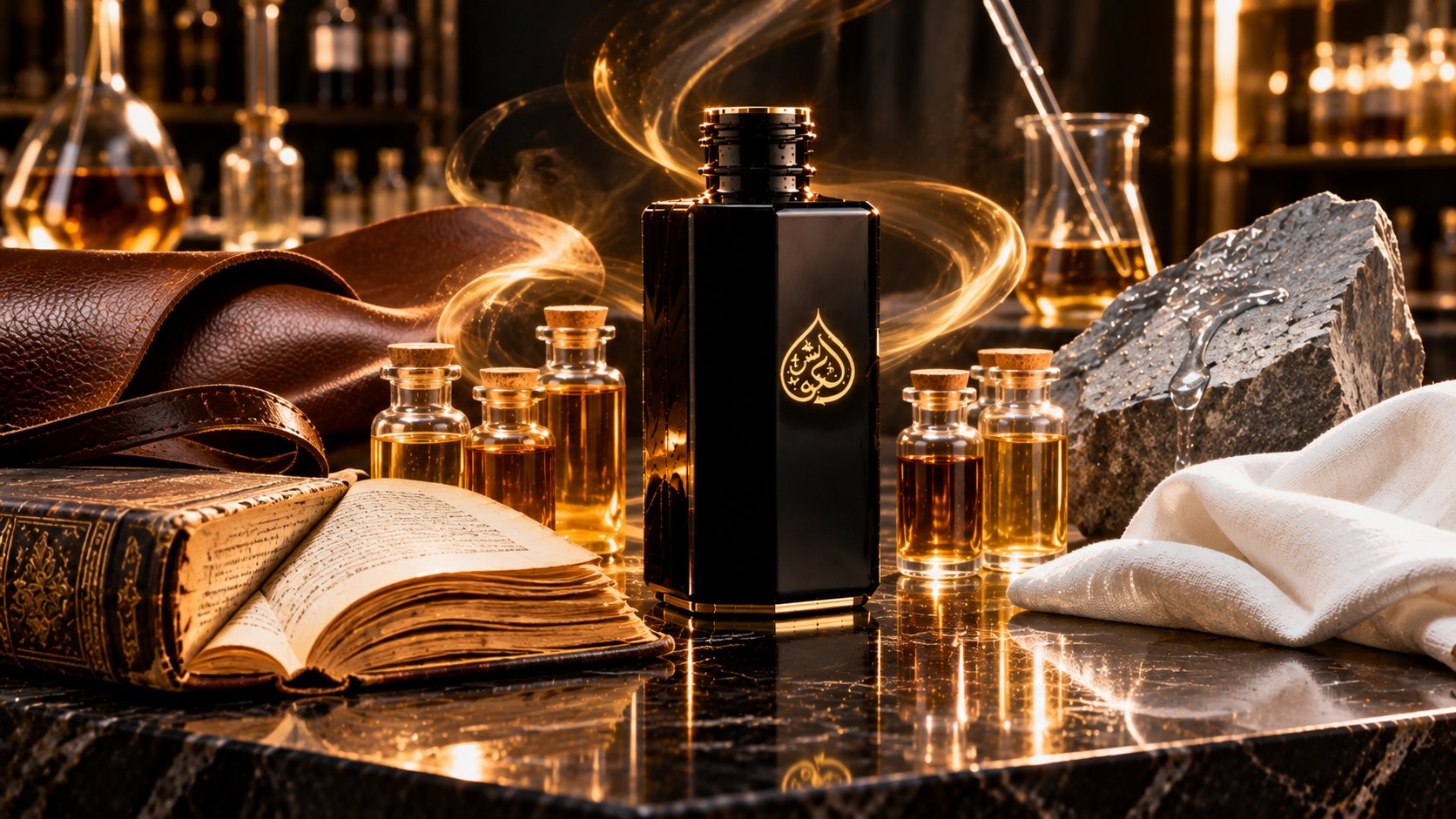
How Do Perfumers Recreate Smells That Cannot Be Extracted?
Imagine walking into an old library.
The shelves are filled with leather-bound books.
The air carries a distinctive aroma of aged paper, wood and dust.
Now imagine a perfumer trying to capture that exact atmosphere inside a bottle.
How would they do it?
They cannot simply place an old book into a distillation apparatus and expect to produce a beautiful essential oil.
The same problem arises with countless other smells.
Fresh leather.
Cold stone.
Newly printed paper.
Warm pavement.
A clean cotton shirt.
Even the atmosphere of an old wooden building.
How do perfumers recreate smells that cannot simply be extracted from their source?
The answer reveals one of the most creative areas of modern fragrance development.
It involves aromatic chemistry, sensory perception and the construction of something called a fragrance accord.
1. Not Everything That Smells Can Produce an Essential Oil
Many familiar perfume ingredients come from natural aromatic materials.
Rose petals can be processed to produce rose oil or other extracts.
Certain woods can yield aromatic oils.
Citrus peels can provide fragrant essential oils.
But not every scented object contains a practical quantity of extractable aromatic material.
And not every extraction process produces a substance that smells like the original object.
Consider the smell of freshly printed paper.
That odour may involve volatile compounds released from inks, coatings, paper materials and manufacturing residues.
There is no single essential oil called freshly printed paper that captures the complete experience.
Likewise, the characteristic smell of a leather jacket comes from a complex combination of materials and processing-related compounds.
Perfumers therefore need another approach.
2. What Is a Fragrance Accord?
A fragrance accord is a combination of aromatic materials designed to create a particular overall impression.
The individual ingredients may smell quite different from the final result.
Imagine a musical chord.
A chord consists of several notes played together.
Each note has its own identity.
But when combined, they create a new musical impression.
Fragrance accords work in a broadly similar way.
A perfumer might combine several aromatic materials to evoke the smell of leather.
Another combination might suggest fresh linen.
A third could evoke warm paper or polished wood.
The resulting accord doesn't necessarily reproduce the target smell molecule for molecule.
Instead, it creates a recognisable sensory impression.
An accord is not always an exact chemical copy of something. It can be an artistic reconstruction of how that thing smells to us.
3. How Do Perfumers Recreate the Smell of Leather?
Leather is one of the most fascinating examples.
Leather has a recognisable smell, but that smell is not produced by one universal molecule.
Its aroma can vary depending on the animal hide, tanning method, dyes, oils, finishes and other processing materials.
Traditional leather fragrances have often drawn on smoky, resinous, woody and animalic aromatic characteristics.
Certain fragrance materials can help suggest these qualities.
For example, some compositions use birch-tar-like smoky notes, labdanum-like resinous warmth or specialised aroma chemicals that contribute leather-like impressions.
However, not every material associated with historical leather accords is suitable for unrestricted modern cosmetic use.
Safety requirements and ingredient restrictions must be considered.
Modern perfumers may construct leather accords using carefully selected combinations of compliant materials.
Some leather fragrances smell smoky and rugged.
Others are soft, suede-like and elegant.
This demonstrates that leather in perfumery is not one fixed smell.
It is a family of sensory interpretations.
4. Can You Really Recreate the Smell of an Old Book?
Yes, perfumers can create accords that evoke old books and libraries.
But first, we need to understand what creates the smell of aged paper.
As paper ages, some of its chemical components undergo degradation.
These processes can release volatile organic compounds.
The exact substances depend on the paper's composition, age, storage conditions and manufacturing history.
Researchers studying historic books and paper have identified various volatile compounds associated with material degradation.
Some of these substances can contribute sweet, vanilla-like, almond-like or other aromatic impressions.
However, an old book's smell is not identical across every library.
Leather bindings, adhesives, wooden shelves and environmental conditions can also contribute to the overall aroma.
A perfumer attempting to recreate an old library might therefore combine woody, papery, sweet and leathery characteristics.
The goal is to create an atmosphere that people recognise.
Not necessarily to reproduce every compound emitted by an actual historical book.
5. How Can Perfume Smell Like Cold Stone?
This is where perfumery becomes particularly abstract.
Cold stone does not have one universal aromatic composition.
Different minerals and surfaces can release or retain different substances.
And what people describe as the smell of stone may involve nearby moisture, soil, microorganisms or other environmental materials.
Yet fragrances can successfully evoke a cold mineral atmosphere.
How?
Perfumers use combinations of aromatic characteristics that people associate with particular environments.
A mineral-inspired accord might feel dry, cool, airy or slightly metallic.
The sensation can be strengthened by other elements in the composition.
For example, an accord may contrast a cool opening with dry woody materials to suggest a stone building.
The result is often a perceptual illusion rather than an exact chemical reconstruction.
Perfumery can recreate the idea of a place even when that place has no single defining aroma molecule.
6. Why Do Some Perfumes Smell Like Clean Laundry?
Clean laundry is another excellent example.
The smell of freshly washed clothing is often associated with detergent fragrances and fabric-care products.
Many people therefore learn to associate particular aromatic combinations with cleanliness.
A perfumer can use this association when constructing a fragrance.
Certain musky, floral, aldehydic and other materials may contribute to clean-laundry impressions.
But the smell of clean laundry is partly cultural and learned.
A fragrance that one person associates with freshly washed sheets might remind another person of soap or a household cleaning product.
This illustrates an important principle.
Fragrance accords work partly because our brains connect particular aromatic patterns with familiar experiences.
7. What Is Headspace Analysis?
Scientists can sometimes investigate the smell of an object without extracting an essential oil from it.
One method involves analysing the volatile compounds released into the surrounding air.
This is known as headspace analysis.
Imagine placing a fragrant object inside a suitable sampling environment.
As volatile compounds escape from the object, they enter the surrounding gas phase.
Scientists can collect a sample of those compounds using specialised techniques.
The collected substances may then be analysed using instruments such as gas chromatography–mass spectrometry.
This can help identify some of the molecules contributing to the object's aroma.
However, headspace analysis does not automatically provide a complete perfume formula.
It gives analytical information that must be interpreted.
8. Why Can't Scientists Simply Copy Every Molecule?
Suppose a laboratory identifies dozens of volatile compounds released from an old book.
Why not combine those compounds in exactly the same proportions?
Wouldn't that recreate the smell perfectly?
Not necessarily.
There are several challenges.
First, analytical instruments have detection limits.
Some important odour-active compounds may be present at very low concentrations.
Second, not every detected compound contributes equally to the perceived smell.
Some substances have very low odour thresholds and can strongly influence the aroma even at tiny concentrations.
Others may be present in relatively large amounts but contribute little to the overall odour.
Third, the original object may release different compounds as temperature, humidity and other conditions change.
And finally, some detected materials may be unsuitable for use in a cosmetic fragrance.
A perfumer must therefore decide which aspects of the original aroma are important and how to reproduce them safely and effectively.
9. What Is an Odour Threshold?
An odour threshold describes the concentration at which a substance becomes detectable under particular conditions.
Different aromatic compounds have different thresholds.
Some are detectable at extremely low concentrations.
Others require much larger amounts.
This means that the most abundant molecule in an odour sample is not necessarily the most important one for its smell.
Imagine a mixture containing a large amount of one relatively weak-smelling compound and a tiny amount of a very potent aromatic material.
The potent material may have a disproportionate effect on the overall impression.
This is one reason fragrance reconstruction requires sensory evaluation alongside chemical analysis.
10. Why Is the Human Nose Still Important in Modern Laboratories?
Analytical instruments can provide remarkable information about chemical composition.
But they do not experience smell the way humans do.
A chromatogram shows analytical signals.
It does not automatically tell a perfumer whether a mixture smells comforting, luxurious, dusty or nostalgic.
Human sensory evaluation remains important.
Professional perfumers and fragrance evaluators assess how ingredients smell individually and in combination.
They may compare reconstructed accords with reference objects.
They may also adjust the formula to improve the desired impression.
A technically accurate reconstruction might not be the most attractive perfume.
Sometimes a more artistic interpretation produces a better result.
11. Can a Perfume Recreate an Entire Place?
This is one of the most exciting possibilities in perfumery.
Imagine trying to recreate the atmosphere of an old Arabian market.
What would that smell like?
Perhaps warm wood.
Spices.
Leather.
Resins.
Fresh textiles.
Aromatic smoke.
The market itself does not have one fixed chemical formula.
Its smell changes throughout the day and depends on the objects, people and activities present.
A perfumer can nevertheless construct an accord that evokes the atmosphere.
The same principle can apply to a forest cabin, an old library or a coastal town.
The fragrance becomes a sensory interpretation of a place.
This is why perfumery can be closely connected with storytelling.
12. Why Do Different Perfumers Recreate the Same Smell Differently?
Imagine asking three perfumers to recreate the smell of an old library.
One might emphasise vanilla-like notes from aged paper.
Another might focus on leather bindings and polished wood.
A third might create a dry, dusty and slightly smoky composition.
All three fragrances could be recognisable interpretations of the same concept.
But they would smell different.
This happens because the target experience is complex and partly subjective.
Each perfumer chooses which characteristics to emphasise.
Their available ingredients, technical knowledge and artistic preferences also influence the result.
Reconstructing a smell is not always about finding one correct formula. It can involve choosing which parts of an experience deserve to be remembered.
13. Does an Accord Need Natural Ingredients?
No.
Fragrance accords can contain natural extracts, synthetic aroma chemicals or combinations of both.
The choice depends on the desired scent, technical requirements, safety considerations and other factors.
Some synthetic materials are particularly useful because they provide aromatic characteristics that are difficult to obtain consistently from natural extracts.
Others may help create impressions that do not correspond to a practical natural ingredient.
However, natural materials can also contribute richness and complexity to an accord.
There is no universal rule that one category is always better.
The important consideration is how the materials work together in the finished fragrance.
14. What Makes an Impossible Smell Convincing?
A successful accord doesn't necessarily contain every chemical compound associated with the target object.
Instead, it captures enough recognisable characteristics to create the intended impression.
Imagine a fragrance designed to evoke a freshly opened book.
A small number of carefully selected aromatic materials might be enough to remind someone of paper, ink and wood.
The brain fills in some of the remaining context through memory and association.
This is part of the artistry of perfumery.
The perfumer works not only with molecules but also with the expectations and experiences of the person smelling them.
15. Why This Matters for Perfume Lovers
Understanding fragrance accords changes the way we interpret perfume descriptions.
When a fragrance is described as having a leather note, that does not necessarily mean it contains an extract taken from leather.
When a perfume has a mineral character, it does not mean the manufacturer distilled a stone.
And when a fragrance evokes old books, it may be the result of a carefully constructed aromatic composition rather than an extract from paper.
These descriptions communicate sensory impressions.
They help customers imagine the character of a fragrance.
But they should not automatically be interpreted as literal ingredient lists.
The Bottom Line
How do perfumers recreate smells that cannot be extracted?
They use chemistry, sensory evaluation and creative formulation.
Fragrance accords combine aromatic materials to evoke recognisable objects, environments and experiences.
Headspace analysis can help scientists investigate the volatile compounds associated with particular smells.
But the final fragrance often requires artistic interpretation.
At Al Kowthar Fragrances, we believe this is one of the most fascinating aspects of perfumery.
A perfume can do more than reproduce the aroma of a flower or a piece of wood.
It can evoke an old library, a leather workshop, a distant city or a memory from childhood.
And sometimes, the most extraordinary fragrances are not created by extracting a smell from nature.
They are created by imagining how an experience should smell, then building that experience one aromatic ingredient at a time.
"Explore Al Kowthar Fragrances" (https://alkowtharfragrance.com/shop)