28 October 2026 · 9 min read
Can You Copy a Perfume? The Science Behind Reverse Engineering Fragrances
Can scientists copy a perfume? Discover how laboratories analyse fragrance formulas how dupes are developed and why exact copies are difficult.
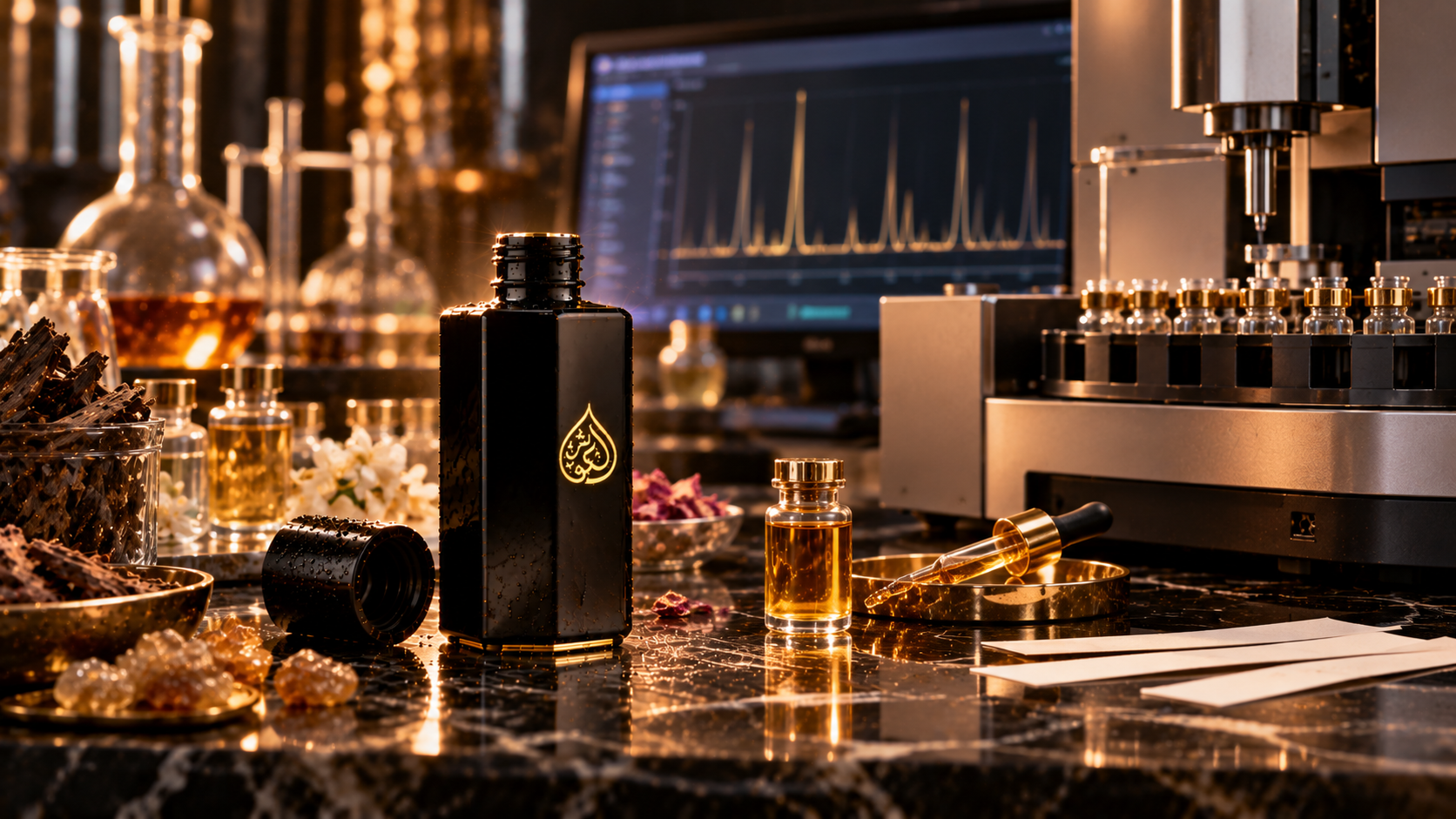
Imagine purchasing a luxury perfume for €300.
You love everything about it.
The opening is beautiful, the scent develops perfectly, and the fragrance has become one of your favourites.
But then you discover something interesting.
Another company sells a fragrance that smells remarkably similar for a fraction of the price.
You try it.
The resemblance is astonishing.
How can two different companies create perfumes that smell almost identical?
Did someone discover the original formula?
Did scientists analyse the perfume in a laboratory?
Or did a skilled perfumer simply recreate the fragrance using their sense of smell?
The answer involves one of the most fascinating areas of modern perfumery: fragrance reverse engineering.
Let's explore how it works.
What Is Perfume Reverse Engineering?
Reverse engineering is the process of studying an existing product to understand how it was made.
In perfumery, it involves analysing a finished fragrance to identify its chemical components and estimate how they contribute to the overall composition.
Imagine receiving a perfume without knowing its formula.
You don't know which aromatic materials were used, how much of each ingredient was added, or how the fragrance was constructed.
But you have the finished product.
Reverse engineering attempts to work backwards from that finished perfume.
The goal might be to understand its composition, investigate its authenticity, compare it with another fragrance, or develop a similar scent.
However, there's an important distinction.
Analysing a perfume is not the same as recovering its exact original recipe.
How Do Scientists Analyse a Perfume?
One of the most important techniques used in fragrance analysis is called gas chromatography–mass spectrometry, commonly abbreviated to GC-MS.
Although the name sounds complicated, the basic principle is relatively straightforward.
A perfume contains a mixture of different chemical compounds.
GC-MS helps scientists separate many of those compounds and investigate their identities.
Step 1: Taking a small sample
A laboratory begins with a carefully prepared sample of the fragrance.
The preparation depends on the product's composition and the analytical method being used.
Step 2: Separating the compounds
Gas chromatography separates suitable volatile and semi-volatile compounds.
As the sample moves through a specialised column, different compounds emerge at different times.
This produces a pattern of signals known as a chromatogram.
Step 3: Identifying the compounds
Mass spectrometry provides information about the chemical substances emerging from the column.
Researchers compare the resulting mass spectra with reference libraries and other analytical information.
This can help identify many of the compounds present.
Step 4: Estimating the composition
Additional analytical methods and calibration procedures can help estimate the quantities of identified materials.
The result may provide a detailed picture of the fragrance's chemical composition.
But even a sophisticated analysis has limitations.
Can GC-MS Reveal the Exact Perfume Formula?
Not necessarily.
A laboratory may identify many ingredients in a fragrance without recovering the complete manufacturing formula.
There are several reasons.
1. Natural ingredients contain complex mixtures
Imagine a perfume containing natural rose oil.
Rose oil is not one chemical.
It contains numerous aromatic compounds.
When analysed, those compounds may appear as separate signals.
The scientist must determine whether they came from rose oil, another natural extract, individual aroma chemicals, or a combination of materials.
Different ingredients can contain overlapping chemical components.
This makes identifying the original raw materials more complicated than identifying individual molecules.
2. Some ingredients are present in tiny quantities
A perfume may contain a highly impactful aromatic compound at an extremely low concentration.
Even a small amount can make an important contribution to the fragrance.
Identifying and accurately measuring trace ingredients can be challenging.
3. Some compounds are difficult to separate
Complex perfumes can contain substances that produce overlapping analytical signals.
More advanced techniques may improve separation, but no single method reveals everything equally well.
4. Not every ingredient is suitable for the same analytical technique
Some fragrance components are less volatile or may not behave well under the conditions used in conventional GC-MS analysis.
Other analytical methods may be needed.
5. The finished perfume may have changed
A perfume can undergo chemical changes during manufacturing and storage.
The composition measured in a finished bottle may therefore differ slightly from the mixture originally prepared.
A chemical analysis can provide an extremely useful map of a perfume, but a map is not always the complete recipe.
Why Is the Perfumer's Nose Still Important?
Modern laboratories can identify chemical substances with remarkable precision.
But creating a beautiful perfume requires more than reading analytical data.
A perfumer must understand how aromatic materials smell individually and how they behave together.
Some ingredients have powerful effects at extremely low concentrations.
Others influence the balance, texture or overall character of a composition.
Two formulas can contain many of the same materials and still produce noticeably different results.
This is why a perfumer may use laboratory findings alongside repeated smelling and evaluation.
The analytical data helps explain what is present.
The perfumer's experience helps determine how the fragrance should be constructed.
Science can identify molecules. Perfumery requires understanding how those molecules create a scent experience.
How Are Inspired-By Perfumes Created?
Inspired-by fragrances are designed to resemble the scent profile of an existing perfume.
They can be developed through different approaches.
Some manufacturers use laboratory analysis to investigate the composition of a reference fragrance.
Others rely heavily on the expertise of perfumers who evaluate the original and develop a similar composition.
Some use a combination of both methods.
The process may involve repeated adjustments until the resulting fragrance achieves the intended resemblance.
However, not every inspired-by perfume is produced through sophisticated laboratory reverse engineering.
And not every inspired-by fragrance uses the same ingredients as its reference.
A similar smell can sometimes be achieved using a different combination of aromatic materials.
Why Do Some Perfume Copies Smell Almost Identical?
Our sense of smell responds to combinations of aromatic compounds.
When two fragrances produce sufficiently similar patterns of odour perception, they may smell remarkably alike.
A perfumer doesn't necessarily need to reproduce every ingredient in the original formula to create a recognisable resemblance.
Instead, the most important aromatic characteristics may be recreated using suitable materials.
For example, a fragrance might be recognised by a particular combination of sweetness, woods, musk and amber-like notes.
If another composition reproduces those characteristics convincingly, the overall impression may be very similar.
But similarity is not always consistent throughout the fragrance's development.
Why Do Some Perfume Dupes Smell Different After an Hour?
Have you ever compared an original perfume with an inspired-by version?
Initially, they seem almost identical.
But after an hour, one becomes sweeter while the other develops a stronger woody character.
Why?
Because the fragrances may contain different ingredients or different proportions of similar ingredients.
A perfume is not a fixed smell.
Its aromatic composition changes as materials evaporate and interact with the application surface.
Small formulation differences can affect which characteristics become prominent over time.
Two fragrances may have similar openings but different drydowns.
The reverse can also happen.
An inspired-by fragrance may initially smell different but become more similar to its reference after the opening fades.
This is why judging fragrance similarity from the first few seconds can be misleading.
Does a More Expensive Perfume Have a More Complicated Formula?
Not necessarily.
The price of a perfume does not directly reveal how many ingredients it contains.
A relatively simple fragrance can be expensive because it uses costly materials, requires specialised production or carries significant brand and distribution costs.
A more affordable perfume may contain a complex mixture of aromatic compounds.
Likewise, a high ingredient count does not automatically produce a better fragrance.
Perfumery is about the relationship between materials.
Sometimes a carefully constructed formula with fewer ingredients can be more effective than a complicated composition.
The number of ingredients is not a reliable measure of fragrance quality.
Can a Synthetic Ingredient Recreate the Smell of a Natural Material?
Sometimes, synthetic aroma chemicals can reproduce particular aspects of natural scents.
For example, vanillin is strongly associated with the characteristic smell of vanilla.
But natural vanilla extract contains numerous compounds.
Vanillin alone does not reproduce every aspect of natural vanilla.
The same principle applies to many other aromatic materials.
A natural extract may contain a complex mixture that gives it depth and character.
A perfumer may use several individual aroma chemicals to recreate a similar impression.
This is called constructing an accord.
However, natural ingredients can also vary between batches.
Synthetic materials may provide greater consistency for particular aromatic characteristics.
Neither category is automatically superior.
Both have important roles in modern perfumery.
Is Reverse Engineering the Same as Counterfeiting?
No.
It's important to distinguish between fragrance similarity and deceptive product imitation.
An inspired-by fragrance may be marketed under its own brand and identity while offering a scent profile resembling another perfume.
A counterfeit product, by contrast, may falsely present itself as a genuine product from another brand.
These are different issues.
However, the legal position surrounding inspired-by fragrances can be complicated.
Trademark law, advertising rules, packaging, comparative marketing and other intellectual property considerations may apply.
The fact that two perfumes smell similar does not automatically establish whether a particular product or marketing practice is lawful.
Businesses must consider the laws relevant to the markets in which they operate.
Can Perfume Formulas Be Kept Secret?
Yes.
Fragrance formulas can be commercially valuable information.
Manufacturers may protect their formulations through confidentiality agreements, restricted access and trade-secret practices.
Unlike a publicly disclosed patent, a trade secret depends on maintaining secrecy and satisfying the relevant legal requirements.
But a finished fragrance is a physical product that can be examined and chemically analysed.
This creates an interesting challenge for perfume manufacturers.
A formula may remain confidential even when competitors can investigate aspects of its chemical composition.
Reverse engineering can reveal useful information, but it does not necessarily provide every manufacturing detail or ingredient specification.
Could Artificial Intelligence Help Recreate Perfumes?
Artificial intelligence and computational methods are increasingly being investigated for applications involving chemical analysis, odour prediction and fragrance formulation.
Such systems may help researchers identify patterns, compare chemical data or predict certain sensory characteristics.
However, accurately predicting how a complex fragrance will smell remains difficult.
Human odour perception involves interactions between many aromatic compounds, their concentrations and the person experiencing them.
AI may become an increasingly useful tool for perfumers.
But it should not be assumed that a computer can automatically analyse any perfume and reproduce a perfect copy.
Can Perfume Oils Be Reverse-Engineered Too?
Yes.
Perfume oils can also be analysed to investigate their aromatic composition.
However, the carrier materials and formulation can influence sample preparation and analytical interpretation.
A concentrated fragrance oil may differ significantly from a finished alcohol-based perfume.
Likewise, two products containing similar aromatic materials may behave differently because of their carriers and concentrations.
This is particularly relevant when comparing perfume oils, attars and spray fragrances.
The overall scent profile may be similar, but the wearing experience can differ.
Does a Similar-Smelling Perfume Mean It's the Same Quality?
Not necessarily.
Two fragrances can smell similar while differing in other important respects.
These may include ingredient quality, manufacturing consistency, stability, regulatory compliance and how the finished product behaves over time.
A fragrance that smells pleasant during an initial test still needs to be appropriately formulated and assessed for its intended use.
Price alone cannot establish these qualities.
Neither can scent similarity.
The best approach is to evaluate a fragrance as a complete product rather than judging it exclusively by how closely it resembles another perfume.
The Bottom Line
Can scientists copy a perfume?
They can analyse its chemical composition and use that information to help create a remarkably similar fragrance.
But reproducing the exact original formula is not always possible.
Natural ingredients contain complex mixtures.
Some compounds are difficult to identify or measure.
And even small formulation differences can influence how a fragrance develops.
This is what makes reverse engineering such an interesting meeting point between chemistry and creativity.
At Al Kowthar Fragrances, we believe that understanding how perfumes are developed makes the world of fragrance even more fascinating.
Behind every bottle is a carefully constructed combination of aromatic materials.
And behind every successful fragrance is more than a list of ingredients.
There is knowledge, experimentation and an understanding of how scent works.
A laboratory can help reveal what's inside a perfume. But recreating its character remains an art as well as a science.
"Explore Al Kowthar Fragrances" (https://alkowtharfragrance.com/shop)