5 October 2026 · 6 min read
How Is Oud Oil Made? From Agarwood to Dehn Al Oud
Discover how oud oil is made from agarwood, from the formation of fragrant resin to the traditional distillation process that creates dehn al oud.
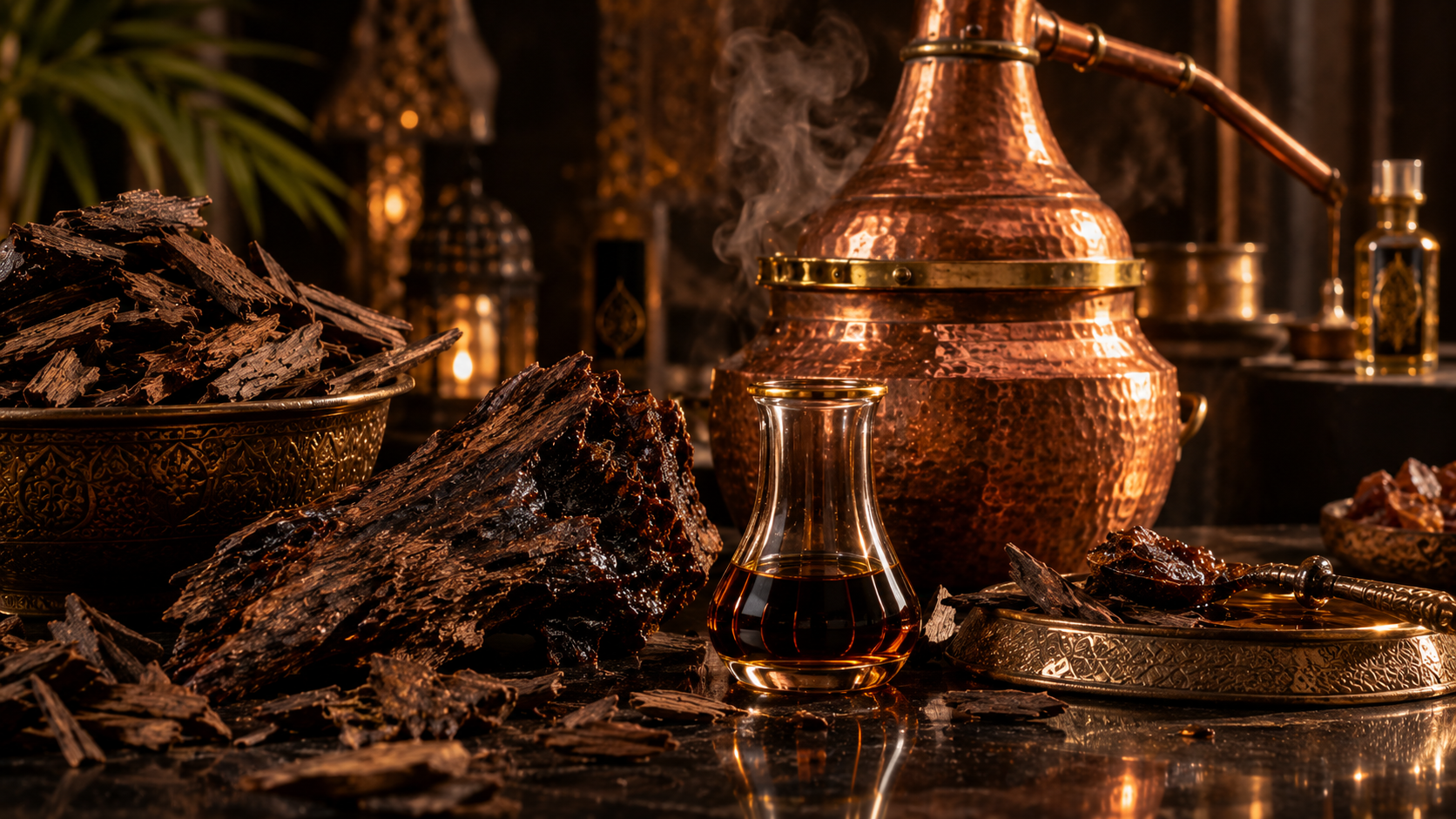
Oud is one of the most mysterious and treasured materials in perfumery.
You may have smelled it in an attar, perfume oil or traditional Middle Eastern fragrance, but have you ever wondered where oud oil actually comes from?
It doesn't begin as a bottle of dark, luxurious oil.
It begins with agarwood — a fragrant, resin-rich wood formed inside certain trees.
The journey from wood to oud oil is long, traditional and surprisingly complex.
What Is Oud?
Oud, also known as agarwood or aloeswood, refers to the fragrant resinous wood associated with certain trees in the genus Aquilaria and related genera.
Healthy wood does not naturally have the rich, powerful aroma associated with oud.
The distinctive fragrance develops when the tree responds to injury and microbial activity by producing aromatic resin.
Over time, this resin can accumulate within the wood.
The result is the dark, intensely fragrant material that has become one of perfumery's most prized ingredients.
Where Does Agarwood Come From?
Agarwood-producing trees are associated with parts of South and Southeast Asia.
Different growing regions can produce wood with noticeably different aromatic characteristics.
The resulting oud can vary dramatically depending on factors such as:
- Species
- Geographic origin
- Age of the wood
- Resin content
- Cultivation conditions
- Processing method
- Distillation technique
This is one reason experienced oud enthusiasts can detect differences between oils from different origins.
Oud isn't simply one smell.
It is a whole world of aromas.
How Does Fragrant Resin Form?
This is one of the most fascinating parts of the story.
When certain agarwood-producing trees are injured or exposed to microbial activity, they can respond by producing defensive compounds.
These compounds accumulate within parts of the wood.
As the process develops, the affected wood becomes increasingly resinous and aromatic.
The transformation can take considerable time.
That resin is what gives agarwood its extraordinary fragrance.
So when you smell a rich oud oil, you're experiencing the result of a biological process that happened inside the tree.
From Tree to Agarwood
Once suitable resinous wood has developed, it can be harvested and prepared for processing.
The wood may be:
- Selected
- Cleaned
- Sorted
- Cut
- Chipped
- Graded
Not every piece of wood contains the same amount or quality of resin.
Some pieces may contain very little.
Others can be extremely resin-rich.
This variation contributes to the enormous differences in value between different grades of agarwood.
Why Is Good Agarwood So Valuable?
The quality of agarwood can vary enormously.
Highly resinous material is much more desirable than ordinary, lightly resinous wood.
Its origin, rarity, age, appearance, aroma and processing history can all influence its value.
This is why the phrase "oud" doesn't automatically mean one fixed quality or price.
There are many different grades and styles.
Two oud oils can both legitimately be called oud while smelling completely different.
How Is Oud Oil Extracted?
Traditional oud oil is commonly produced through a process involving water distillation.
Prepared agarwood is immersed in or exposed to water and heated as part of the distillation process.
The aromatic compounds are released and carried through the distillation system.
The resulting distillate contains aromatic material and water.
Through separation and collection, the fragrant oil can be obtained.
The resulting oil is commonly known as dehn al oud or simply oud oil.
Why Is Distillation So Important?
The wood itself doesn't automatically smell exactly like the finished oil.
Distillation changes how the aromatic materials are presented.
The process can influence the final character of the oil depending on:
- The raw material
- Preparation
- Soaking or fermentation practices
- Distillation duration
- Heat
- Equipment
- Water
- Distiller expertise
- Collection and ageing
This is why two distillers working with similar-looking wood can produce very different oils.
The distiller isn't simply extracting a fixed smell.
They are helping shape the final aromatic profile.
What Does Real Oud Oil Smell Like?
There isn't one universal oud smell.
Depending on its origin and production, oud can smell:
- Woody
- Smoky
- Animalic
- Sweet
- Earthy
- Resinous
- Spicy
- Leather-like
- Medicinal
- Floral
- Fruity
- Warm
- Balsamic
Some oud oils can be extremely powerful.
Others can be surprisingly soft, smooth and elegant.
This diversity is part of what makes oud so fascinating.
Why Can Oud Smell Animalic?
Certain traditional oud oils can have an unmistakably animalic character.
Some people describe these oils as leathery, barn-like, earthy or even slightly medicinal.
Others find these characteristics fascinating and luxurious.
This doesn't necessarily mean something has gone wrong.
It can be part of the natural aromatic profile of the material.
For someone accustomed to modern commercial fragrances, authentic traditional oud can therefore be a completely different experience.
Why Does Oud Change as You Wear It?
Oud oil contains numerous aromatic compounds with different physical properties.
As you wear it, some become noticeable earlier while others emerge later.
This means a quality oud can evolve significantly over time.
You may initially notice something sharp or medicinal.
Later, it may become sweeter, warmer, woodier or more resinous.
The drydown can be completely different from the opening.
Does Darker Oud Mean Better Oud?
Not necessarily.
Colour can provide clues about an oil, but darkness alone isn't a reliable measure of quality.
The final appearance can be influenced by the raw material, extraction process, concentration and ageing.
A lighter oud oil isn't automatically inferior.
Likewise, an extremely dark oil isn't automatically superior.
The most important thing is the overall quality and character of the oil.
Why Is Dehn Al Oud So Special?
Dehn al oud isn't simply "wood perfume."
It represents the concentrated aromatic result of a long process beginning with a living tree.
The tree develops resin.
The resin-rich wood is selected and prepared.
The material is processed and distilled.
The resulting oil is then evaluated for its character.
That journey is part of what makes oud so culturally and historically significant.
Cultivated Oud vs Wild Oud
Modern oud production can involve cultivated agarwood as well as naturally occurring material.
This distinction matters because wild agarwood resources have faced serious conservation pressure.
Cultivation and controlled production can help provide fragrance materials while reducing pressure on naturally occurring populations.
For consumers, understanding where fragrance materials come from is increasingly important.
Luxury shouldn't simply mean rarity.
It should also mean responsible craftsmanship and respect for the material.
Oud Is More Than an Ingredient
For centuries, oud has occupied a special place in fragrance culture across the Middle East and Asia.
It appears in oils, attars, incense and modern perfumes.
But the next time you smell oud, remember that you're not simply smelling a fragrance ingredient.
You're experiencing the result of:
a tree → resin formation → agarwood → preparation → distillation → oil.
That is a remarkable journey for something that ultimately fits into a tiny bottle.
The Beauty of Oud
At Al Kowthar Fragrances, we believe understanding an ingredient makes experiencing it even more meaningful.
Oud is not one smell.
It is not simply "strong wood."
It is a complex material shaped by origin, resin, craftsmanship and time.
And perhaps that's why oud continues to captivate fragrance lovers around the world.
A few drops can carry an entire story.