30 October 2026 · 10 min read
How Does Your Nose Recognise Thousands of Different Smells?
How can your nose recognise so many scents? Discover the remarkable biology behind smell receptors, fragrance perception and the human brain.
How Does Your Nose Recognise Thousands of Different Smells?
Close your eyes for a moment.
Imagine the smell of freshly cut grass.
Now imagine a ripe orange.
Then freshly brewed coffee.
Finally, imagine the deep, woody aroma of oud.
These scents are completely different.
Yet your nose can recognise them almost instantly.
You don't need to see the grass, orange, coffee or oud to know that each has a distinctive smell.
But here's the fascinating question.
How can one small organ recognise such an enormous variety of different scents?
Your nose doesn't contain a separate sensor for every smell in the world.
Instead, your brain uses an extraordinary biological system capable of interpreting complex patterns of chemical information.
Understanding this system reveals why perfume is so much more than a pleasant smell.
1. What Actually Happens When You Smell Something?
Let's begin with a simple example.
Imagine opening a bottle of perfume.
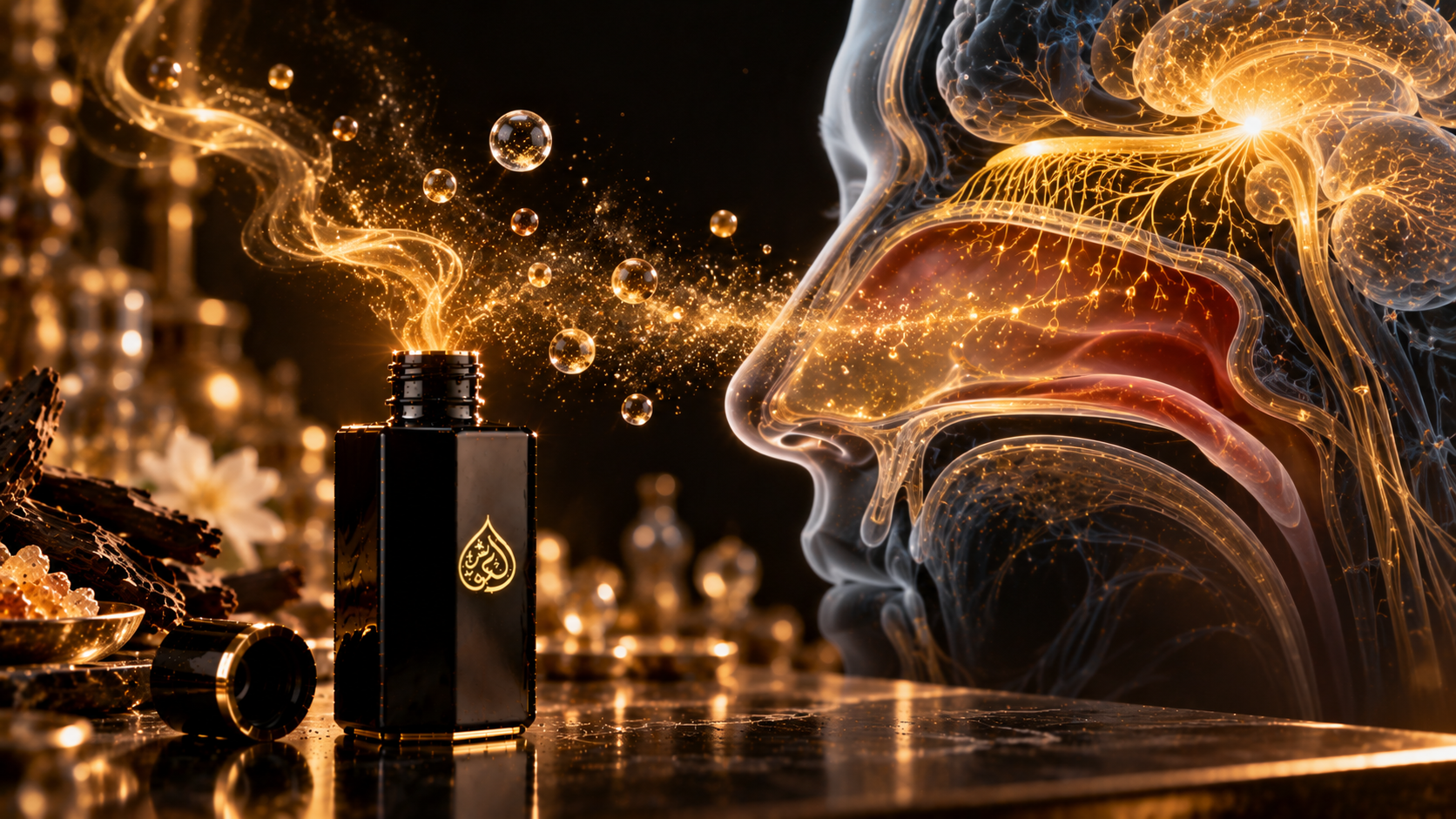
Aromatic molecules escape from the liquid and enter the surrounding air.
When you breathe in, some of those molecules travel into your nasal cavity.
Near the upper region of the nasal cavity is a specialised area of tissue called the olfactory epithelium.
This tissue contains sensory neurons involved in detecting odours.
These neurons have structures that interact with odorant molecules.
When suitable molecules activate particular receptors, the sensory cells generate signals.
Those signals travel towards the brain.
The brain then processes the information, allowing you to experience a smell.
All of this can happen remarkably quickly.
What we experience as fragrance begins with molecules interacting with specialised sensory receptors.
2. Does Your Nose Have a Different Receptor for Every Smell?
No.
And this is one of the most remarkable features of human olfaction.
Humans have approximately 400 types of functional olfactory receptor genes, although the precise number varies between individuals.
Yet we can distinguish far more odours than we have receptor types.
How is that possible?
The answer is a system known as combinatorial coding.
Rather than assigning one receptor to one specific smell, the olfactory system uses combinations of receptor responses.
A single odorant molecule may activate multiple receptor types.
And a particular receptor may respond to multiple odorants.
Different molecules therefore produce different patterns of activity.
The brain interprets these patterns as different odour experiences.
Think of it like music.
A piano has a limited number of keys.
Yet those keys can be combined to create an enormous variety of melodies.
Similarly, the olfactory system uses combinations of receptor responses to represent a vast range of smells.
3. How Does Your Brain Know the Difference Between Rose and Coffee?
Imagine smelling a rose.
A mixture of volatile compounds reaches your nose.
These compounds activate particular combinations of olfactory receptors.
Now imagine smelling coffee.
Coffee releases a different and highly complex mixture of aromatic compounds.
The pattern of receptor activation changes.
Your brain processes these different patterns and, through experience and learning, associates them with particular odours.
This is how you can recognise the difference between familiar smells.
However, smell perception isn't simply a matter of reading a chemical barcode.
The brain also integrates information about context, memory and expectations.
For example, the same odour may be interpreted differently depending on what you believe you are smelling.
Your experience of fragrance is created by the interaction between chemical signals and the brain's interpretation of them.
4. Why Do Some Smells Seem Similar?
Have you ever smelled two different perfumes and noticed that they share a familiar character?
Perhaps both remind you of vanilla.
Or both have a recognisable citrus quality.
This can happen because different aromatic compounds and mixtures may produce overlapping patterns of receptor activation.
The brain may therefore perceive similarities between them.
Perception is also influenced by experience.
If you've encountered many fragrances containing similar aromatic characteristics, you may learn to recognise those shared features.
Professional perfumers and fragrance evaluators often develop highly refined abilities to identify and describe odours.
Their training doesn't necessarily give them entirely new types of receptors.
Instead, experience helps them pay attention to distinctions that an untrained person might overlook.
5. Can Humans Really Detect a Trillion Different Smells?
You may have encountered the claim that humans can distinguish one trillion odours.
This figure comes from scientific research that attempted to estimate the enormous discriminatory capacity of human smell.
However, the estimate has been debated.
Researchers have questioned aspects of the assumptions and methods used to extrapolate such a large number.
Therefore, it would be misleading to present one trillion as a firmly established count of smells that every human can distinguish.
What scientists can say with confidence is that human olfaction has an extraordinary capacity to discriminate between different odour mixtures.
The exact number of distinguishable smells remains difficult to define.
Unlike colours or musical pitches, odours do not fit neatly along a small number of simple perceptual dimensions.
Our sense of smell is remarkably capable, even if its ultimate limits are still being investigated.
6. Why Can Some People Smell Things That Others Cannot?
Imagine two people smelling the same perfume.
One immediately notices a particular musky ingredient.
The other barely detects it.
Why?
Part of the answer lies in genetic variation.
Humans differ in the genes that encode their olfactory receptors.
These differences can influence sensitivity to particular aromatic molecules.
Some individuals may be especially sensitive to certain odorants.
Others may have difficulty detecting them.
Scientists use the term specific anosmia to describe reduced or absent sensitivity to particular odours despite otherwise functioning olfaction.
For example, variation in certain olfactory receptor genes has been associated with differences in the perception of specific musky or other aromatic compounds.
This means two people can experience the same fragrance differently because their sensory systems are not identical.
But genetics isn't the only factor.
Age, health, environmental exposure and experience can also influence smell perception.
7. Why Are Some Smells Detectable at Extremely Low Concentrations?
Certain aromatic compounds can be detected at remarkably low concentrations.
Others require much larger amounts before they become noticeable.
This difference is related to an odour's detection threshold.
A detection threshold describes the concentration at which a substance becomes detectable under specified conditions.
Different odorants have different thresholds.
Some sulfur-containing compounds, for example, can have very low detection thresholds.
This helps explain why a tiny amount of a powerful aromatic material can have a noticeable influence on a perfume.
It also explains why perfumers must measure certain ingredients with great care.
Adding slightly too much of a potent material can dramatically change the overall composition.
However, detection thresholds vary between individuals and depend on testing conditions.
There is no single universal threshold that applies equally to everyone.
8. Why Does Smell Have Such a Strong Connection With Memory?
Imagine smelling a fragrance you haven't encountered for twenty years.
Suddenly, you're reminded of a particular house.
A family gathering.
A childhood holiday.
Or someone you once knew.
The memory may appear unexpectedly and feel remarkably vivid.
Why does this happen?
The olfactory system has important connections with brain regions involved in emotion and memory.
These include areas associated with the amygdala and hippocampal memory systems.
This helps explain why odours can become powerful cues for autobiographical memories.
However, the relationship is complex.
Not every smell produces an emotional memory.
And other senses, such as vision and hearing, can also evoke vivid recollections.
Nevertheless, odours are particularly interesting because of the way olfactory information is processed and connected with emotional learning.
A fragrance can become associated with an experience, allowing the smell to act as a cue that brings the memory back.
9. Why Do We Sometimes Recognise a Smell but Cannot Name It?
Here's an interesting experiment.
Ask someone to smell an unfamiliar fragrance without seeing its bottle.
They may immediately say:
"I know this smell!"
But when asked to identify it, they struggle.
Perhaps they describe it as warm, sweet or woody.
Yet they cannot find the correct word.
This is a well-known challenge in olfactory perception.
Recognising an odour and naming it are not the same task.
Odour identification requires the brain to connect a sensory experience with stored knowledge and language.
People often find this more difficult than identifying familiar visual objects.
However, training and experience can improve odour naming.
Professional perfumers frequently use structured fragrance vocabularies to describe aromatic characteristics.
This helps them communicate complex sensory experiences more precisely.
10. Can You Train Your Nose to Become Better at Smelling?
Yes, certain aspects of smell recognition and discrimination can improve with practice.
This is particularly relevant to people interested in perfumery.
You don't need expensive laboratory equipment to begin developing your ability to describe fragrances.
Start by smelling familiar materials individually.
For example:
- Fresh lemon peel.
- Coffee beans.
- Vanilla.
- Cinnamon.
- Rose petals.
- Fresh mint.
- Sandalwood, where available.
Pay attention to each aroma.
Try describing its characteristics without immediately naming the ingredient.
Is it sharp?
Sweet?
Dry?
Green?
Warm?
Creamy?
Woody?
Then compare different materials.
You may begin noticing distinctions that previously escaped your attention.
Keeping a simple fragrance journal can also help.
Write down what you smell, what it reminds you of and how your impression changes over time.
Repeated practice can strengthen your familiarity with different odour profiles.
However, training cannot necessarily overcome every biological limitation.
For example, someone with a particular form of specific anosmia may continue to have difficulty detecting a certain compound.
11. Why Does Your Nose Sometimes Get Confused by Perfume?
Perfumes often contain complex mixtures of aromatic compounds.
When several ingredients are present together, their perceived odours don't always combine in a simple, predictable way.
One ingredient may dominate.
Another may become less noticeable.
Two ingredients may produce an overall impression that differs from what you would expect when smelling them separately.
Scientists study these interactions as part of odour mixture perception.
Processes such as masking and suppression can influence the way mixtures are experienced.
This is one reason perfume creation is so challenging.
A perfumer cannot always predict the finished fragrance simply by considering each ingredient independently.
The overall sensory result must be evaluated.
The smell of a perfume is not necessarily the simple sum of its individual ingredients.
12. Why Is Smell So Important to the Experience of Flavour?
Here's something that surprises many people.
Much of what we casually describe as the flavour of food depends on smell.
When you eat, volatile compounds can travel from the mouth towards the nasal cavity through a process called retronasal olfaction.
Your brain combines this information with taste and other sensory inputs.
The result is the rich experience we call flavour.
Your tongue detects basic taste qualities such as sweetness, sourness, saltiness, bitterness and umami.
But distinguishing the complex flavour of coffee from chocolate involves much more than taste alone.
Smell plays a major role.
This is one reason food can seem less flavourful when nasal congestion interferes with olfaction.
It also demonstrates how deeply our sense of smell is integrated into everyday life.
13. What Does This Mean for Perfume Lovers?
Understanding the biology of smell changes the way we think about fragrance.
When two people disagree about a perfume, neither necessarily has to be mistaken.
Their olfactory sensitivities, previous experiences and personal associations may differ.
A fragrance that feels beautifully balanced to one person might seem overwhelmingly sweet to another.
Someone may notice a woody material immediately, while another detects the floral elements more strongly.
This is why perfume preferences are so personal.
It's also why testing a fragrance yourself can be more informative than relying entirely on someone else's description.
Reviews can help you understand a fragrance's general character.
But they cannot perfectly predict your own sensory experience.
The Bottom Line
How does your nose recognise so many different smells?
It uses a sophisticated biological system in which hundreds of olfactory receptor types respond to aromatic molecules.
Different combinations of receptor activity allow the brain to distinguish an enormous variety of odours.
But the experience doesn't end in the nose.
Memory, learning, genetics, context and individual sensitivity all influence how we perceive fragrance.
At Al Kowthar Fragrances, we believe the science of smell makes perfumery even more fascinating.
Every time you open a perfume bottle, countless aromatic molecules begin interacting with one of the most remarkable sensory systems in the human body.
And within moments, your brain transforms those chemical signals into something meaningful.
A familiar aroma.
A new discovery.
Or perhaps a memory you haven't thought about in years.
Perfume may begin in a bottle, but the experience of fragrance is created in the brain.
"Explore Al Kowthar Fragrances" (https://alkowtharfragrance.com/shop)