10 November 2026 · 9 min read
The Hidden History of Sandalwood in Perfumery
Discover why Indian sandalwood became so valuable, what caused its scarcity and how plantations and modern perfumery are changing its future.
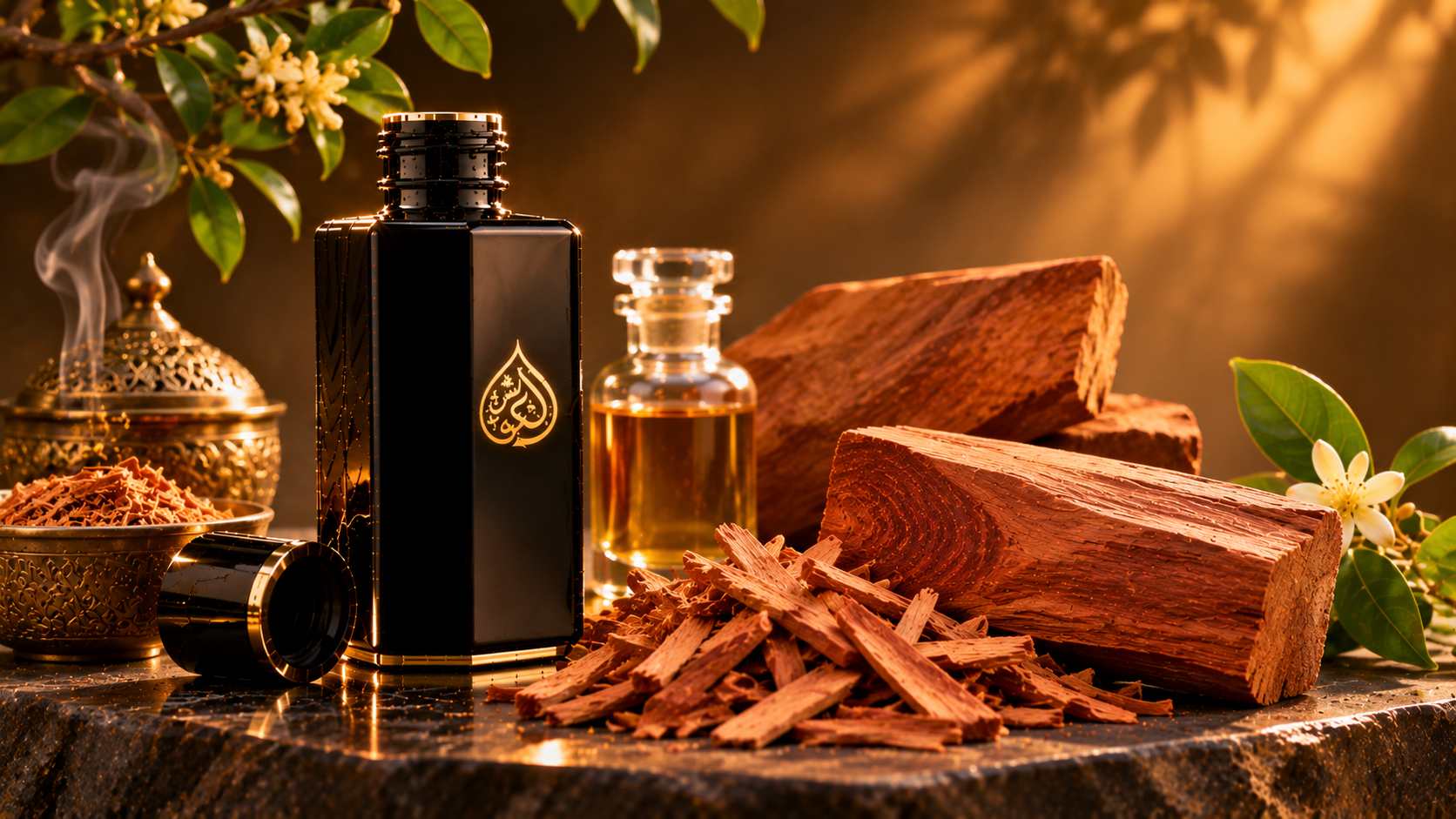
The Hidden History of Sandalwood in Perfumery: From Sacred Wood to Global Luxury
Imagine walking through a forest in southern India several centuries ago.
Among the surrounding trees grows something extraordinary.
It does not produce a spectacular flower or a particularly impressive fruit. Its greatest treasure is hidden inside its trunk and roots.
A fragrant heartwood that can take decades to develop.
For thousands of years, this wood has been treasured for its distinctive aroma, used in religious traditions, carved into precious objects and traded across great distances.
Today, we know it as sandalwood.
Its smooth, creamy and woody scent has become one of the most recognisable foundations of luxury perfumery.
But behind this beautiful ingredient lies a remarkable story involving ancient trade, colonial commerce, illegal harvesting, environmental conservation and modern fragrance chemistry.
How did a tree become so valuable that entire industries emerged around its scent? And why did the world begin searching for alternatives to the original Indian sandalwood?
The answer begins long before modern perfume bottles existed.
1. What Exactly Is Sandalwood?
Sandalwood is a name applied to several aromatic woods, particularly species belonging to the genus Santalum.
One of the most historically celebrated is Santalum album, commonly known as Indian sandalwood.
This species is especially associated with South Asia, although it is also cultivated elsewhere.
The aromatic material prized by perfumers comes primarily from the tree's heartwood and, in suitable harvesting operations, its roots.
Unlike the outer sapwood, the heartwood can accumulate significant quantities of fragrant oil.
The resulting essential oil is valued for its warm, soft, woody and creamy character.
However, not every tree called sandalwood belongs to the same species, and not every sandalwood oil has the same chemical composition.
That distinction becomes particularly important when examining the ingredient's history.
2. Why Was Indian Sandalwood So Highly Prized?
Indian sandalwood acquired enormous cultural and commercial significance over many centuries.
Its aromatic wood has been used in incense, religious ceremonies, traditional preparations, carvings and perfumery.
Its appeal was not limited to one region or community.
Sandalwood became part of wider trading networks connecting South Asia with other parts of Asia and beyond.
Its fragrance was particularly desirable because of its distinctive character.
Rather than being sharply smoky or aggressively woody, high-quality Indian sandalwood oil can have a smooth, creamy warmth.
In perfume compositions, that quality makes it valuable for creating a rounded woody foundation.
It can complement floral, amber, spicy and resinous ingredients without necessarily dominating them.
But sandalwood's desirability also created a serious long-term challenge.
3. The Treasure Hidden Inside the Tree
One of the reasons sandalwood is expensive is that its valuable aromatic material does not develop instantly.
A young sandalwood tree does not necessarily contain the quantity or quality of heartwood oil sought by commercial buyers.
Heartwood formation and oil accumulation generally increase as the tree matures, although the results vary considerably with age, genetics and growing conditions.
Commercial cultivation therefore requires patience.
Unlike an annual crop that can be harvested after one growing season, sandalwood represents a long-term investment.
Land, labour, maintenance and protection may be required for many years before harvesting.
And even then, the amount of valuable oil recovered depends on the material and extraction process.
This long production cycle helps explain why supply cannot always respond quickly when demand increases.
4. Sandalwood Has an Unusual Biological Secret
Here is something many perfume lovers do not know.
Sandalwood trees are hemiparasitic.
This means they can photosynthesise, but they also obtain water and nutrients from neighbouring plants through specialised connections called haustoria.
Consequently, growing sandalwood successfully involves more than simply planting seeds in the ground.
Cultivators often need suitable host plants to support healthy development.
The choice of host species, local climate, soil conditions and plantation management can influence tree growth.
This biological characteristic makes sandalwood cultivation particularly interesting.
It also adds complexity to commercial plantations.
The valuable perfume ingredient depends on an ecological relationship between different plants.
5. How Did Sandalwood Become a Major Trade Commodity?
For centuries, aromatic woods and resins travelled through commercial networks linking producers, merchants and consumers.
Sandalwood was one of the materials that could command significant value.
It was transported for uses extending beyond personal fragrance, including incense, craftsmanship and ceremonial applications.
Over time, organised commercial harvesting became increasingly important.
In parts of southern India, sandalwood resources came under extensive government control.
These arrangements were shaped by the wood's economic value and concerns about protecting valuable supplies.
However, the combination of strong demand, valuable timber and limited availability also created incentives for unauthorised harvesting and illegal trade.
The very characteristics that made sandalwood desirable contributed to pressure on its natural populations.
6. What Happened to India's Sandalwood Forests?
The decline of Indian sandalwood resources cannot be attributed to one simple cause.
Several factors have affected natural populations and commercial availability.
These include historical overexploitation, illegal cutting, habitat pressures and difficulties associated with regeneration and management.
Sandalwood spike disease, which can severely affect infected trees, has also presented challenges in parts of India.
Meanwhile, demand for aromatic heartwood and essential oil continued.
Because mature trees take years to develop, replacing lost resources is not straightforward.
This created a difficult situation.
A highly desirable natural material faced pressures that could not be solved simply by harvesting more trees.
The industry needed new approaches to cultivation, conservation and supply.
7. Why Did Australia Become Important?
Australia has become a major part of the modern sandalwood story.
The country has its own native sandalwood species, including Santalum spicatum, commonly known as Australian sandalwood.
But Australian growers have also cultivated Indian sandalwood, Santalum album, particularly in tropical northern regions.
This is an important distinction.
Indian sandalwood and Australian sandalwood are not simply the same ingredient grown in different countries.
The common names may refer to different botanical species.
At the same time, Santalum album grown in Australia remains the same species as Indian sandalwood.
Plantation development has offered the industry an additional source of sandalwood material outside traditional harvesting regions.
However, plantations are not automatically environmentally sustainable.
Their impacts depend on land use, water requirements, management, harvesting practices and other factors.
Responsible sourcing requires examining how the material was produced, not merely where it came from.
8. Do All Sandalwood Oils Smell the Same?
No.
Different sandalwood species can produce oils with different chemical profiles and aromatic characteristics.
Even within one species, growing conditions, tree maturity, heartwood quality and processing methods can influence the resulting material.
Indian sandalwood oil is especially associated with compounds called alpha-santalol and beta-santalol.
These are important contributors to its characteristic odour.
Other sandalwood species can have different proportions of aromatic constituents.
As a result, two oils marketed under the general name sandalwood may not smell identical.
For perfumers, botanical identification and reliable supplier documentation are therefore essential.
The common name alone may not provide enough information about the ingredient.
9. How Is Sandalwood Oil Extracted?
Sandalwood essential oil is commonly obtained by steam distillation of prepared aromatic wood.
The wood may be chipped or ground before processing to facilitate extraction.
Steam helps carry volatile aromatic compounds from the material.
The vapour is then cooled, allowing the condensed water and essential oil to be separated.
The process can require substantial time and energy.
The amount of oil recovered varies according to the species, wood quality, oil content and distillation conditions.
This means the price of sandalwood oil reflects more than the cost of cutting a tree.
It can also reflect years of cultivation, the quantity of suitable heartwood, processing requirements and commercial supply conditions.
10. Why Is Genuine Sandalwood Oil So Expensive?
Several factors contribute to the value of high-quality sandalwood oil.
First, trees require significant time to mature.
Second, only part of the harvested material may contain the desired concentration of aromatic oil.
Third, cultivation and harvesting can involve considerable labour and management costs.
Fourth, demand comes from multiple industries, not just fine fragrance.
Finally, legal supply, conservation requirements and traceability can affect availability.
These factors help explain why genuine sandalwood oil can be substantially more expensive than many widely available fragrance materials.
However, prices vary greatly by species, grade, origin, quantity and market conditions.
A high price alone does not prove that a product is authentic or responsibly sourced.
11. Why Do Perfumers Use Synthetic Sandalwood Materials?
As natural sandalwood became increasingly valuable and supply-constrained, fragrance chemists developed synthetic materials capable of producing sandalwood-like odours.
These materials are not necessarily exact chemical copies of natural sandalwood oil.
Instead, they can provide particular aspects of the sandalwood impression.
Some have creamy, smooth woody characteristics.
Others are more powerful, diffusive or distinctive.
Their use allows perfumers to create sandalwood-inspired compositions without relying exclusively on natural sandalwood oil.
Synthetic sandalwood materials can also offer consistency and specific performance characteristics.
But this does not mean every synthetic alternative is environmentally superior.
Environmental impacts must be evaluated across production, sourcing and use rather than assumed from whether a material is natural or synthetic.
12. Does Synthetic Sandalwood Make Natural Sandalwood Obsolete?
Not at all.
Natural sandalwood oil remains a valued material because of its complex composition and distinctive aromatic profile.
For some perfumers, that complexity is difficult to replace with a single synthetic ingredient.
However, synthetic sandalwood aroma chemicals have expanded the creative possibilities available to fragrance designers.
A perfumer might use natural sandalwood oil for a particular nuance, synthetic materials for additional diffusion, or a combination of both.
The best approach depends on the fragrance concept, budget, performance requirements and applicable safety standards.
Rather than treating natural and synthetic materials as enemies, modern perfumery often uses them as complementary tools.
13. Can Sandalwood Be Produced Sustainably?
Sandalwood cultivation has the potential to support more carefully managed supplies.
Plantations can reduce reliance on harvesting certain wild resources when they are appropriately designed and operated.
However, responsible production requires attention to several issues.
These include land management, biodiversity, host-plant cultivation, water use, disease management, harvesting practices and the welfare of people involved in production.
Traceability is equally important.
A supplier's claim that an oil is natural or plantation-grown should be supported by suitable documentation.
Botanical identity, country of origin and the supply chain may all matter.
For businesses purchasing natural fragrance ingredients, sustainability is a question of evidence rather than attractive marketing language.
14. What Does the Future Hold for Sandalwood?
The future of sandalwood is likely to involve a combination of approaches.
Cultivated natural sandalwood will continue to play an important role.
Improved growing techniques and responsible resource management may help support future supplies.
Analytical testing can assist with botanical identification and authenticity.
Meanwhile, fragrance chemistry will continue to develop new sandalwood-like materials.
Perfumers may increasingly use carefully designed combinations of natural and synthetic ingredients to achieve particular aromatic results.
The challenge is to preserve the value of this extraordinary natural resource while meeting demand responsibly.
15. What Can Perfume Lovers Learn from Sandalwood's Story?
The story of sandalwood reveals something important about the fragrance industry.
Behind a single perfume note may lie centuries of history, complex biology, international trade and scientific innovation.
When a fragrance description mentions sandalwood, the word may refer to natural essential oil, synthetic sandalwood materials or an accord designed to evoke the characteristic aroma.
Those possibilities are not identical.
Understanding the difference allows customers to appreciate perfume descriptions with greater knowledge.
It also encourages more thoughtful questions about ingredient origins and sourcing.
Conclusion: A Fragrance That Changed the World
Sandalwood is far more than a pleasant woody scent.
It is the product of a remarkable tree, a long history of trade and an industry that has continually adapted to changing supplies.
Its journey from Indian forests to international plantations and modern laboratories illustrates the relationship between nature, commerce and human creativity.
At Al Kowthar Fragrances, we believe that appreciating perfume becomes even more rewarding when we understand the stories behind its ingredients.
The next time you encounter a beautiful sandalwood fragrance, remember that its inspiration may have taken decades to grow and centuries to become part of the perfumer's palette.
Some fragrances tell their story through the way they smell. Sandalwood tells its story through the history of the world around it.
"Explore Al Kowthar Fragrances" (https://alkowtharfragrance.com/shop)