10 November 2026 · 10 min read
The Hidden Engineering Behind Perfume Bottles
Discover how perfume bottles, pumps and closures are engineered, why some bottles cost more and how packaging protects fragrance during everyday use.
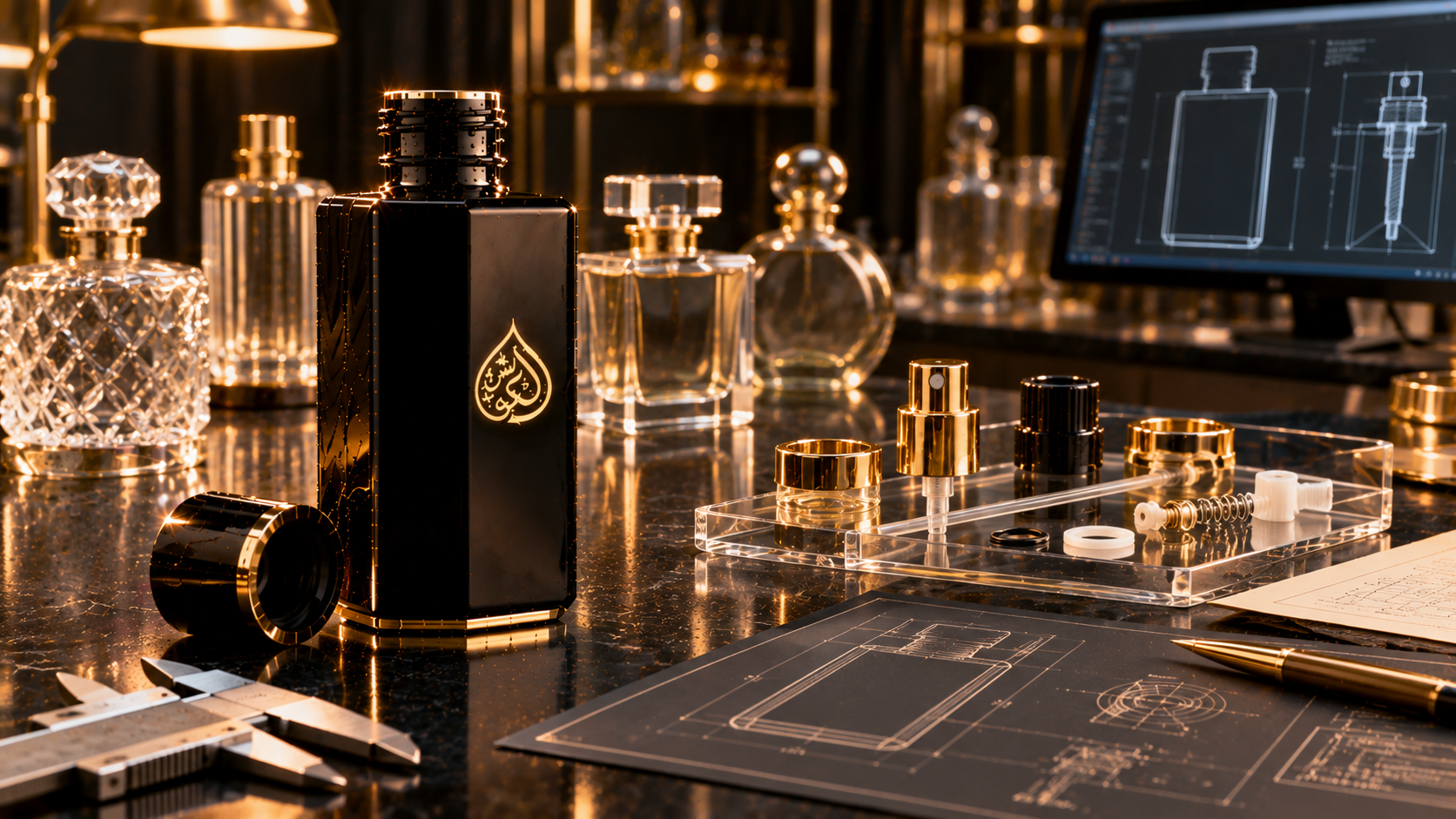
The Hidden Engineering Behind Perfume Bottles: Why Fragrance Packaging Is More Complicated Than It Looks
Imagine holding two perfume bottles.
Both contain 50 millilitres of fragrance.
Both look luxurious.
Yet one feels surprisingly heavy, while the other is light and compact.
One has a beautifully smooth atomiser.
The other occasionally leaks around the neck.
One survives international shipping without difficulty.
The other arrives with a cracked base.
How can two bottles designed to hold the same amount of perfume perform so differently?
The answer lies in something most customers never see.
Perfume packaging engineering.
Behind a luxury fragrance bottle is a world of glass manufacturing, mechanical tolerances, sealing systems, materials science and quality-control testing.
The bottle is not simply a decorative container.
It is a carefully designed system intended to hold, protect and dispense a chemical formulation.
And sometimes, the smallest component can determine whether the entire product succeeds or fails.
1. Why Is Perfume Packaging So Important?
Perfume packaging has several responsibilities.
It must contain the fragrance without leaking.
It must be compatible with the ingredients inside.
It should withstand normal handling, transport and storage.
It must dispense the product in the intended way.
And, of course, it contributes to the appearance and identity of the fragrance.
These requirements can conflict with one another.
A dramatic bottle shape might look beautiful but be difficult to manufacture.
A particularly heavy bottle might feel luxurious but increase transport weight.
An unusual cap may be visually distinctive yet inconvenient to remove.
Packaging development therefore involves balancing aesthetics, function, cost and reliability.
2. How Are Glass Perfume Bottles Manufactured?
Many perfume bottles are produced using mould-based glass-forming processes.
The exact manufacturing method depends on the bottle's size, shape, neck design and production requirements.
In simplified terms, glass-forming operations involve melting raw materials, forming molten glass into a desired shape and cooling it under controlled conditions.
A process called annealing helps reduce internal stresses that could otherwise contribute to breakage.
Perfume bottles may then undergo additional operations such as decoration, coating, printing or inspection.
Creating a visually impressive glass bottle is not always straightforward.
Sharp edges, unusual proportions and thick decorative bases can introduce manufacturing challenges.
The bottle must remain practical to produce at scale.
3. Why Are Some Perfume Bottles So Heavy?
Luxury perfume bottles sometimes contain far more glass than is necessary simply to hold the fragrance.
A thick base can create a substantial, premium feel.
It may also make the bottle appear more imposing on a shelf.
However, weight is not the same as quality.
A heavy bottle may increase shipping costs and material consumption.
It can also create additional handling and breakage considerations.
A well-designed lighter bottle may offer excellent functionality while using less material.
The choice depends on the brand's priorities and the engineering requirements.
A substantial glass base can communicate luxury, but it should not be mistaken for proof of superior fragrance quality.
4. Why Is the Bottle Neck So Important?
One of the most technically important parts of a perfume bottle is also one of the smallest.
The neck.
This is the area where the dispensing system connects to the container.
Its dimensions must be compatible with the intended closure.
Depending on the product, the closure might be a screw cap, roll-on assembly, crimped spray pump or another dispensing system.
Small dimensional differences can matter.
A neck that is too wide, too narrow or otherwise outside specification may prevent a proper seal.
The result can be leakage, poor closure retention or assembly problems.
This is why packaging manufacturers work with precise neck-finish specifications and dimensional tolerances.
A bottle that looks compatible with a pump is not necessarily mechanically compatible with it.
5. How Does a Perfume Atomiser Actually Work?
A perfume atomiser is a small mechanical dispensing system.
In many conventional designs, pressing the actuator operates a miniature pump.
The pump draws liquid through a dip tube and forces it through an outlet designed to produce a spray.
The geometry of the dispensing system influences the spray pattern and droplet formation.
But the pump is not the only factor.
The fragrance's viscosity, surface tension and other physical properties can affect dispensing performance.
A pump that works well with one formulation may behave differently with another.
This is particularly important when comparing alcohol-based perfumes with oil-based products.
A dispensing system should be selected and tested for the actual formulation.
6. Why Do Some Perfumes Spray a Fine Mist While Others Produce Large Droplets?
Spray performance depends on several interacting factors.
These include pump design, actuator geometry, nozzle characteristics and the physical properties of the liquid.
Some systems produce a relatively fine, dispersed spray.
Others deliver a more concentrated stream or larger droplets.
The amount dispensed per actuation can also vary.
This affects how the fragrance is applied and experienced.
However, a finer mist is not automatically better for every product.
The desired application depends on the formulation and intended use.
A roll-on perfume oil, for example, has very different dispensing requirements from a conventional fine-fragrance spray.
7. Why Do Some Perfume Bottles Leak?
Leakage can arise from several causes.
An incompatible neck and closure may fail to seal correctly.
A damaged or poorly seated sealing component may create a pathway for liquid.
Manufacturing defects can also affect performance.
In some cases, temperature changes and transport conditions may contribute to leakage problems.
The formulation itself matters too.
A liquid may interact differently with sealing materials or flow through very small gaps depending on its properties.
This is why packaging compatibility should be tested using the actual finished product.
Simply filling a bottle with water and observing no leakage does not establish that it will perform identically with perfume.
8. What Is Packaging Compatibility Testing?
Packaging compatibility testing evaluates how a finished formulation and its container behave together.
A manufacturer may examine whether the product causes changes in packaging components.
Potential issues can include swelling, softening, cracking, discolouration or loss of sealing performance.
The tests may also assess whether the packaging affects the product.
For example, some materials can interact with fragrance ingredients.
The appropriate testing programme depends on the formulation, packaging system and intended market.
This is especially important for products containing complex mixtures of aromatic compounds.
A container should not be assumed suitable simply because it looks attractive or is advertised as a perfume bottle.
9. Why Can Perfume Damage Labels and Decorative Finishes?
Fragrance formulations can contain ingredients capable of interacting with certain inks, adhesives, coatings and plastics.
If perfume repeatedly contacts a poorly chosen label material, the label may deteriorate.
Adhesives can lose performance.
Printed decoration may become damaged.
Some surface finishes can discolour or soften.
The degree of resistance depends on the specific materials and formulation.
This is why packaging suppliers offer different decoration methods, including direct printing, hot-foil stamping, coatings and various label constructions.
No decorative method should be assumed universally resistant to every fragrance formulation.
Testing remains important.
A premium appearance must be supported by practical durability.
10. Why Do Some Bottles Have a Screw Neck and Others Use a Crimped Pump?
These are two different approaches to securing a dispensing system.
A screw-neck bottle uses threads that allow a compatible closure to be attached and, in many designs, removed.
A crimped system uses a metal mounting component mechanically secured around a suitable bottle neck.
Crimped systems are common in many conventional perfume sprays.
They can provide a secure assembly when correctly specified and manufactured.
Screw systems may offer advantages for certain refillable or reusable designs.
However, refillability depends on more than the presence of threads.
The closure, sealing components, product compatibility and intended refill process all matter.
Neither system is automatically superior for every application.
11. Why Are Roll-On Perfume Bottles Different?
Roll-on perfume bottles use a rolling ball to transfer fragrance onto the skin.
The ball sits within a housing designed to retain it while allowing rotation.
When the bottle is moved across the skin, the ball carries a small amount of product from the container to the application surface.
The ball's fit, the housing design and the liquid's properties influence performance.
If the fit is unsuitable, the applicator may dispense too much product, too little product or leak.
This makes roll-on packaging a specialised engineering system rather than simply a bottle with a ball inserted into the neck.
For perfume-oil brands, reliable roll-on components are particularly important.
12. Why Do Manufacturers Use Different Plastics and Metals?
A perfume packaging system may include glass, metal, plastic, elastomers and decorative coatings.
Each material has different properties.
Some plastics offer flexibility or chemical resistance.
Others provide rigidity or dimensional stability.
Metals may be used for springs, decorative components or closure assemblies.
Elastomeric materials may provide sealing functions.
But material selection requires attention to the finished formulation.
A component that performs well with water may not necessarily perform well with an aromatic oil mixture or alcohol-based fragrance.
The compatibility of the complete packaging assembly is what matters.
13. How Are Perfume Bottles Tested for Shipping?
Perfume bottles can experience considerable stress during transport.
Packages may be dropped, compressed, vibrated or exposed to changing temperatures.
Manufacturers and brands may use transport-simulation testing to evaluate how packaging performs under anticipated distribution conditions.
Tests can include controlled drops, vibration and compression.
The outer carton and internal protective packaging are important parts of the system.
A strong glass bottle may still break if it is poorly protected inside its shipping box.
Conversely, a thoughtfully designed protective package can help reduce damage.
This is why transport packaging should be developed alongside the retail bottle rather than treated as an afterthought.
14. Why Are Custom Perfume Bottles Expensive to Develop?
A completely custom bottle may require specialised moulds, tooling, sampling and testing.
The manufacturer must translate a design concept into a shape that can be produced consistently.
That process may involve several rounds of revisions.
Some designs require more complex moulds or production operations than others.
Decoration can add further cost.
A custom cap, for example, may require its own tooling and material development.
Minimum order quantities can also affect the economics.
For smaller fragrance brands, using an existing bottle design with distinctive decoration may be more economical than developing a completely new glass mould.
The best choice depends on the brand's identity, budget and production scale.
15. Why Are Some Perfume Bottles Difficult to Recycle?
Glass itself is widely recyclable where appropriate collection and processing systems exist.
However, a finished perfume package may contain several materials joined together.
Metal components, plastic pumps, adhesives and decorative finishes can complicate separation.
Some bottles are also difficult to empty completely.
Recycling outcomes depend on local collection systems and processing capabilities.
A package described as recyclable in theory may not be accepted in every local recycling programme.
This is why packaging sustainability requires consideration of the complete product system.
Reducing unnecessary material, designing for separation and exploring appropriate refill systems may all contribute to improved packaging outcomes.
16. Is Refillable Packaging Always More Sustainable?
Not automatically.
Refillable packaging can reduce the need to manufacture a completely new primary container for every purchase.
However, the environmental benefit depends on how the system is used.
A heavy refillable bottle may have a greater initial material footprint.
Refill packs also require manufacturing and transport.
If customers rarely refill the bottle, the expected environmental benefit may not be realised.
A proper assessment should consider the number of reuse cycles, packaging materials, transport and other relevant factors.
The most sustainable design is not always the one that looks most environmentally friendly.
It is the one that performs well across its actual life cycle.
17. What Makes a Truly Premium Perfume Bottle?
A premium perfume bottle should offer more than visual appeal.
Its design should feel intentional.
The closure should fit securely.
The dispensing system should work consistently.
The materials should be compatible with the fragrance.
The decoration should withstand normal use.
And the packaging should protect the product through distribution and everyday handling.
These qualities may not be obvious when a customer first sees the bottle.
But they become apparent through repeated use.
A beautifully engineered bottle can make the fragrance experience feel effortless.
18. Why This Matters for Perfume Lovers
Understanding packaging engineering changes how we evaluate fragrance presentation.
A heavy bottle is not necessarily a better bottle.
A sophisticated atomiser does not automatically mean the fragrance itself is superior.
And an expensive-looking cap may have little to do with the quality of the liquid inside.
At the same time, good packaging genuinely matters.
It protects the fragrance, supports reliable application and contributes to the overall experience.
For perfume lovers, the most useful question is not simply whether a bottle looks luxurious.
It is whether its design, materials and function work together successfully.
Conclusion: The Invisible Science Behind Every Bottle
The next time you pick up a perfume bottle, consider what went into creating it.
The glass had to be formed.
The neck had to be manufactured within appropriate tolerances.
The closure had to fit.
The dispensing system had to work with the formulation.
The decoration had to survive everyday handling.
And the finished package had to withstand the journey from manufacturer to customer.
At Al Kowthar Fragrances, we believe that understanding these details reveals another fascinating dimension of the fragrance world.
Perfumery is often described as the art of creating beautiful scents.
But the experience of wearing perfume also depends on the science and engineering of the container that holds it.
A beautiful fragrance deserves packaging that does more than look extraordinary. It should perform extraordinarily well, too.
"Explore Al Kowthar Fragrances" (https://alkowtharfragrance.com/shop)