19 October 2026 · 6 min read
Does Perfume Attract Mosquitoes and Other Insects? The Science Explained
Does perfume attract mosquitoes or other insects? Discover how fragrance affects insect behaviour and why some scents may attract or repel them.
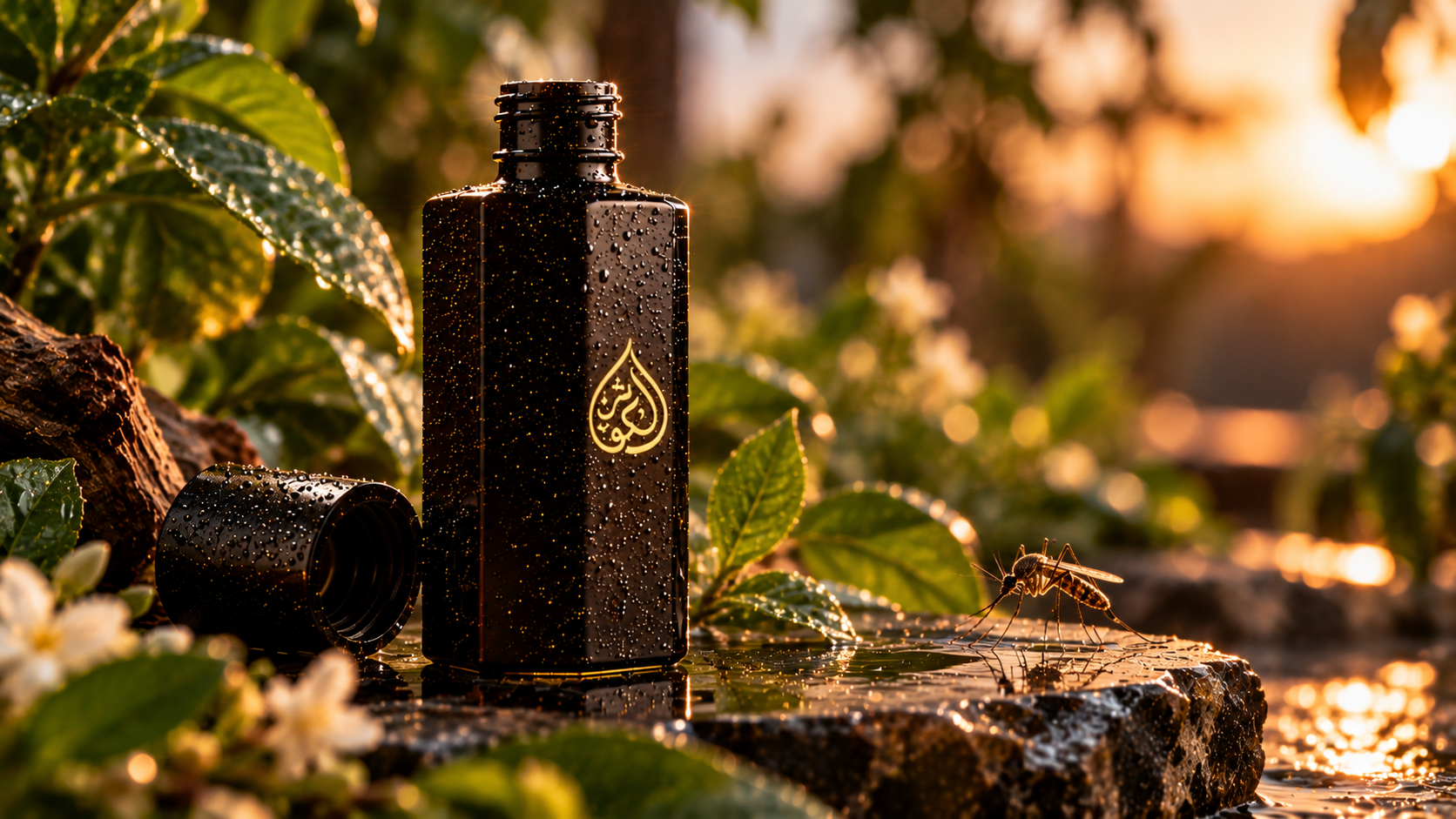
You're enjoying a warm summer evening.
You've applied your favourite perfume, perhaps something floral, fruity or sweet.
Then you notice something strange.
Mosquitoes seem to be everywhere.
And suddenly you wonder:
Could my perfume actually be attracting them?
It's an interesting question because the relationship between fragrance and insects is far more complicated than most people realise.
Some insects rely heavily on smell to find food, identify flowers, locate mates and navigate their environment.
But does that mean wearing perfume makes you more attractive to mosquitoes?
Let's explore the science.
Can Perfume Really Attract Mosquitoes?
Some fragrances may influence mosquito attraction, but perfume does not automatically attract mosquitoes.
Research has shown that certain scented products can change how attractive a person appears to mosquitoes.
However, the effect depends on the fragrance formulation, the mosquito species and other environmental factors.
Some scented products may increase attraction.
Others may reduce it.
And some may have little noticeable effect.
So the idea that all sweet or floral perfumes attract mosquitoes is an oversimplification.
How Do Mosquitoes Find Humans?
Mosquitoes don't simply fly around randomly until they find someone.
Many mosquito species use a combination of sensory signals to locate potential hosts.
These include:
- Carbon dioxide from breathing
- Human skin odours
- Body heat
- Moisture
- Visual cues
- Environmental conditions
Female mosquitoes of blood-feeding species use these signals to locate hosts.
Carbon dioxide can alert them to the presence of a potential host, while other cues help guide them closer.
This is why your natural body odour and surrounding environment can matter more than the perfume you're wearing.
Why Is Smell So Important to Insects?
Many insects have highly developed chemical sensing systems.
They detect airborne molecules using specialised sensory structures, including receptors associated with their antennae.
These systems help insects identify important chemical signals in their surroundings.
For example, some insects use floral odours to locate nectar-producing flowers.
Others use chemical signals to locate food sources or potential mates.
Mosquitoes use odour information as part of their host-seeking behaviour.
This makes fragrance chemistry particularly interesting.
A molecule that smells pleasant to a human may have a completely different biological significance to an insect.
Do Floral Perfumes Attract Bees?
Floral fragrances can contain aromatic compounds similar to those released by flowers.
Since bees use floral scent as one of several cues when locating flowers, certain perfume aromas may attract their attention.
However, a perfume smelling like flowers does not guarantee that bees will be attracted to the person wearing it.
Real flowers provide a combination of signals, including scent, colour, shape and potential food rewards.
A human wearing perfume presents a very different combination of cues.
So while floral fragrance may influence an insect's interest, it is not equivalent to being a flower.
What About Sweet and Fruity Perfumes?
Sweet and fruity fragrances often contain materials that remind us of ripe fruit, nectar or flowers.
Some of these odour profiles may be relevant to insects searching for food.
But it is important to distinguish between a human description and a chemical signal.
When we describe a perfume as sweet, we are talking about how our brain interprets its smell.
Insects may respond to particular molecules rather than to the general concept of sweetness.
Two perfumes that smell equally sweet to us may produce very different responses in insects.
The chemistry matters more than the marketing description.
Does Vanilla Perfume Attract Mosquitoes?
Vanilla is one of the most recognisable fragrance notes.
Its warm, sweet aroma is widely used in perfumes, body oils and scented products.
But there is no reliable universal rule that vanilla perfume attracts mosquitoes.
Mosquito responses depend on the complete scent mixture and the conditions in which it is encountered.
Some ingredients associated with pleasant-smelling fragrances have also been investigated for insect-repellent effects.
However, a normal vanilla perfume should not be assumed to attract or repel mosquitoes simply because it smells like vanilla.
Can Perfume Actually Repel Mosquitoes?
Some aromatic compounds have insect-repellent properties.
For example, certain plant-derived materials have been studied for their ability to interfere with mosquito host-seeking behaviour.
However, this does not mean that every perfume containing those ingredients is an effective repellent.
Repellent performance depends on the active ingredients, their concentrations, the formulation and how long the product remains effective.
A fragrance designed to smell pleasant is not necessarily designed or tested to protect against mosquito bites.
Perfume should not replace a proven insect repellent.
When protection is needed, use a properly registered repellent according to its instructions.
Why Do Mosquitoes Bite Some People More Than Others?
Have you ever noticed that mosquitoes seem to target one person while largely ignoring another?
Individual differences in mosquito attraction are well documented.
Several factors can influence how mosquitoes respond to a person, including skin odour chemistry, carbon dioxide output, heat and environmental conditions.
The communities of microorganisms living on the skin can also contribute to differences in body odour.
This means two people wearing the same perfume may still attract different numbers of mosquitoes.
The fragrance is only one part of a much larger sensory picture.
Does Sweat Make a Difference?
Sweat and skin chemistry can influence the odours released from the body.
Some substances associated with human body odour play a role in mosquito host detection.
Heat and moisture also provide sensory information.
During warm weather, you may sweat more, spend more time outdoors and encounter more mosquitoes.
These factors can make it difficult to determine whether perfume itself is responsible for increased mosquito activity.
A mosquito appearing after you apply fragrance does not prove that the fragrance attracted it.
Are Perfume Oils Different From Spray Perfumes?
Perfume oils and sprays use different delivery systems.
An alcohol-based spray distributes fine droplets over a relatively large area.
A perfume oil is usually applied directly to specific areas of the skin.
This can affect how fragrance materials are released into the surrounding air.
However, there is no general rule that perfume oils attract fewer mosquitoes than sprays.
The response of insects depends on the actual volatile compounds released, their concentrations and the surrounding conditions.
An oil-based perfume is not automatically an insect repellent.
Should You Avoid Perfume When Going Outdoors?
Not necessarily.
There is no need to assume that wearing any perfume outdoors will automatically attract insects.
However, if you repeatedly notice insect activity around a particular scented product, you may choose to avoid it during outdoor activities.
If you're travelling somewhere with a significant mosquito-borne disease risk, prioritise established mosquito protection measures.
These may include:
- Using an effective insect repellent
- Wearing suitable protective clothing
- Using window screens or mosquito nets where appropriate
- Following local public health guidance
Fragrance preferences should never replace proper protection.
Why This Matters to Perfumery
One of the most fascinating things about fragrance is that aromatic molecules do not exist only for human enjoyment.
Plants release volatile compounds for many reasons.
Some attract pollinators.
Others contribute to defence or communication.
Humans have learned to extract, recreate and combine many aromatic materials to produce perfumes.
But the natural world continues to respond to these molecules in ways that are very different from our own.
A scent that reminds you of a beautiful flower may mean something entirely different to an insect.
The Bottom Line
Can perfume attract mosquitoes and other insects?
Sometimes, depending on the formulation and the insect involved.
But perfume is not the only factor influencing insect behaviour, and it is incorrect to assume that every sweet or floral fragrance will attract mosquitoes.
The relationship involves chemistry, biology and environmental conditions.
At Al Kowthar Fragrances, we believe the world of perfume becomes even more fascinating when we understand how fragrance interacts with the world around us.
Perfume isn't simply something we smell.
It is part of a much larger world of aromatic chemistry.
And sometimes, the most interesting questions begin when we look beyond the bottle.
"Explore Al Kowthar Fragrances" (https://alkowtharfragrance.com/shop)