30 October 2026 · 10 min read
Can You Smell Perfume in Space? The Science of Fragrance Without Gravity
Can astronauts smell perfume in space? Discover how fragrance molecules behave in microgravity and why smelling works differently aboard spacecraft.
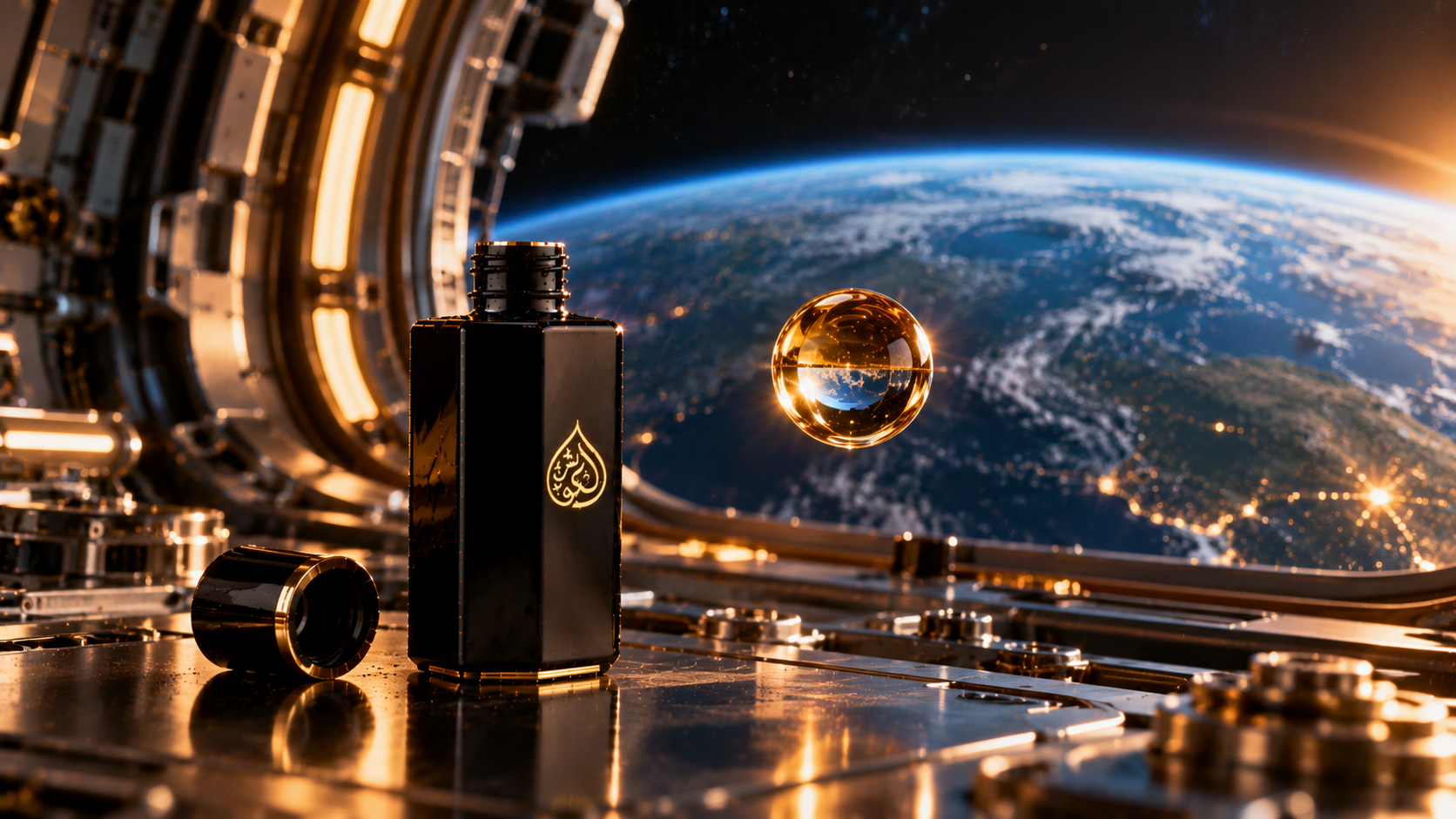
Imagine travelling hundreds of kilometres above Earth.
You're floating inside a spacecraft.
Outside the window, our planet appears as a beautiful blue sphere surrounded by darkness.
Everything around you seems weightless.
A pen floats beside you.
Water forms shimmering droplets.
Even your body behaves differently.
Now imagine something unusual.
You take out a small bottle of perfume.
You apply a tiny amount to your wrist.
And suddenly, an interesting question comes to mind.
Can you actually smell perfume in space?
Does fragrance need gravity to reach your nose?
Would perfume molecules float around the spacecraft?
And would your favourite fragrance smell the same as it does on Earth?
The answers reveal some fascinating connections between fragrance chemistry, physics and human biology.
Let's explore what happens to perfume when gravity is no longer behaving the way we're accustomed to.
1. Can Humans Smell in Space?
Yes. Humans can smell inside a pressurised spacecraft.
Our sense of smell depends on airborne molecules reaching specialised sensory receptors inside the nose.
When you smell perfume on Earth, volatile aromatic compounds enter the surrounding air.
Some eventually reach your nose.
Inside a spacecraft such as the International Space Station, astronauts live in a pressurised environment containing breathable air.
Aromatic molecules can therefore travel through that air and be detected.
The basic biological mechanism of smell still functions.
But there's an important distinction.
You can smell inside a spacecraft because there is air. You cannot smell directly through the vacuum of space.
2. Why Can't You Smell Perfume in the Vacuum of Space?
Imagine opening a perfume bottle outside a spacecraft.
Not inside the pressurised cabin.
But directly in the vacuum of space.
Would the fragrance spread like it does in a room?
No.
The environment is completely different.
On Earth, perfume molecules evaporate into the surrounding atmosphere.
They travel through air and can eventually reach our noses.
In the vacuum of space, there is no comparable atmosphere surrounding the perfume.
Volatile materials can escape from exposed liquids, and the behaviour of the remaining liquid can be dramatically affected by the low pressure.
But there is no breathable air through which a person could safely inhale the fragrance.
More importantly, humans cannot expose their unprotected noses to the vacuum of space and breathe normally.
So the question isn't simply whether aromatic molecules exist outside the spacecraft.
The issue is whether those molecules can reach a functioning human nose under breathable conditions.
Without a suitable atmosphere, the ordinary experience of smelling perfume cannot occur.
3. Does Perfume Need Gravity to Spread?
This is where things become particularly interesting.
You might assume that perfume needs gravity to travel through the air.
But that isn't correct.
Gas molecules are constantly moving because of their thermal energy.
They collide with one another and spread through the surrounding environment.
One of the processes involved is called diffusion.
Diffusion does not require ordinary Earth gravity.
This means fragrance molecules can still spread through the air inside a spacecraft.
However, gravity influences another important process: natural convection.
4. What Is Natural Convection?
On Earth, temperature differences can create air movement.
Warm air often rises because it becomes less dense than the surrounding cooler air.
Cooler air may move to replace it.
This circulation is known as natural convection.
It can influence how airborne substances move through a room.
But in microgravity, ordinary buoyancy-driven convection is greatly reduced.
Warm air does not rise in the familiar way it does on Earth.
This changes how heat and airborne substances move through an enclosed environment.
So what happens to perfume molecules?
They can still diffuse.
But their distribution depends heavily on other forms of air movement.
And inside a spacecraft, that brings us to something extremely important.
5. Why Is Ventilation So Important in Space?
The International Space Station uses mechanical ventilation to circulate cabin air.
This is essential for several reasons.
Astronauts need fresh air to reach their breathing zones.
Carbon dioxide must be managed.
Heat must be removed.
And airborne contaminants need to be controlled.
Without adequate airflow, gases and other substances could accumulate in localised areas.
The same principle would apply to aromatic molecules released from a fragrance.
Instead of relying on ordinary gravity-driven convection, perfume vapours would be transported largely through diffusion and mechanically generated airflow.
This means the location of ventilation outlets and the direction of air currents could influence where a fragrance becomes noticeable.
In a spacecraft, the ventilation system can play a major role in determining where a smell travels.
6. Would Perfume Smell Stronger in Zero Gravity?
Not necessarily.
It's tempting to imagine fragrance molecules floating around in a concentrated cloud.
But that would be an oversimplification.
The perceived strength of a perfume depends on several factors.
These include the amount of aromatic material released, its chemical properties, airflow and the sensitivity of the person smelling it.
Microgravity changes certain physical processes, but it does not automatically make every fragrance stronger.
A perfume might become noticeable in one part of a cabin because of airflow patterns.
Elsewhere, the same fragrance might be less detectable.
The spacecraft's air circulation and filtration systems would also influence the situation.
There is no universal rule that perfume becomes more powerful simply because gravity is reduced.
7. What Would Happen if You Sprayed Perfume in Space?
Imagine using a normal perfume atomiser inside a spacecraft.
On Earth, spraying perfume produces a cloud of tiny liquid droplets.
These droplets move through the air.
Some evaporate.
Others may settle onto nearby surfaces.
In microgravity, the behaviour changes.
Without ordinary gravitational settling, droplets do not fall in the same way they do on Earth.
Instead, their movement is influenced by the spray's initial momentum, airflow, evaporation and interactions with surfaces.
Some droplets could remain suspended or travel with the cabin ventilation.
This would create practical concerns.
Why would spraying perfume be problematic?
Spacecraft are carefully controlled environments.
Introducing unnecessary airborne droplets and volatile chemicals could interfere with air-quality management.
Liquid droplets could also reach equipment or surfaces where they are not wanted.
For these reasons, an ordinary perfume spray would not be a sensible product to use casually aboard a spacecraft without appropriate approval and safety evaluation.
Just because perfume can produce a smell in microgravity doesn't mean spraying it inside a spacecraft is a good idea.
8. Would Perfume Oil Behave Differently From Spray Perfume?
Yes, the method of application would make a difference.
A perfume oil is usually applied directly to the skin using a roll-on, applicator or another controlled method.
Unlike a spray, it does not intentionally disperse a cloud of droplets into the surrounding air.
However, aromatic compounds can still evaporate from the applied oil.
Those molecules can enter the cabin atmosphere and travel through the air.
The amount released would depend on the formulation, application quantity, temperature and other conditions.
From a purely physical perspective, a controlled application method could reduce the immediate dispersal of liquid droplets compared with spraying.
But this does not mean perfume oil is automatically approved or safe for spacecraft use.
Any product introduced into such an environment would need to satisfy the relevant operational and safety requirements.
9. Does the Human Sense of Smell Change in Space?
This is another fascinating question.
Astronauts can experience physiological changes during spaceflight.
One of the most noticeable effects of microgravity is the redistribution of body fluids.
On Earth, gravity influences how fluids are distributed throughout the body.
In microgravity, fluids shift towards the upper body.
This can contribute to facial puffiness and sensations resembling nasal congestion, particularly during adaptation to spaceflight.
Because nasal airflow and other physiological factors can influence smell perception, these changes may affect how some astronauts experience odours.
However, the effects are not identical for everyone.
It would be misleading to claim that all astronauts lose their sense of smell or that every fragrance becomes weaker in space.
The human body changes in microgravity, and those changes may influence the experience of smelling.
10. What Does Space Actually Smell Like?
This question has fascinated people for years.
Astronauts have described unusual odours associated with equipment and spacesuits after spacewalks.
Some descriptions compare these smells to metallic, smoky or burnt aromas.
But there's an important scientific distinction.
Astronauts are not directly smelling the vacuum of space.
They are detecting odours after returning to a pressurised environment.
The precise causes of these reported smells are not fully established.
Several explanations have been proposed involving substances associated with exposed surfaces or equipment.
However, we should not treat any single explanation as conclusively proven.
The reports are fascinating because they reveal how unusual chemical environments can produce unfamiliar odour experiences.
11. Could Perfume Help Astronauts Feel More Comfortable?
Smell is closely connected with memory and emotional associations.
A familiar fragrance can remind someone of home, family or a particular place.
For astronauts spending extended periods away from Earth, familiar sensory experiences might have psychological value.
However, this does not mean perfume has been established as an effective treatment for the stresses of spaceflight.
Introducing fragrances into spacecraft would also raise practical questions about air quality, crew preferences and individual sensitivities.
A smell that one astronaut finds comforting might be unpleasant to another.
Shared environments require particular consideration.
The idea of familiar scents supporting wellbeing in space is interesting, but it would need careful research and evaluation.
12. Could Scientists Design a Perfume Specifically for Space?
In principle, fragrance researchers could investigate formulations intended for use in microgravity environments.
But the design requirements would be very different from those of ordinary consumer perfumes.
Researchers would need to consider factors such as:
- How aromatic materials evaporate.
- How ventilation transports airborne compounds.
- How the product is applied.
- Whether it introduces unwanted droplets.
- How ingredients interact with spacecraft materials.
- How the fragrance affects cabin air quality.
- Whether crew members tolerate the smell.
A fragrance designed for a spacecraft might prioritise controlled release rather than powerful projection.
But such a product would require substantial testing and appropriate authorisation.
It would be a specialised environmental and engineering challenge, not simply a new perfume formula.
13. Could We Smell Perfume on Mars?
Mars presents another interesting situation.
The planet has an atmosphere, but it is extremely thin compared with Earth's and consists primarily of carbon dioxide.
The surface environment is not breathable for humans.
A person standing unprotected on Mars could not simply open a perfume bottle and smell it normally.
However, inside a pressurised habitat containing breathable air, smelling would be possible.
Aromatic molecules could evaporate and travel through the habitat atmosphere.
The same basic principles would apply as inside a spacecraft.
Ventilation, temperature and the composition of the indoor atmosphere would influence how fragrances behave.
Whether humans can smell perfume depends much more on the presence of a suitable atmosphere than on being located on Earth.
14. What Does Space Teach Us About Perfume on Earth?
Although most of us will never wear perfume aboard a spacecraft, this thought experiment reveals something important about fragrance.
Perfume is not simply a liquid that sits on the skin.
Its aromatic compounds interact with the surrounding environment.
Their movement depends on physical processes such as evaporation, diffusion and airflow.
On Earth, we rarely think about these processes because they happen around us constantly.
But microgravity makes their importance easier to appreciate.
It shows that gravity influences some aspects of how fragrance spreads, while molecular motion and ventilation remain essential.
Understanding these principles helps explain why the same fragrance can behave differently in different environments.
The Bottom Line
Can you smell perfume in space?
Yes, inside a pressurised spacecraft containing breathable air.
Fragrance molecules can evaporate and reach the human nose even in microgravity.
However, the way those molecules move through the environment can differ from what happens on Earth.
Natural convection is greatly reduced.
Mechanical ventilation becomes especially important.
And spraying perfume would introduce practical concerns involving airborne droplets and cabin air quality.
Outside a spacecraft, in the vacuum of space, humans cannot experience fragrance in the ordinary way because there is no breathable atmosphere.
At Al Kowthar Fragrances, we believe the science of perfume becomes even more fascinating when we explore unusual questions.
From the chemistry of aromatic ingredients to the physics of scent travelling through the air, fragrance connects us with many different areas of science.
And perhaps one day, as humans travel farther into space, researchers will investigate new ways to recreate familiar scents beyond Earth.
Until then, one thing is certain.
Even without ordinary gravity, the molecules responsible for fragrance can still move through the air.
"Explore Al Kowthar Fragrances" (https://alkowtharfragrance.com/shop)