28 October 2026 · 9 min read
Can Scientists Recreate a Perfume That's Hundreds of Years Old?
Can scientists recreate ancient perfumes? Discover how archaeology and modern chemistry reveal the ingredients and fragrances of lost civilisations.
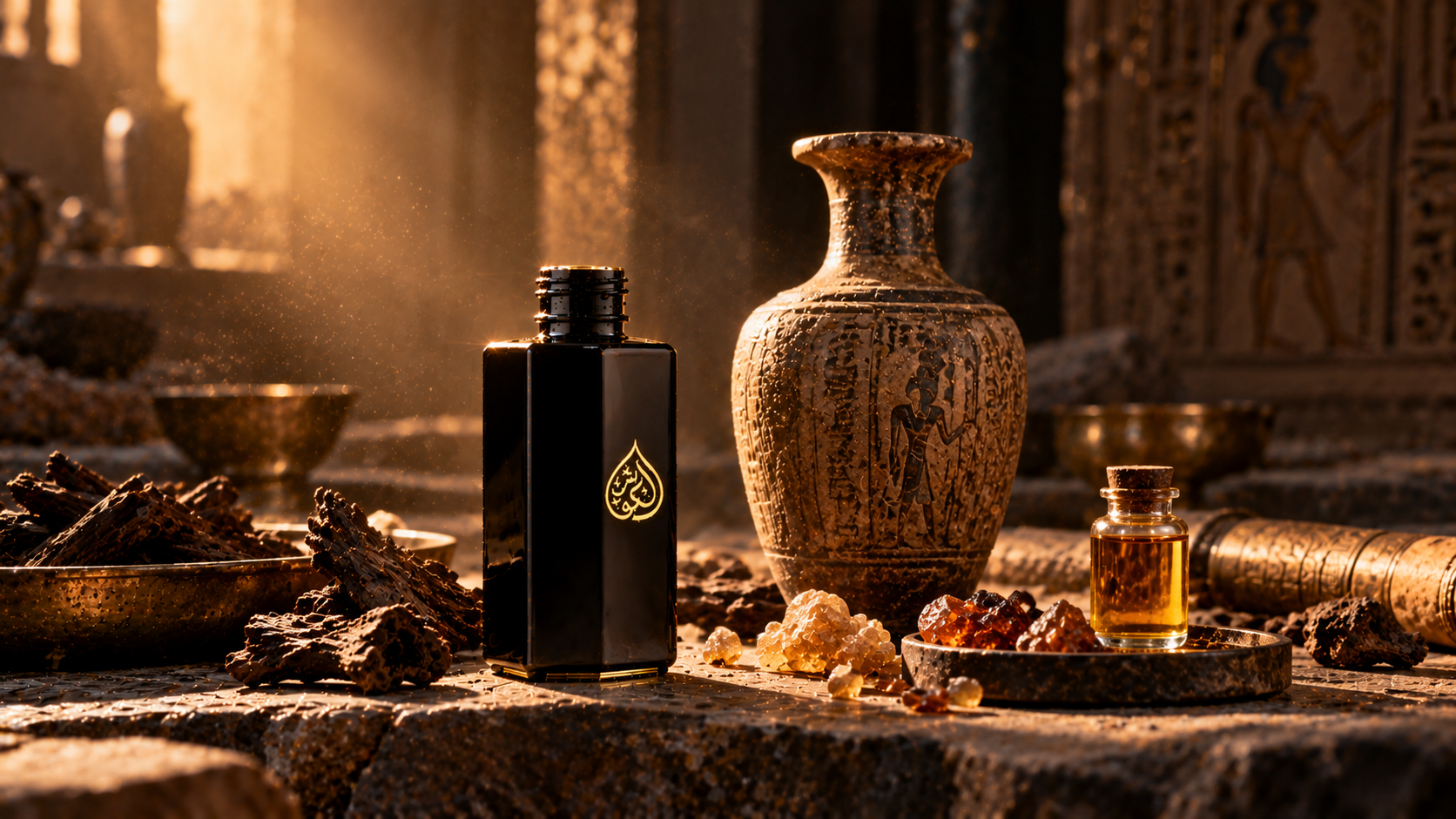
Imagine an archaeologist opening a small ceramic vessel that has remained buried for nearly two thousand years.
Inside, they discover traces of an ancient substance.
Perhaps it was once a perfume.
Perhaps it belonged to a wealthy merchant, a Roman citizen or someone living in ancient Egypt.
The original owner disappeared centuries ago.
The civilisation around them changed.
The language they spoke may no longer be used.
But something remarkable remains.
Tiny chemical traces of the fragrance they once wore.
Could modern scientists analyse those traces and discover what the perfume originally smelled like?
Could they go even further and recreate it?
The answer is fascinating.
And it reveals how archaeology, chemistry and the history of fragrance are coming together to investigate the scents of the ancient world.
1. Perfume Is Much Older Than Modern Perfume Bottles
Today, we associate perfume with elegant glass bottles, luxury packaging and carefully designed fragrances.
But the human use of aromatic substances goes back thousands of years.
Ancient civilisations used fragrant oils, resins, woods, flowers and other aromatic materials for different purposes.
These included personal grooming, ceremonies, religious practices and the scenting of spaces or objects.
In ancient Egypt, aromatic preparations played important roles in daily life and ceremonial traditions.
In the Greek and Roman worlds, scented oils were used for personal fragrance and other purposes.
Many of these preparations were quite different from the alcohol-based perfumes familiar to modern consumers.
They frequently involved oils, fats, resins and botanical materials.
Ancient perfume was often closer in form to a scented oil or aromatic ointment than to a modern spray fragrance.
2. How Can Archaeologists Discover an Ancient Perfume?
When archaeologists excavate ancient settlements, tombs and buildings, they sometimes discover containers associated with aromatic substances.
These may include:
- Small ceramic vessels.
- Glass perfume bottles.
- Stone containers.
- Sealed jars.
- Containers retaining traces of oily or resinous material.
The vessel itself can provide important clues.
Its shape, decoration and archaeological context may suggest how it was used.
But appearance alone cannot prove that a container once held perfume.
A small vessel could have contained medicine, cosmetics, oils or other substances.
This is where chemical analysis becomes important.
3. Can Perfume Survive Underground for Thousands of Years?
Not usually in its original form.
Perfume is chemically complex.
Many aromatic substances are volatile, meaning they can evaporate over time.
Others may undergo oxidation, hydrolysis or different chemical transformations.
After hundreds or thousands of years, the original fragrance may have changed dramatically or disappeared.
However, some less volatile compounds and chemical residues can survive under favourable conditions.
Scientists may be able to identify traces of oils, waxes, resins or other substances.
These residues provide clues about the original preparation.
But there's an important distinction.
Finding chemical evidence of an ancient perfume does not mean the perfume still smells the way it originally did.
The surviving residue is only part of the historical puzzle.
4. How Do Scientists Identify Ancient Perfume Ingredients?
One of the most useful analytical techniques is called gas chromatography–mass spectrometry, commonly abbreviated to GC-MS.
The name sounds complicated, but the basic idea is surprisingly understandable.
Step 1: Collecting a sample
Researchers carefully collect a small sample of residue from an archaeological object.
Because ancient materials are valuable and often fragile, sampling must be carefully controlled.
Step 2: Separating the chemical components
Gas chromatography helps separate suitable compounds within a complex sample.
Different compounds travel through the analytical system at different rates.
This allows researchers to examine substances that would otherwise be mixed together.
Step 3: Identifying chemical clues
Mass spectrometry provides information about the molecular characteristics of the separated compounds.
Researchers compare the resulting data with reference information to help identify them.
Step 4: Interpreting the evidence
Scientists then consider what the identified compounds might reveal.
For example, certain chemical markers may suggest the historical presence of particular plant oils, resins or other ingredients.
However, identifying a compound does not always establish its exact botanical source.
Different natural materials can contain overlapping chemical substances.
Researchers must therefore interpret the chemical findings alongside archaeological and historical evidence.
5. A Remarkable Discovery: Roman Perfume From Spain
In 2023, researchers published an analysis of a Roman-era perfume residue discovered in Carmona, Spain.
The material was associated with a small quartz vessel recovered from a funerary context.
The researchers investigated the surviving contents using analytical techniques.
Their findings suggested that the preparation included a vegetable oil base and evidence consistent with patchouli essential oil.
This was particularly interesting because patchouli is strongly associated with regions of Asia.
The discovery raised questions about the movement of aromatic materials through ancient trade networks.
Does this mean scientists recovered the exact Roman perfume?
No.
The research provided evidence about surviving components of the preparation.
It did not establish the complete original formula or reproduce the precise smell experienced by someone in Roman times.
Nevertheless, the study demonstrated how chemical analysis can reveal surprising information about ancient aromatic substances.
A tiny residue inside an ancient container can tell us something about the ingredients and trade connections of a civilisation.
6. What Did Ancient Egyptian Perfume Smell Like?
Ancient Egypt is particularly fascinating because aromatic materials were important in several aspects of Egyptian culture.
Historical sources and archaeological evidence refer to ingredients and preparations involving resins, oils and fragrant botanical materials.
One famous aromatic preparation was known as kyphi.
Kyphi is often described as a complex mixture of fragrant ingredients.
Different historical sources preserve different recipes or descriptions.
Some versions include materials such as resins, wine, honey and aromatic plants.
However, the precise compositions varied, and there is no single universally established kyphi formula representing every period of ancient Egyptian history.
Can we recreate kyphi today?
Researchers and modern perfume makers can attempt reconstructions using historical descriptions.
But these reconstructions involve interpretation.
Ancient ingredient names may be difficult to identify precisely.
Plant varieties may have changed.
Preparation methods may not be fully documented.
And historical texts do not always provide the exact proportions needed to reproduce a mixture.
As a result, modern kyphi reconstructions are best understood as informed interpretations rather than guaranteed copies of a single ancient fragrance.
7. Can Scientists Recreate a Perfume From an Ancient Recipe?
Sometimes, researchers can produce a plausible reconstruction.
Imagine discovering a historical recipe describing a fragrant oil made from rose, resin and a particular vegetable oil.
If the ingredients can be identified and the preparation method is sufficiently clear, researchers may attempt to reproduce it.
But several challenges remain.
Ancient measurements
Historical recipes may use measurement systems that are difficult to interpret precisely.
Uncertain ingredient names
A plant mentioned in an ancient text may not correspond neatly to a modern botanical name.
Different raw materials
Plants grown thousands of years ago may have differed from modern cultivated varieties.
Growing conditions, harvesting methods and geographical origins also influence aromatic composition.
Missing preparation details
A historical recipe might list ingredients without explaining exactly how they were processed.
Heating, soaking, grinding and extraction can all influence the final aroma.
Chemical ageing
Even if the original formula were known, the scent of an ancient preparation might have changed during storage.
These uncertainties make exact reconstruction extremely difficult.
8. Could Ancient Perfume Smell Completely Different From Modern Perfume?
Yes.
Many historical aromatic preparations differed substantially from modern fine fragrances.
Modern perfumery has access to a vast range of synthetic aroma chemicals, refined natural extracts and advanced production techniques.
Ancient perfume makers worked with the materials and extraction methods available to them.
They might use aromatic woods, resins, flowers, spices and infused oils.
Some preparations may have been thick, oily or resinous.
Others may have been relatively light.
And many would not have produced the same initial scent cloud associated with a modern alcohol-based spray.
This does not make ancient perfumery inferior.
It simply reflects a different technological and cultural approach to fragrance.
9. Why Were Oils So Important in Ancient Perfumery?
Oils were useful carriers for aromatic substances.
Certain fragrant materials could be infused into oils or incorporated into oil-based preparations.
This made it possible to apply aromatic mixtures to the body or use them for other purposes.
Unlike modern alcohol-based sprays, these preparations were often applied directly.
However, the composition and consistency of historical products varied considerably.
Some ancient fragrances were liquid oils.
Others were ointments or more complex preparations.
The use of aromatic oils demonstrates that perfume history is not limited to modern spray bottles.
The relationship between fragrance and oil stretches back thousands of years.
10. What Can Ancient Perfumes Teach Us About Trade?
One of the most interesting aspects of ancient perfumery is the movement of aromatic materials between regions.
Fragrant woods, resins, spices and oils could travel through extensive trade networks.
Aromatic materials from one region might become highly valued thousands of kilometres away.
These exchanges connected merchants, communities and civilisations.
The movement of perfume ingredients can therefore provide clues about historical commerce and cultural interaction.
When researchers identify an aromatic material in an archaeological context far from its likely source, it may raise important questions.
Where did the ingredient originate?
How did it travel?
Who traded it?
Who could afford to use it?
A perfume ingredient can become evidence of a much larger historical story.
However, identifying a material does not automatically reveal its exact trade route.
Historical conclusions require supporting evidence.
11. Could We Ever Smell Exactly What an Ancient Egyptian Smelled?
This is perhaps the most fascinating question of all.
Even if scientists reconstructed an ancient fragrance with impressive accuracy, could we experience it exactly as someone did thousands of years ago?
Probably not with complete certainty.
There are several reasons.
First, the original formula may be incomplete or uncertain.
Second, the raw materials available today may differ from their ancient equivalents.
Third, the original preparation and storage conditions may be impossible to reproduce precisely.
And finally, our perception of fragrance is influenced by experience, memory and cultural associations.
An aroma familiar to someone in the ancient world might carry very different associations for a modern person.
We may be able to reconstruct a plausible chemical mixture.
But recreating the complete sensory and cultural experience is another challenge entirely.
12. Why Is Reconstructing Ancient Perfume Important?
The value of this research goes far beyond satisfying curiosity.
Ancient fragrance studies can help researchers understand:
- Historical trade and commerce.
- Botanical materials used by earlier civilisations.
- Ancient manufacturing techniques.
- Personal grooming and daily life.
- Cultural and ceremonial practices.
- The development of aromatic preparations over time.
Fragrance can reveal aspects of history that written documents alone may not capture.
A small container of aromatic residue may provide evidence about what people valued, how they lived and the materials they exchanged.
13. What Does Ancient Perfumery Have to Do With Modern Fragrance?
More than you might expect.
Many aromatic materials treasured in historical societies remain important in perfumery today.
Rose, frankincense, myrrh, sandalwood and other botanical ingredients continue to inspire modern compositions.
Of course, modern perfumery has evolved considerably.
New technologies allow perfumers to isolate, synthesise and combine aromatic substances in ways that ancient makers could not.
Yet the underlying human fascination remains familiar.
People have long sought to capture beautiful smells, preserve aromatic materials and use fragrance as part of their lives.
The bottles have changed.
The methods have evolved.
But our interest in scent continues.
The Bottom Line
Can scientists recreate perfumes from hundreds or even thousands of years ago?
Sometimes they can produce scientifically informed reconstructions, but recovering the exact original fragrance is much more difficult.
Modern analytical techniques can identify surviving chemical residues.
Historical texts can provide clues about ingredients and preparation methods.
Archaeological discoveries can reveal how aromatic materials were used and traded.
Together, these sources allow researchers to reconstruct parts of the ancient fragrance world.
But missing ingredients, chemical deterioration and incomplete historical records mean that many reconstructions remain interpretations rather than exact reproductions.
At Al Kowthar Fragrances, we find this connection between history and fragrance particularly fascinating.
Every aromatic material has a story.
Some stories begin in laboratories.
Others begin in forests, fields and ancient trade routes.
And a few are still being uncovered from objects buried thousands of years ago.
A fragrance may disappear from the air, but its history can survive for centuries.
"Explore Al Kowthar Fragrances" (https://alkowtharfragrance.com/shop)