28 October 2026 · 11 min read
Can Perfume Last 100 Years? What Really Happens to Vintage Fragrances
Can a perfume survive for 100 years? Discover what happens to vintage fragrances, why old bottles change and how experts preserve historic scents.
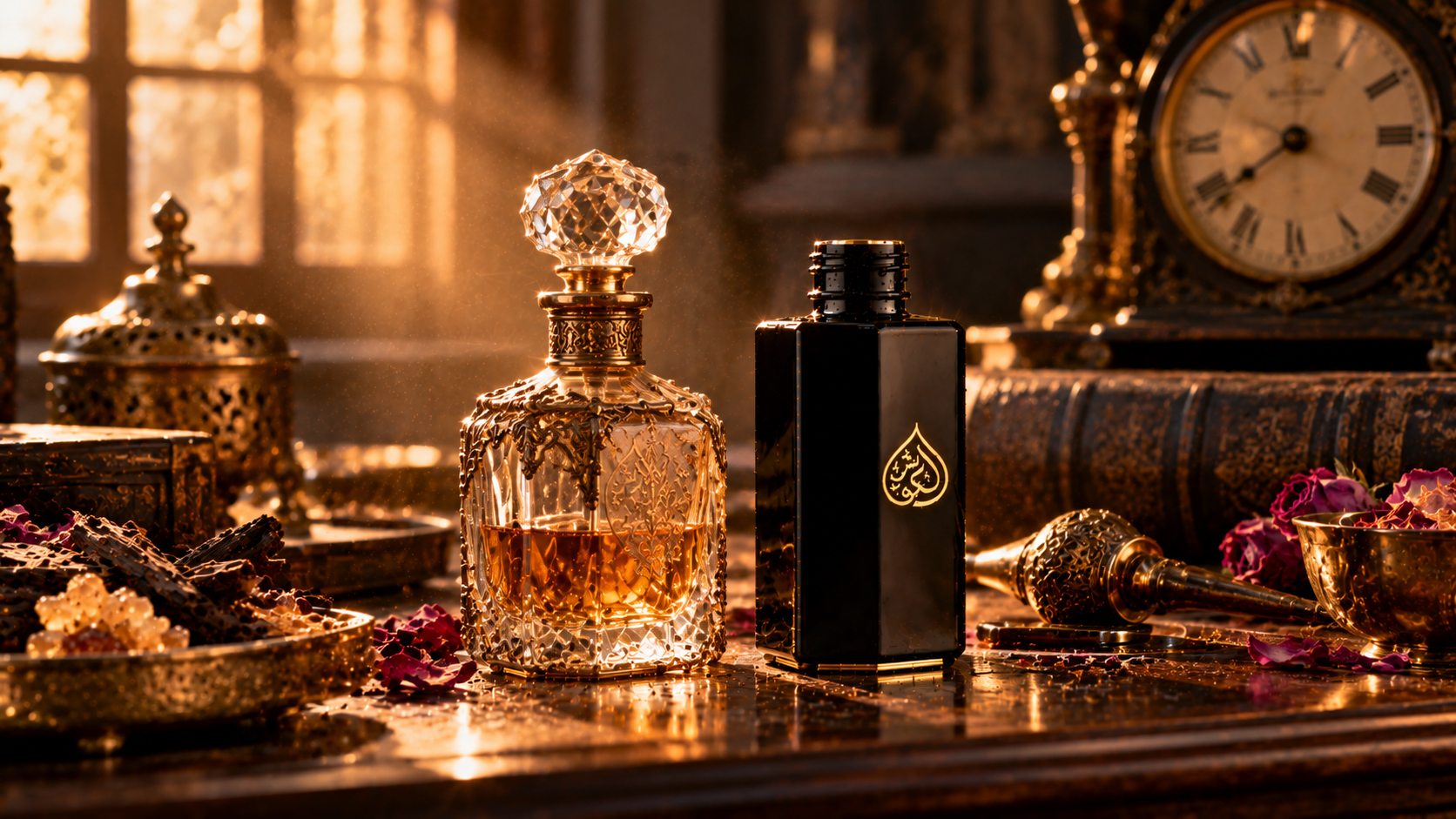
Imagine walking into an antique shop.
Among the old books, clocks and jewellery, you notice a beautiful glass perfume bottle.
The label is slightly faded.
The glass has an unusual design.
And the shopkeeper tells you something extraordinary.
The perfume was manufactured in 1926.
It's now 2026.
That means the fragrance inside the bottle could be one hundred years old.
You carefully examine it.
The liquid is still there.
The bottle appears to be sealed.
But an interesting question comes to mind.
If you opened it today, would it still smell like the perfume someone wore a century ago?
Or would one hundred years of chemical changes have transformed it into something completely different?
The answer takes us into the fascinating world of vintage perfumery, fragrance chemistry and scent conservation.
Can Perfume Really Survive for 100 Years?
Yes, perfume liquid can sometimes remain inside a bottle for a century or longer.
But that doesn't necessarily mean the fragrance has survived unchanged.
There is an important difference between a perfume physically remaining in its container and retaining its original aromatic character.
A bottle may still contain liquid after decades.
Some of its original ingredients may also remain detectable.
But the composition could have changed considerably.
Certain aromatic compounds may have evaporated.
Others may have undergone chemical reactions.
And the balance between the surviving ingredients may be different from the original formula.
A hundred-year-old perfume can survive as a historical object without surviving as an unchanged fragrance.
What Happens to Perfume Over Several Decades?
Perfume is a mixture of chemical substances.
These may include aromatic compounds, solvents, carrier oils and other formulation ingredients.
Over time, some of these substances can change.
Several processes are particularly important.
1. Oxidation
Some fragrance ingredients can react with oxygen.
These reactions may produce new chemical compounds.
As a result, a perfume's smell, colour or other properties can change.
However, different ingredients have different susceptibilities to oxidation.
Some are relatively stable under particular conditions.
Others are more reactive.
2. Evaporation
Even when a perfume bottle appears closed, its seal may not be completely impermeable.
Over many years, volatile compounds may escape through imperfect closures.
Alcohol and certain aromatic materials can be lost at different rates.
This may alter the remaining composition.
3. Chemical reactions
Fragrance ingredients can undergo other reactions over time.
For example, some compounds may break down or interact with other substances in the formulation.
These processes can influence the fragrance's aroma and appearance.
4. Changes involving the packaging
The container itself can matter.
Older bottles may contain materials or closures that interact with the fragrance.
Seals, stoppers and spray mechanisms can deteriorate.
This may allow air to enter or liquid to escape.
The result depends on the original packaging and how the bottle has been stored.
Would a Perfume From 1926 Still Smell Good Today?
Possibly.
But there is no guarantee.
Some vintage perfumes remain recognisable after many decades.
Others change significantly.
A fragrance may lose much of its original opening while retaining recognisable characteristics from less volatile materials.
In some cases, the remaining scent may still be pleasant.
In others, deterioration may produce an unpleasant or unfamiliar smell.
A collector might describe an old perfume as smelling rich, dark or unusually concentrated.
But that doesn't necessarily mean the fragrance has improved with age.
It may simply have changed.
An old perfume smelling pleasant is not proof that it smells the way its creator intended.
Why Do Some Vintage Perfumes Become Darker?
One of the most noticeable changes in certain old perfumes is their colour.
A liquid that was originally pale yellow may gradually become amber, orange or brown.
Why?
Some aromatic compounds and other formulation ingredients can undergo chemical reactions that produce coloured substances.
Oxidation and other ageing processes may contribute to these changes.
However, not every perfume darkens with age.
And colour alone cannot reliably establish whether a fragrance is still chemically stable or suitable for use.
Some perfumes are naturally dark because of their ingredients.
Others remain relatively pale despite undergoing changes.
A darker perfume is not automatically a ruined perfume, but neither is it proof of improved quality.
Can a Perfume Bottle Remain Sealed for a Century?
It depends on the container and closure.
Glass can provide an effective barrier for many fragrance materials.
But the weakest point is often the seal.
Historical perfume bottles may use stoppers, corks, seals or other closure systems that behave differently from modern packaging.
Over time, these materials can deteriorate.
A bottle may look sealed while allowing small amounts of volatile material to escape.
Even modern packaging is not necessarily designed to preserve a perfume unchanged for one hundred years.
This makes the condition of the closure particularly important when evaluating vintage fragrances.
Why Do Some Old Perfumes Smell Different From Modern Versions?
Imagine finding a perfume originally launched in the 1950s.
You purchase a vintage bottle and compare it with a bottle manufactured today.
The two fragrances share the same name.
But they don't smell identical.
There are several possible explanations.
The formula may have changed
Perfume manufacturers sometimes reformulate fragrances.
Changes can occur because of ingredient availability, regulatory requirements, production considerations or creative decisions.
Natural materials may differ
Some natural aromatic ingredients vary according to their origin, growing conditions and processing methods.
The vintage perfume may have aged
Even if the original and modern formulas were identical, decades of chemical change could affect the older bottle.
The concentration may differ
Products released under the same fragrance name may exist in different concentrations or formulations.
This is why comparing a vintage perfume with its modern counterpart can be fascinating.
But it's also why we should be careful about assuming every difference is caused by reformulation.
Sometimes the formula has changed. Sometimes the old perfume has changed. Sometimes both have changed.
Are Vintage Perfumes Valuable?
Certain vintage perfumes are highly sought after by collectors.
Their value may depend on factors such as rarity, historical significance, packaging, condition and demand.
An unopened bottle from a discontinued fragrance line may attract considerable interest.
Likewise, an unusual bottle design or historically significant release may have value as a collectible object.
However, age alone does not make a perfume valuable.
A century-old bottle may be rare without being especially desirable.
And a valuable collectible may no longer contain fragrance that resembles its original scent.
For collectors, the bottle, label, packaging and provenance can be just as important as the liquid inside.
How Do Museums Preserve Historical Perfume Bottles?
Museums face a particularly interesting challenge.
A historical perfume bottle is both a physical object and potential evidence of an earlier scent.
Preserving these two aspects may require different approaches.
The bottle itself could be made from fragile glass, ceramic or another material.
Its label might be made from ageing paper.
Its stopper could be damaged.
And the liquid may be chemically unstable.
Conservators must therefore consider the condition of the entire object.
In some cases, opening a sealed bottle could damage its historical integrity.
For this reason, preservation does not necessarily involve opening every bottle to smell its contents.
Instead, experts may document the object, investigate its materials and assess the risks associated with handling or sampling it.
The Perfume Library That Preserves Fragrance History
One of the most fascinating institutions in the perfume world is the Osmothèque, an international perfume archive based in France.
Its purpose includes preserving and documenting fragrances from different periods of perfumery.
This is important because perfumes can disappear from the market.
A fragrance may be discontinued.
Its original formula may become difficult to reproduce.
Or a manufacturer may change the composition over time.
A perfume archive can help preserve knowledge about fragrances that might otherwise be forgotten.
How can a perfume archive protect a scent?
Preservation may involve maintaining carefully controlled reference samples, documenting formulas and reconstructing historical compositions where reliable information is available.
Appropriate storage conditions can help slow chemical deterioration.
But the challenge is not simply keeping a bottle full.
The aim is to preserve reliable information about the fragrance itself.
A perfume archive is not just a collection of bottles. It is also a record of scent history.
Can Scientists Analyse a 100-Year-Old Perfume?
Yes, provided suitable material is available and analysis is appropriate.
Modern analytical techniques can help investigate the chemical composition of historical fragrance residues.
One important technique is gas chromatography–mass spectrometry, or GC-MS.
It can help researchers identify many volatile and semi-volatile compounds.
Other methods may also be used, depending on the sample.
However, analysing an aged perfume presents a particular problem.
The chemical composition measured today may differ from the original formula.
Researchers must consider which compounds may have survived, which may have degraded and whether new substances formed during ageing.
This makes the interpretation more complicated than analysing a freshly manufactured fragrance.
A Fascinating Scientific Question: Can We Recreate the Original Smell?
Suppose scientists discover a perfume bottle manufactured in 1926.
They analyse the remaining liquid.
Could they recreate the fragrance as it originally smelled?
Potentially, they could develop a scientifically informed reconstruction.
But the accuracy would depend on the available evidence.
If the original formula survives, that could provide an important starting point.
If historical ingredient specifications are available, they could offer further clues.
Chemical analysis of the remaining liquid might also help.
However, if the formula is unknown and the perfume has undergone substantial deterioration, reconstructing the original aroma becomes much more uncertain.
The surviving material may not reveal every ingredient or its original concentration.
This is one reason fragrance preservation increasingly involves both physical samples and chemical documentation.
Could We Preserve a Perfume Manufactured Today Until 2126?
Imagine creating a perfume in 2026.
You want someone living in 2126 to experience it.
How would you preserve the fragrance?
Simply placing a bottle in a cupboard and hoping for the best would not guarantee success.
A more scientific approach would involve several complementary methods.
Preserve a reference sample
A carefully selected container and controlled storage environment could help reduce certain forms of deterioration.
However, no storage method can guarantee that a complex perfume will remain chemically unchanged for a century.
Record the complete formula
Preserving accurate formulation records would make future reconstruction more feasible.
This includes ingredient identities, proportions and relevant specifications.
Document the raw materials
Natural extracts can vary significantly.
Recording their botanical origins, suppliers and analytical characteristics could help future researchers understand the original composition.
Preserve analytical information
Chemical analysis of the freshly manufactured perfume could provide a useful reference.
Future scientists could compare this information with the aged sample.
Document the scent itself
Descriptions from trained evaluators could help preserve information about the intended fragrance character.
However, written descriptions cannot fully replace the sensory experience.
Together, these methods could improve the chances of understanding or reconstructing the fragrance in the future.
The most reliable way to preserve a perfume's identity may involve preserving its formula and scientific records alongside the physical fragrance.
Can Freezing Perfume Make It Last Forever?
No.
Lower temperatures can slow certain chemical reactions.
But freezing is not a universal solution for preserving every fragrance formulation.
Very low temperatures can affect the physical behaviour of some mixtures.
Certain ingredients may become less soluble or separate under particular conditions.
Packaging materials can also respond differently to temperature changes.
Specialist preservation requires an understanding of the specific formulation and container.
The goal is to establish appropriate, stable conditions rather than assume that colder is always better.
Is a 100-Year-Old Perfume Safe to Wear?
Age alone cannot establish whether a historical perfume is safe for skin application.
An old fragrance may contain ingredients that are no longer permitted or are subject to different restrictions in modern cosmetic products.
Its composition may also have changed through chemical deterioration.
In addition, the condition of the container and possible contamination may be uncertain.
For these reasons, a historical perfume should not automatically be treated as a product suitable for normal cosmetic use.
A valuable vintage bottle may be better appreciated as a collectible or historical object.
Being able to smell an old perfume does not establish that it is safe to apply to the skin.
What Can Vintage Perfumes Teach Us About History?
Perfume is more than a collection of aromatic ingredients.
It can reflect the culture, technology and artistic preferences of a particular period.
A fragrance created in the 1920s may reveal something about the materials and styles valued at that time.
A perfume from the 1970s might reflect a very different approach to fragrance composition.
Historical bottles can also tell us about manufacturing, packaging design and consumer tastes.
When fragrances are preserved alongside their formulas and records, they become valuable sources of information.
They allow future generations to investigate how perfumery developed.
In this sense, preserving perfume is also a way of preserving cultural history.
Why Is Fragrance Preservation So Difficult?
A painting can remain visible for centuries.
A sculpture can survive for thousands of years.
But fragrance presents a different challenge.
The substances responsible for smell are often volatile.
They can evaporate, react or change.
And unlike a painting, the original sensory experience cannot be preserved simply by protecting the object's appearance.
A bottle may remain beautiful while the fragrance inside changes beyond recognition.
This makes perfume an unusually challenging form of cultural heritage.
We can preserve the bottle, but preserving the smell is a much more complicated scientific task.
The Bottom Line
Can perfume last 100 years?
A perfume can physically survive for a century, and some of its original aromatic characteristics may remain detectable. But retaining its exact original smell is far more difficult.
Over decades, evaporation, oxidation and other chemical processes can change a fragrance.
The bottle and closure can also influence how well the contents survive.
Scientists can investigate historical perfumes, while archives and conservators work to preserve fragrance heritage for future generations.
Perhaps the most interesting lesson is that preserving a perfume requires more than protecting the liquid.
It also involves protecting the knowledge behind its creation.
At Al Kowthar Fragrances, we believe every fragrance has a story worth understanding.
From the aromatic materials used in its creation to the memories it inspires, perfume connects chemistry, craftsmanship and human experience.
And perhaps, a hundred years from now, someone will discover a bottle created in our own time and wonder what the world smelled like in 2026.
A fragrance may be temporary, but its story can survive for generations.
"Explore Al Kowthar Fragrances" (https://alkowtharfragrance.com/shop)